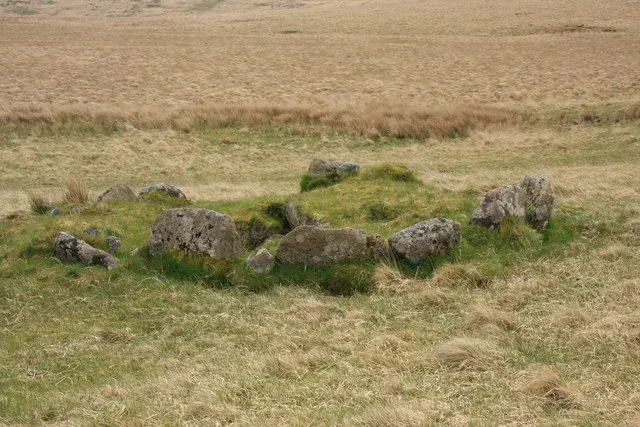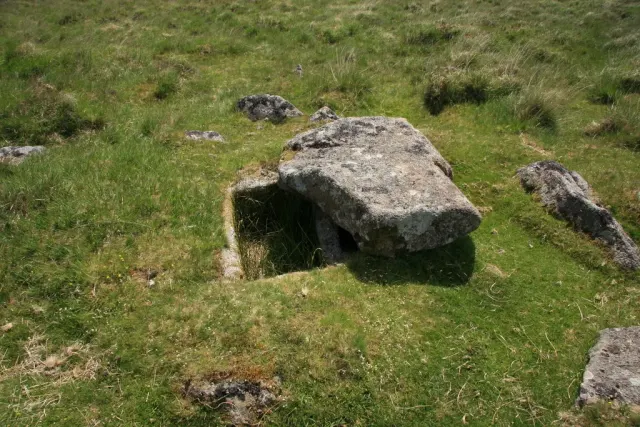
Cairn with a displaced cover stone, Shavercombe Brook
A cairn 4 m across with a central cist 1.3 m long whose cover stone, 1.5 m by 1.3 m, lies displaced on it, south of the Shavercombe Brook.

Dartmoor's archaeology and heritage - antiquities, historic buildings and museums.
A cairn 4 m across with a central cist 1.3 m long whose cover stone, 1.5 m by 1.3 m, lies displaced on it, south of the Shavercombe Brook.
A cairn 8 m across and up to 1 m high with a central hollow, the north-eastern of two on the west slope of Penn Beacon, near a group of springs.
A cairn 7 m across with part of its kerb and a cist 1.2 m long whose west side slab is vein quartz, near the head of a southern tributary of the Langcombe Brook.
A cairn 4.5 m across with a kerb of three large stones and a cist 0.9 m long whose slabs were put back in place in an excavation in 1900.
Bronze Age burial cairn with stone burial chamber, located south of Royal Hill on Dartmoor.
A cairn with a kerb of eleven stones 5 m across and a cist 1 m by 0.5 m with all four slabs in place, 150 m west of Legis Lake, the cover slab displaced.
A cairnfield of at least 25 mounds, with a kerbed funerary cairn and two lengths of walling that show a field system was starting to be laid out, above the Blackaton Brook.
At least 29 small cairns, five joined fields, a hut circle, a cairn with a cist and a ring cairn 17.5 m across south of Moorgate Farm below Row Tor, pitted by military training.
A cairnfield of 21 mounds, three hut circles and a leaning boundary stone cut T on the South Tawton and Forest parish boundary, above Taw Marsh.
Photograph by Glavind Strachan Photography“At a hamlet near the parish of South Tawton, a small town on the borders of Dartmoor, there is an interesting story told of a ghost which assumes the form of a remarkably handsome Guernsey Cow, and appears at midnight promenading to and fro”
Also on Our DartmoorChurch of St Peter, Peter Tavy — Grade I granite church, probably 14th century and much rebuilt in the 15th, whose tower was struck by lightning on 21 November 1893.