Buttern Hill coaxial fields and hut circles
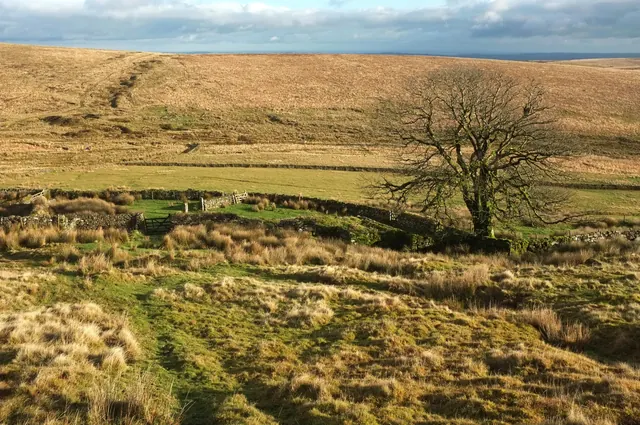
Part of the Buttern Hill coaxial field system with three parallel reaves and two hut circles, a 10.1 m one with a double upright-stone wall and a porch, and a 4.4 m one.
Dartmoor's archaeology and heritage - antiquities, historic buildings and museums.
Part of the Buttern Hill coaxial field system with three parallel reaves and two hut circles, a 10.1 m one with a double upright-stone wall and a porch, and a 4.4 m one.
Buckfastleigh
Where a USAAF C-47 Skytrain flew into the hillside at Huntingdon Warren in mist on 13 October 1945, killing all seven aboard. A small cross made at school stands on a boulder near the ruined farm.
A Dartmoor fact about Cosdon Hill
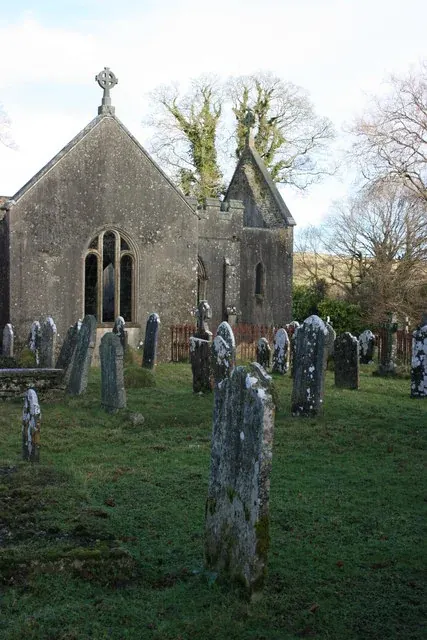
Buckfastleigh
The tomb of Squire Richard Cabell (d. 1677) of Brook Hall, Buckfastleigh, sealed under an iron-barred stone structure locally known as "the Sepulchre." Local legend held that a phantom pack of hounds ran with him across the moor, and the tomb is the leading, though unconfirmed, candidate for the real legend behind Conan Doyle's The Hound of the Baskervilles.
Bronze Age cairn on the open moor west of Archerton, a scheduled monument and marker of prehistoric settlement.
A heather-covered cairn 11 m across and over 1 m high with a hollow in its middle, on a south slope above the Plym, near an enclosure with hut circles.
A round cairn 5.5 m across with a cist 0.86 m by 0.48 m still under a displaced 1.44 m cover slab, overlooking Deadman's Bottom.
A round cairn 4 m across and 0.6 m high on a small promontory on the north-west slope of Hen Tor, excavated to show a cist 1.2 m by 0.75 m.
A cairn cemetery of nine round cairns, 4 to 6.9 m across, set in two lines above the North Teign, four with pits from robbing or early digs.
A cairn 12 m across and 0.5 m high with a kerb 6 m across inside the mound, best preserved on the south side, on the brow of Ringmoor Down near the Eylesbarrow reave.