It would possibly be fair to say that “Our Dartmoor” has come about through stubbornness, or maybe just a misguided sense of the injustice of the modern world.
It all started when I decided to apply for a job I felt I was genuinely well suited to, working for the Dartmoor National Park Authority. I wrote (what I personally considered) a perfectly good, heartfelt cover letter setting out exactly why I thought I’d be a nice fit for the position. I didn’t even get an interview.
I’d have been quite happy to fail the interview (I’m decidedly not everyone’s cup of tea). Not only didn’t I get an interview, but apparently my hours and hours of thoughtful consideration and (in my opinion) rather witty repartee didn’t even warrant anything more than a standard “no” email:
We wish to inform you that at this stage we will not be progressing your application, as there were applicants whose applications more closely met this role’s specific requirements. Unfortunately, due to the volume of applications we receive, we are unable to provide specific individual feedback at this stage.
Obviously I’m no HR expert, but I’m 99.9% sure my resume fitted almost to a tee the job description that was posted. I’m also obviously not stupid enough to think that what an employer writes on their list of “wants” is actually what they desire. My first real job, working for a very well known Banking Corporation, should really have stated they wanted “a sheep, somebody who doesn’t necessarily need to be smart or quick witted, but should most definitely be willing to brown nose at every given opportunity. People who have the capacity to think for themselves and are likely to point out our stupidity to us when we make blatant mistakes need not apply.”
This ground my gears somewhat.
I think we can presume AI weeded me out before any actual human saw my application. I’m old, I’m opinionated and I didn’t write a boring corporate “Yes, I shall do as instructed, even if I disagree completely with what I’m being asked to do” scenario. You see, if you’re getting on and tech savvy like me, you remember very much being taught (in ‘O’ Level Computer Studies) GIGO, Garbage In Garbage Out. AI is only ever as smart as the people who control it (that’s another story, which, oddly, I do address later in this longwinded piece).
So, the crux:
While researching the job, the processes and the expected outcomes, it dawned on me that I could actually do a better job of it on my own, without the constraints of bureaucracy, without the constant back and forth to Accounts and the seemingly perpetual meetings, and, all the time, answering to nobody.
So that’s what I’m doing.
It was a while ago now that I wrote my cover letter, and, if I remember correctly, I’d (at some point in the almost two weeks it took me to write this) misread how many words you were allowed ... so I’m certain not all of this made it to the final cut, but as it didn’t even warrant a personal email, I think the full version deserves an airing.
Here is the letter I sent, reproduced in full. Make of it what you will (or skip it, straight to the important bits below).
The cover letter
I’ve loved Dartmoor since my parents first took me when I was really tiny!
If I’m honest, I’d consider leaving it there and making you work a little, however, I’m fairly sure that won’t be the main requisite for an interview, so I should probably flesh this out with a tad more information.
Read the letter in fullHide the letter
Through numerous drafts and rewrites, starting out all sensible and official sounding before conceding that really isn’t me. Honesty might not always be the best policy, it does, though, save a lot of unnecessary backpedalling and track covering in the future.
Let me tell you a story.
The other day I was walking a well trod route of mine on the moor, planning on taking my dog for a swim before it got too hot to be out and about. On the way I stopped at a favourite tor as the view is phenomenal. The light wasn’t great and the expected sunrise was adequate at best, at least I was out and about and enjoying the fresh air.
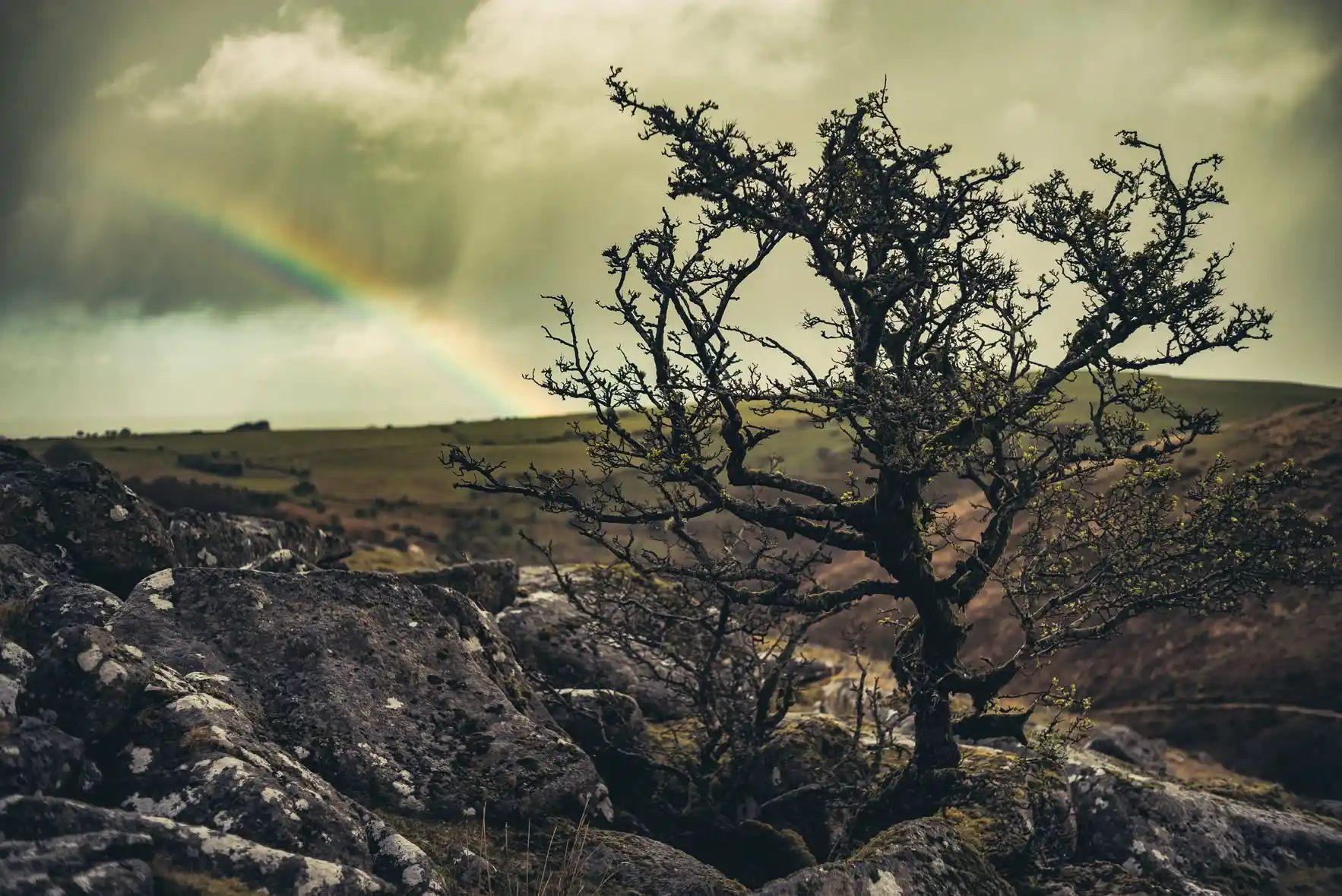
On heading down to the river I was disturbed to notice that one of the hawthorns I enjoy photographing had obviously succumbed to the weather, or maybe some overzealous ponies or cows.
No, it had been smashed down by some complete reprobate, there were no parts of the broken tree lying around and I could only postulate that my old friend had ended up as firewood. (You can entertain yourself for a moment by working out which word I substituted with “reprobate”).
This upset me way more than I would have expected it and reminded me why I’m on a sabbatical at present and why, if I want to have a decent work-life balance that benefits both parties, I’d do well to avoid separating emotion and pragmatism.
The consequence of this misadventure is I’m going to write this as myself, not some glorified or sanitised, text book version of the perfect employee (if such a person actually exists).
I’m very much imperfect, yet, also prone to downplaying how amazing I am at certain things. If nothing else, I hope to inform and entertain for a few minutes.
I will first address the fact that I’m getting on a bit (we are all aware that employers aren’t legally allowed to ask your age, however, in reality it’s quite straightforward to ascertain with hardly a Sherlock Holmes level of deduction).
I’m very fit, though I’d say I’m most definitely built for stamina rather than speed.
I hike pretty regularly.
I take individuals and groups on bespoke organised walks and am training for the Hill & Moorland Leader qualification, taking my assessment in October this year.
I’ve an incredibly active mind (maybe a little too active sometimes) and I’m forever going out of my way to learn new things.
As I proceed in editing this masterpiece it occurs to me (not for the first time) this could be one of those vacancies that the law dictates has to be advertised externally even though Dave’s son in marketing is already earmarked for it. Meaning that all the thoughtful hours of soul searching and idle scribblings by countless prospective candidates are as worthless as the promises of a politician.
Please; if this is the case; would you be kind enough to keep my application for when Dave’s son invariably finds something better (i.e. less hard work).
It also occurs to me the DNPA are in the process of appointing a new Chief Executive, maybe pass my details along to the committee.
I’m positive I’d leave a lasting impression.
As a part time vacancy the position fits well with my own personal agenda and a part time vacancy based on Dartmoor, is like manna from heaven to me.
I’m working on my retirement plan (more on this later) and obviously have zero interest in promotion and I am all about getting a job done and going with the flow. That’s not to say that I’d hesitate to give educated, level headed and well thought out suggestions or counter arguments if required, or if I deemed them necessary.
It just means I’m very happy in my place.
As a bonus, I adore being on the moor in all weathers as much as I enjoy tinkering with technology, wandering around in the mist and mizzle capturing images and gathering information to later tell stories is a perfect match.
Rather than regurgitate a rather dry list of bullet points that show I fulfill the requirements of the position, something which a cursory glance at the application form and my website would do, I’ll endeavour to lighten your day with a succinct precis of my relevant skills and knowledge.
I’ll not lie here, I do not like the internet as much as I once did.
It was originally a marvellously democratic place where people celebrated uniqueness. Where they gave away their ideas, their time, their expertise. Now everything has to be monetised, those with the deepest pockets, those who already have social reach, or those willing to bend over backwards and dance to whichever tune is trending on that day, are the only ones to be noticed.
I’m not saying the truly unique and talented aren’t discovered, merely that if you do anything creative and don’t already have influence, cash or otherwise, you’ll rarely succeed. This is a real world observation from running my own and others social media accounts and not purely a subjective opinion.
Luckily for us, the National Park is pretty well known already, so promotion of a new and exciting aspect would unquestionably be a worthwhile pursuit.
On a personal level I have consciously decided not to participate in what I believe can be some of the morally ambiguous online traits of social media. However I have also seen the tremendous good that many institutions are capable of by sharing their efforts and insights online.
My own opinion is that many more people need to be educated about Dartmoor and many people who aren’t ever exposed to its “magic” need to be. Equally those people who think they “know” Dartmoor, need to realise that others with equally valid yet different viewpoints also exist.
I’ve done a little research and apparently the DNPA website uses Squiz, which I’d never heard of, so I’ve started checking out some of their online documentation in case that’s the option for the DDL website.
In the past I’ve used Shopify, Wix, Wordpress and many years ago I built plugins for Joomla. My present website has been built using Squarespace.
In the past I also built websites with handcoded HTML and cleared viruses from my PC (usually caught from the pirated CD of Photoshop everybody used) when all we had available to us was reinstalling the operating system. I can code (to various levels) Javascript, PHP, ASP.NET and a little Python.
I’m used to SEO (though it’s relevance is limited without a budget) and I’m in the process of updating my website to be AI SEO friendly.
Most recently I’ve spent more time perfecting my video editing with DaVinci Resolve and am tinkering with running AI Models locally in an attempt to create characters for a Dartmoor based story I’m working on. I’m also interested in using Raspberry Pi for real world applications (though I’m not very good at it yet).
I’ve become increasingly keen on learning more about photogrammetry and I’m hoping to collaborate with other Dartmoor photographers and enthusiasts to utilise this to eventually create a Virtual Dartmoor for those unable to visit in person as well as encouraging those who might not have considered it before to do so.
My experience in web design, coding and website administration, as well as my knowledge of building PC’s running both Windows and Linux systems means I’m not easily intimidated by techno jargon and/or nerds attempting to exploit luddites.
I’m fairly sure if you peruse my website and social media accounts (including my YouTube) my photography and video skills speak for themselves. I hasten to add that although it has been mentioned numerous times that I have a very distinct style; a style which isn’t to everybody’s taste; I am more than capable of reigning this in to create a more mainstream result.
Just search for Glavind Strachan.
I shoot and develop film, both 35mm and 4x5 Large Format and have my own makeshift darkroom. I’ve shot with various digital camera systems, I worked at Jessops for a while and can turn my hand to any format. I recently started to dabble more in 4K video making.
I’m a qualified CAA Drone Operator and with landowners permission have flown several times on Dartmoor.
In the past I’ve built whole website systems for small and medium sized companies and implemented marketing strategies for these.
I’ve been active in and around many Dartmoor circles over a number of years, making connections and (although mostly failing) to create a small group which helps and promotes one another. The expression “herding cats” truly is an idiom which perfectly describes attempting to bring disparate individuals and groups together.
I attempted at one point to create a zine which I hoped would draw from and inspire more people to be part of a little Dartmoor community working together to promote and support one another. Although both issues were well received and the whole process was incredibly enlightening and character building, I ultimately decided to shelve the publication until I could iron out a few of the wrinkles.
I’m equally at home talking to children and OAP’s. Farmers and CEO’s.
I’ve always enjoyed the company of interesting people, no matter their age or position. I’m also aware that many people need a little encouragement to shine.
I’ll openly admit I’m no longer a very sociable person, that doesn’t in any way mean that I’m not capable of connecting with people and more importantly listening to what they have to say.
It’s been my experience that many so-called “sociable” types seem to suffer from equally increased levels of vanity, narcissism and detrimental levels of self awareness, leading them to invariably miss some social cues that the less flamboyant can more readily pick up on.
I’m a long time vegetarian who lives on a former dairy farm and I actively promote the meat products of many of my local farmer friends.
I could, naively, be labelled as a “woke” left leaning wishy-washy liberal who the oligarchs that control social media would have us believe are the downfall of Western Civilisation. I am a wishy-washy liberal who hikes with (amongst others) ex-military friends with incredibly opposing political viewpoints. We have our love of Dartmoor in common and that is what is important.
My degree in Communication Studies taught me that the most important thing about communicating is listening.
In my years of work, this is probably the main reason businesses fail to live up to their potential. Nobody listens.
As mentioned previously, I’ve recently taken a sabbatical after once again being disappointed that my employer fell foul of this type of mindset. Years of experience has taught me the reason that certain people are in positions of power is because they misinterpret having enough money to be in the fortunate position of being able to fail time and time again until they don’t, as genius entrepreneurship.
I have no delusions of changing anything.
I recently remarked on a social media post that I am just a little concerned that way too many misinterpret “nice” as “stupid”. I am very aware of my limitations and I am equally aware of the shortcomings of others.
As a consequence of my not being gainfully employed at present I have asked two people I have had the pleasure of working alongside recently if they would be happy to give me a reference for this position; ██████████████████ and ████████████████.
Rather cleverly, I thought, not only meeting the reference requirement, but also ticking the “Desirable - experience of collaboration with other organisations” box.
I give you permission to contact either of these ███████████ at any time, even before any interview, I’m sure they’ll happily let you know that I’m a little unusual, however very accommodating, fairly good company and that I take decent photographs at a push.
I can also supply the details of my most recent manager if you require that.
I’d absolutely love to have this job.
Over the years I’ve become aware that I don’t really fit into the way things are supposed to work and as a consequence of this, I’ve recently taken jobs where I can melt into the background and plod along, this wouldn’t be one of those times.
This job would give me the opportunity to work for and alongside those people and organisations I have the greatest interest in, building connections and networking not only for the future of the project, but also my own.
It’s a win for ███████████████████████████ and a win for Paul.
You’d be foolish to let this amazing opportunity slip through your fingers.
I think we can all agree that text rarely conveys anything of a personality, and an interview by its inherent hierarchical nature means a person’s true feelings generally remain hidden until the most inconvenient time in the future.
I have almost zero contingency for a pension and that is one reason I’m organising Guided Photography walks on Dartmoor as part of my Hill & Moorland Leader assessment, hopefully leading to it becoming something I can offer to paying customers in the future.
I suggest somebody from the interview board (or everybody) joins me on a short sojourn (of your choice) where I’ll have very little chance to be anything but myself.
Even if you don’t choose me, I’d be getting something out of the experience (credit for my assessment, some time in Nature and maybe a few photographs). The stress and anguish of writing and rewriting stuff that in truth you’re never even sure will be read by a human being these days might therefore not have been in vain.
Paul
*disclaimer: some aspects of this meandering ramble might have been exaggerated somewhat to make me look a little more exciting than I actually am.
The dots that needed joining
As I’m reading that letter back now (a good eleven months after sending it), I realise almost everything I’ve ever thought about power, and everything my more recent explorations into the way the world works have turned up, is already drafted out in the letter. I just hadn’t actually managed to see the big picture yet.
If indeed a real person had happened to read it, I think we can safely say that the gears within gears within gears meant I was never going to get an interview.
Now to join some dots.
Here’s what I wrote in the naive old days (2025): “those with the deepest pockets, those who already have social reach, are the only ones to be noticed.” Or: “if you do anything creative and don’t already have influence, cash or otherwise, you’ll rarely succeed.” Or my all time favourite: “they misinterpret having enough money to be in the fortunate position of being able to fail time and time again until they don’t, as genius entrepreneurship.”
Of course, I was writing about the internet and about employers. However, now, in hindsight, I realise that I was also writing about something much bigger.
Almost every problem I decide to spend time observing in any detail will ultimately turn out to be a problem of size.
Not evil, not greed. Possible? Probable? But not definite. It’s being BIG.
Once something gets big enough, it stops having to be right to win.
And the oddest part, in my humble opinion: we all come to know this, and we’ve all rather conveniently agreed not to say anything about it.
This changes with Our Dartmoor.
(I should also possibly point out here, I am being philosophical and not at all having a dig at people who need to shift a few kilos, myself included.)
How a small maker gets erased
As part of my general interest in all things Dartmoor (and, weirdly, not even in the slightest bit connected with the Our Dartmoor project) I’ve spent a lot of my spare time recently digging into Dartmoor “legends” and general “history” for fun.
I’m constantly finding the same basic pattern in many of these investigations. Tales which most people call ancient and archetypal usually turn out to have an author, almost always a small one, who then gets conveniently removed from the equation.
Aileen Georgina Skinner assembled the modern version of the Bowerman’s Nose legend in her 1939 book Tales of the Tors. For eighty odd years she was cited (when she was ever given credit) as the faceless “A.G. Skinner”. I assumed she was male until a little light went off in my stupid man brain. Mostly she was forgotten, and now written out of her own story. The National Park’s official version (which, as of the time of writing this, has disappeared) confidently retells her version, and your friendly over confident AI chatbot will double down on the idea that Bowerman was turned to stone by witches!
Here’s my article on this, if you’re at all interested.
Same format, different angle: Mary Maria Colling was a husbandman’s daughter who reached print in 1831 only through a much wealthier (and well known) patron. Her own voice was unmistakably edited to suit an audience that was itself a construction.
Here’s my article on that stupendously interesting story.
(Now, there’s also a third case I’ve stumbled upon. This is fundamentally the present zenith of my recent rabbit hole explorations of Dartmoor myths. Unfortunately for you, I’m not ready to write about it yet, though it follows the very same path and is even more interesting ... and nobody will read it.)
I think we can all see that none of these stories survived because they were true. They survived because each subsequent carrier was bigger than the last. The system just favours size. Bravado over substance. Power over truth. Money over honesty. Reach over modesty.
I would contest that all the writings are excellent and deserve to have been elevated to the level of truth, for no other reason, maybe, than their splendid imagination.
This is why this isn’t debunking. I know people want to believe it is (they’re wrong, and later I’ll explain why). I think legends are brilliant; like any story, the effort to create something should never be belittled. I’m just one of those annoying people who likes to know exactly why a story is the way it is. I want more stories, not less. I also like putting people’s names back where they belong.
The same machine, now automated
This bigness mechanism has never really gone away. It’s just got infinitely faster and stopped needing a human at all.
What I’ve observed over the last few years is the same system that ruined the internet. Which, when it first emerged, was a wonderful, magical place run by the sort of people who played Dungeons and Dragons when they were kids, gave everything away. It was an example of true democracy, wanting nothing more than to show people what you could do and then happily asking you to try as well.
Now everything is about how much money you can make. How much money you can throw at a problem. Gatekeeping. Not even pretending to help others.
Today, search engines and the ubiquitous AI just merrily repeat what is already loudest. Unfortunately what shouts the loudest tends to be the one with the most marketing budget, or the greatest presumed authority. Anybody who actually checks the real source invariably gets buried. As I said, ask a chatbot about the Bowerman’s witch and it’ll confidently tell you she’s ancient and called Levera.
Correctness has no weight in the system. Only volume does.
I will say this plainly and honestly: I’m building this site with the help of AI.
I don’t think AI is bad. I can clearly see why it has its detractors. I hate AI art. I detest AI videos. Anything which takes away from somebody who is creating something isn’t a good use of technology. And, yes, that’s an opinion and you are welcome to disagree with it. Just as you are allowed to disagree with my own use of AI whilst attempting to collate all the information in this website.
My opinion remains that AI isn’t going away anytime soon and I’m very good with technology. I’m going to learn how to utilise it to the benefit of us all. Does it make my stance on AI awkward? Yes it does. Life is complex.
A microphone may be used to amplify sound. The question you should perhaps be asking is who’s holding it and what they are pointing it at.
Back to my letter: “everything has to be monetised, deepest pockets.” Bought reach dressed as community, advertisements disguised as knowledge. It always buys the top of the page, and we rarely read past the top of the page.
Anybody who knows the moor knows that there are systems and measures in place. Do a search for something on Dartmoor and the favoured result might not be what you know to be the best. To illustrate my point: if you Google “Dartmoor Directory” you get this website as the first result, because I know how SEO works and I know how AI bots find information. I’m well aware this directory is flawed ... now apply that logic to other online information.
How bigness keeps us divided
What about big bullies
In my experience we name the playground bully without hesitation, and as adults we actively encourage children to tell us if they are being bullied. However, once that bully is scaled up to a corporation or a government or a world leader, the identical behaviour invariably becomes called strategy, sovereignty, good business practice, realpolitik.
Nothing changed except the scale.
People don’t hate bullies. People hate bullies who attack them.
A right-winger once said to me, sincerely, that “all you lefties want completely open borders.” I don’t. Neither, I suspect, does most of the “left”. I can believe in welcoming refugees, treating migrants decently and recognising the enormous contribution immigration can make, while also believing that a country needs functioning borders, rules and a system capable of enforcing them. Because I am a complex human being. But that doesn’t fit the cartoon image some people like to have. Just as “send them all home” doesn’t fit the reality of most people on the “right”. A long, long time ago I learnt that stereotypes work because they have a “kernel of truth”, and this is also how disinformation works.
Feeling is not thinking
Consider these two people:
David Beckham, footballer, fashion icon, national treasure. Gary Lineker, footballer, television presenter, national treasure.
Mention their politics, though, and suddenly people start deciding which one is the better human being. We will happily take one opinion we dislike and allow it to rewrite everything else we know about the individual.
Think about which one made you bristle.
We judge a whole group by its worst member
Trans rights take nothing from me, so I don’t police them. Like every group of human beings, that group contains a few loud obnoxious idiots. Some of the groups and ideas I support certainly contain complete assholes. A viewpoint, however, doesn’t diminish because someone unpleasant also holds it.
The enemy you were handed
The problem with the online community we have found ourselves embroiled within today is that, by its very nature, it has become theatre. A purity test can only be passed in public, so caring becomes performative. It aids in the manufacture of the confident idiot, Left and Right alike, who’s read nothing but arrives with total clarity, because certainty is what gets rewarded. Honest thinking produces doubt. “Not my area, I’ll listen.” Too complicated.
We learn to feel our opinions instead of thinking them, because feeling performs better.
I abhor opening my Facebook posts these days. People are either virtue signalling or bemoaning “Karens”. Our Dartmoor isn’t about that.
As it says in my letter: “the most important thing about communicating is listening. Nobody listens.”
This stage was constructed on purpose. A puppet that performs its moves without question never takes the time to look up at who might be holding its strings.
Bigness usually wears an official coat
The most respectable form of bigness is the institution; the body with the nice logo and the mission statement, government funding or a well known celebrity as a figurehead.
I should get ahead of something. Yes, the DNPA turned me down. Yes, that’s part of why Our Dartmoor exists. File this under sour grapes if you like, I would, in your shoes. But the problem is way older and goes way deeper than any grudge.
Years before I applied for that job, wanting nothing from them, I wrote an open letter about wild camping. The argument was simple: the rules gatekeep the moor for those with a car, the kit, the time. They push out the interested day-tripper, the city kid, the carless. I suggested we needed education and access, not more rules that only the powerless feel. What is in place does not work.
An institution drifts from serving the thing to serving itself, people who agree with it and “people like us.” Never quite corrupt enough to be a scandal. Just, gently, forever tilted the same way. It gets away with it because objecting costs more than most people can spare financially, or they risk losing something that relies on being on the right side of an “authority”. They have the accountants, the government funding, the solicitors. You have a day off and a crappy old laptop.
To be fair, and I have to apply my own rule here, the problem is never the people. It’s the structure. What I’m bad-mouthing here is a shape, something grown large enough that it no longer has to be right, only big.
The lie underneath
We’re raised from children to believe that fairness is like a law of nature, like the Universe is keeping a ledger and settles up (I guess that succinctly describes religion).
As adults we all know that’s a lie (we might hide that fact from ourselves if we’ve managed to end up further up the ladder before it was pulled away), but working hard rarely gets you rewarded.
The Universe has no fairness clause. Power always flows to power. Size compounds. The big get bigger because they’re big.
If we’re not ignoring this, we’re denying it. Part of the problem is most of us are kept in a perpetual loop where activity is denied either through lack of time, resources, or motivation. Divide-and-conquer runs on the exact same fuel: our unwillingness to stop and think.
A question for you
Here’s the better news: if fairness isn’t a law of the universe, then it’s a thing people make. It can exist when somebody bothers to build it.
Our Dartmoor is that. A free directory that lists on merit, not on who paid. A corner run by fairness instead of size. Everything gets a listing, even those I have reason to dislike.
This isn’t to beat the big thing. You don’t beat the big thing, that’s the entire point. You just refuse to run your own corner by its rules.
Why it looks like this
Our Dartmoor isn’t designed like an institution because it isn’t one. I have no authority to perform, no reputation to protect and no committee to reassure. I’m just one person building a useful thing, which gives me a rare kind of freedom.
The information is as carefully gathered as possible, the purpose is clear and the plan is deliberate. But the design doesn’t need to behave like a council report, a corporate directory or a brochure polished until it has no pulse left. It can be playful, irregular and occasionally odd. It can leave room for surprise.
I answer to nobody about how this corner looks. That isn’t carelessness; it’s independence. The site can be serious about Dartmoor without taking itself too seriously.
Nice, not stupid
Don’t mistake that for softness. Many times whilst trying to establish myself as a photographer I have come across people who mistake nice for stupid. I’m a pacifist, violence is always a last resort, not an incapacity. Put your hands on me and I’ll defend myself. Kindness is not a lack of claws, it’s the wisdom to keep them sheathed.
This idea only works if people set down the divisions, the performances, the enemies they handed to you (and you’ve made for yourselves) and isolate the one feeling we all genuinely share: love for this place. Not needing the same politics or god or ideas of who belongs. Just that one clean emotion, held in common by people who would otherwise cheerfully tell you they have no shared ground.
I don’t mind if you ignore all this. It only proves my point. I gain almost nothing from this venture (maybe an enormous sense of wellbeing).
Criticising is easy. Smirking is easier. Doing nothing is easiest of all. Building things is hard. As a photographer I know doing anything vaguely creative is often a futile and fruitless pursuit, probably not worth it, and, for that reason alone, this is one of the few things that has ever felt worth doing.
I tried. What did you do?
A note on criticism
If you find a factual error, tell me. If you have a reasonable criticism, make it clearly and I’ll consider it. What I won’t do is spend my time answering bad-faith outrage, lazy assumptions or opinions that collapse the moment anyone checks them.
You are entitled to your opinion - if your opinion doesn't stand up to investigation ... it's only an opinion.
If you really think you have something to say, send me an article, don't waste my time with quips on social media.
Our Dartmoor is a free, independent project built in good faith. You don’t have to like it. You do have to make sense.