Yardworthy double stone row
A double stone row leading north-east from a 4 m cairn on a gentle slope above the South Teign, only about five of its stones showing, at Yardworthy.
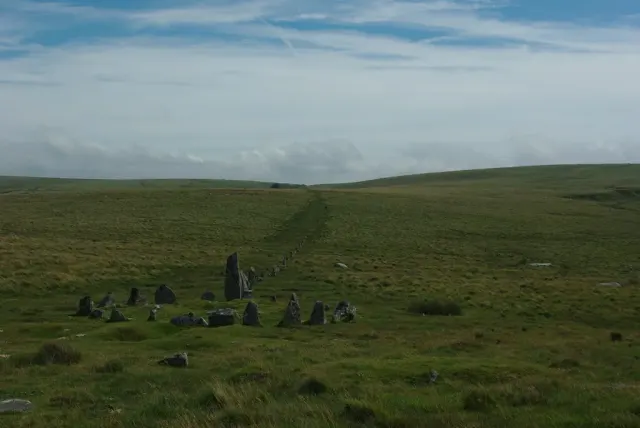
A single stone row 316 m long with at least 174 stones and a 2.8 m standing stone at its western end, beside a cairn ringed by 24 upright stones, on the saddle between Eylesbarrow and Down Tor.
A single stone row 128 m long with 27 stones, 13 still in place, ending in a cairn, and crossed by the Lichway, on the ridge between Cocks Hill and White Tor.
The Ringmoor Down double stone row, 337 m long with 27 stones, ending in a cairn 7 m across with a kerb 12.9 m across that Baring-Gould restored in 1909.
The Hurston Ridge double stone row, 143 m long from a round cairn to a blocking stone, with a second cairn, an enclosure of at least seven huts 210 m long and the Hurston Ridge reave.
Old books sometimes spell "Black Tor" differently. Which of these is one of those spellings?
Bronze Age settlement remains including stone alignment, cairns, hut circles and field boundary on the open moor northeast of Horseyeatt.
The Assycombe double stone row: two lines of stones running 125 m downslope from a ringed cairn, with a reave crossing it, ten hut circles, a medieval longhouse and a post-medieval farmstead.
A hut circle 3.8 m across inside, terraced into a gentle east slope 130 m east of Leeden Tor, with a wall 1.5 m wide.
A hut circle 10.2 m across inside with a single upright-stone wall 1.4 m wide and 1.3 m high, on a west slope of Throwleigh Common above the Forder Brook.