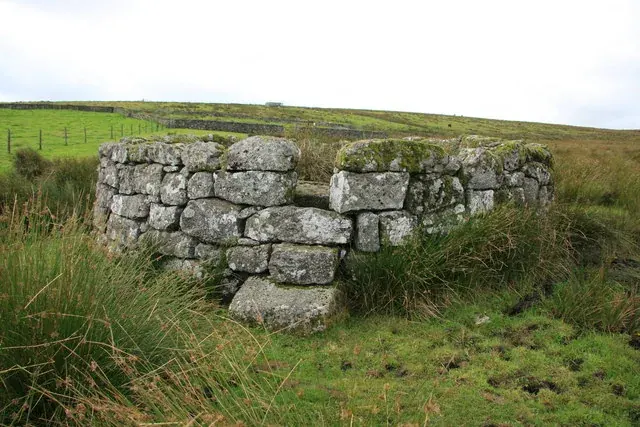
Dovecote near Pridhamsleigh
A circular Grade II* dovecote 6.28 m across with a corbelled domed roof, about 250 nesting holes in 11 tiers and a low Gothic door, restored in 1977, at Pridhamsleigh.
A grade II* listed farmhouse on the eastern edge of Dartmoor, likely medieval in origin with later additions.
A Grade II* listed building on the eastern moor, likely a farmstead or small settlement with roots in medieval or early modern Dartmoor.
An early Christian inscribed stone of about AD 550, a granite pillar 1.75 m high reading DAPANNICI NASC FI, perhaps 'the stone of Dapannicius, son of Nascus', near Uphill farmhouse.

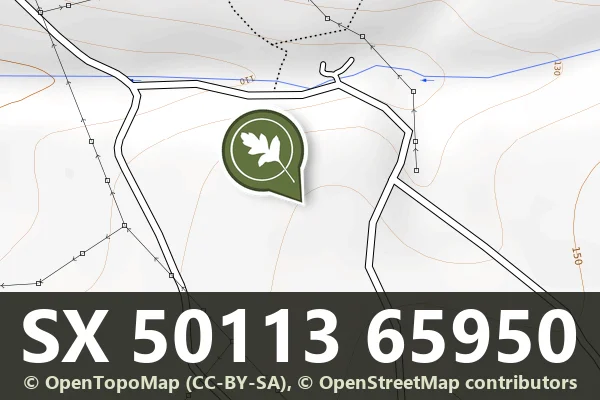
Which Dartmoor place is this?
A large oval enclosure in Boro' Wood, 256 m by 160 m inside, read in turn as a hillfort, a stock enclosure, a copper mine or a woodland bank.
Grade II* listed walls and gateway at West Week Farmhouse, a vernacular survival of rural Dartmoor building tradition.
A spring north of Princetown under a stone canopy with a lintel cut I.F. 1568, linked to John Fitz and the same pixie-mist story told at Okehampton.
The former Guildhall and police station in Tavistock, Grade II*, about 1848 by John Foulston and then Theophilus Jones for the Duke of Bedford, built on the site of the abbey's Great Court and incorporating late 15th-century fabric.
Medieval listed building on Dartmoor. Historic England list entry 1097177.
Photograph by Glavind Strachan Photography“The granite tors still lift their lofty heads to the sky, the heather and gorse still bloom on the moor, the stream yet pursues its way over its rocky bed, and all is here unchanged.”
Also on Our DartmoorWarne's Kitchen — A Grade II* listed kitchen building, likely medieval or early modern in origin, standing on the moor landscape.