Throwleigh Common coaxial field system
Most of the Throwleigh Common coaxial field system, with six settlements including at least 27 hut circles, a reave, at least 27 cairns, part of the 19 km Bradford Leat and two boundary stones.
Scheduled Monument farmstead south of Crazy Well Pool, likely medieval or later, on the open moor.
A Grade II* listed farmhouse, long abandoned, standing on the open moor near Flood with roots in medieval or early modern settlement.
A Grade II* listed dovecote standing near Pridhamsleigh Manor, built to house pigeons for a substantial Dartmoor estate.
A Grade II* listed farmstead on the edge of Dartmoor, with 16th-century origins and the solid character of moorland vernacular building.
The earthwork remains of a medieval settlement abandoned centuries ago, west of Okehampton camp on the moor.
A deserted medieval settlement of up to six buildings, at least two of them longhouses, on the lower north slopes of Black Down.
A deserted medieval settlement of at least eight longhouses on the north-west slopes of East Hill above the West Okement.
Two joined enclosures and a building on a ridge above the West Okement, in the Okehampton Park cleared by Hugh de Courtenay about 1300; the tithe map marks it 'hospital'.
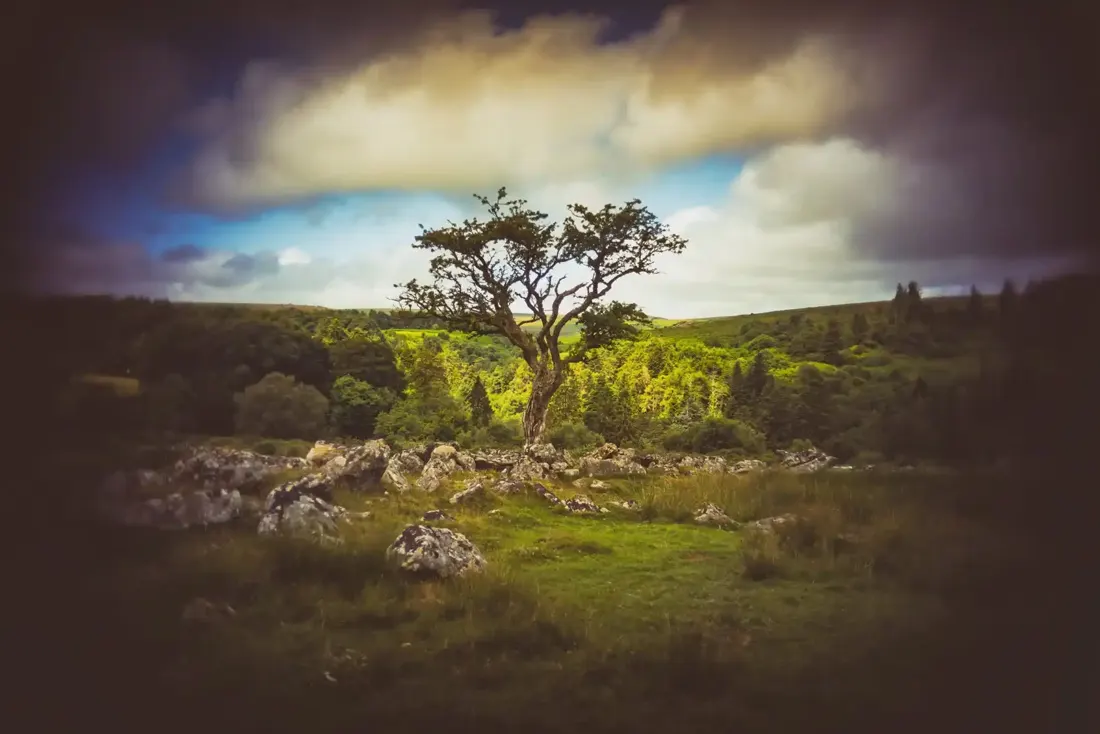
Hawthorn at Round Pound. Photograph by Glavind Strachan Photography“Pixies, too, hold a high place in the imaginations of Devonians. The villagers around Haldon and Dartmoor assert that these little people have their homes among the tors, and keep their houses spotlessly clean ; that they enjoy mad gallops at night on colts, making stirrups in their manes and ...”
Also on Our DartmoorTravels in Georgian Devon — Four-volume edition (1997-2000) of the Rev John Swete's illustrated journals of 1789-1800, edited by Todd Gray and Margery Rowe. Borrow or buy only.