Cairn with a displaced cover stone, Shavercombe Brook
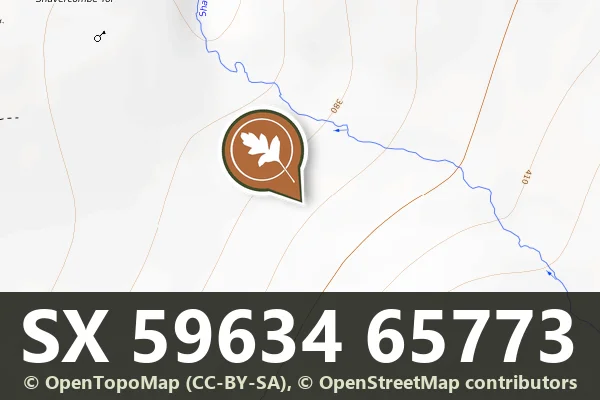
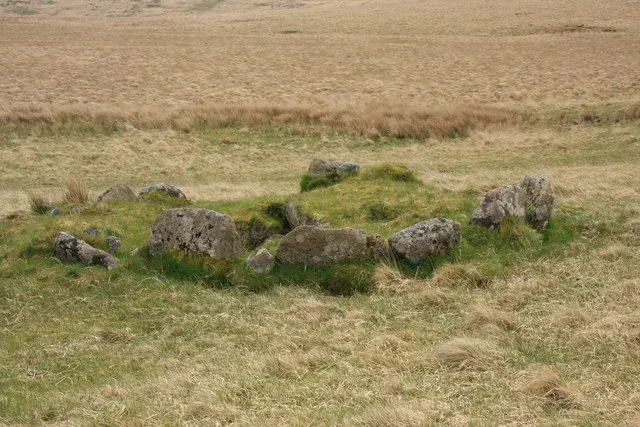
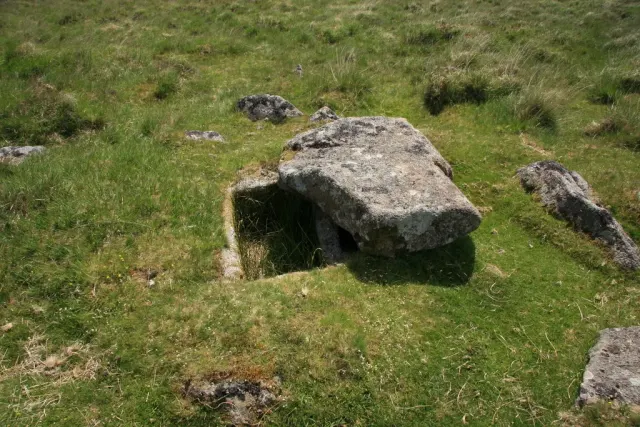
A cairn 4 m across with a central cist 1.3 m long whose cover stone, 1.5 m by 1.3 m, lies displaced on it, south of the Shavercombe Brook.
A cairn 8 m across and up to 1 m high with a central hollow, the north-eastern of two on the west slope of Penn Beacon, near a group of springs.
A cairn 7 m across with part of its kerb and a cist 1.2 m long whose west side slab is vein quartz, near the head of a southern tributary of the Langcombe Brook.
A cairn 4.5 m across with a kerb of three large stones and a cist 0.9 m long whose slabs were put back in place in an excavation in 1900.
A Dartmoor fact about Brentor Church (St Michael de Rupe)
Bronze Age burial cairn with stone burial chamber, located south of Royal Hill on Dartmoor.
A cairn with a kerb of eleven stones 5 m across and a cist 1 m by 0.5 m with all four slabs in place, 150 m west of Legis Lake, the cover slab displaced.
A cairnfield of at least 25 mounds, with a kerbed funerary cairn and two lengths of walling that show a field system was starting to be laid out, above the Blackaton Brook.
At least 29 small cairns, five joined fields, a hut circle, a cairn with a cist and a ring cairn 17.5 m across south of Moorgate Farm below Row Tor, pitted by military training.
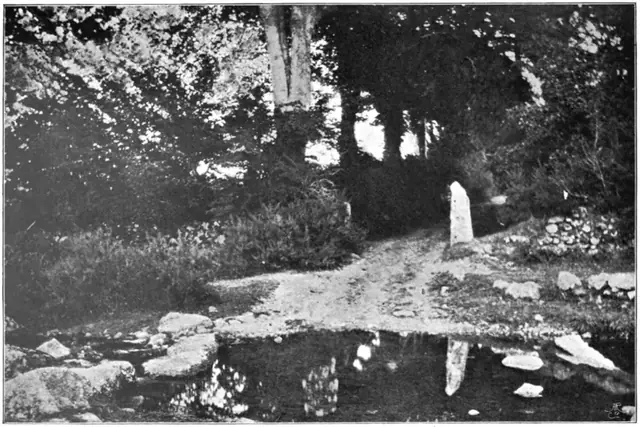
A cairnfield of 21 mounds, three hut circles and a leaning boundary stone cut T on the South Tawton and Forest parish boundary, above Taw Marsh.
Plate from Dartmoor Illustrated, page 100, 1900“In the distant hollow on the left, half hidden by the mist, the two thin towers of Baskerville Hall rose above the trees.”
Also on Our DartmoorSongs of the West — The folk songs of Devon and Cornwall, collected from the mouths of the old singers by Baring-Gould and Fleetwood Sheppard.