Tor cairn on High Willhays summit
A tor cairn on the summit of High Willhays, southern England's highest point: two curved banks against the east face of a rock outcrop, enclosing 13.5 m by 5.5 m.
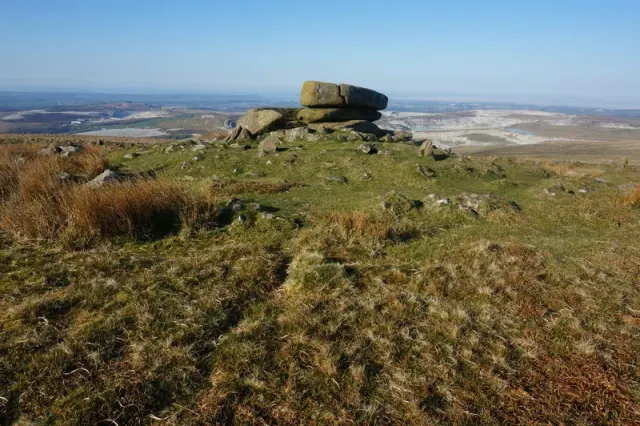
A tor cairn on the summit of Shell Top: a mound of small boulders 16.5 m across and 1.4 m high built round the granite outcrop, which rises another 1.4 m.
A tor cairn of rubble bank round Branscombe's Loaf, a granite outcrop 12 m by 4 m and up to 4 m high, enclosing a space 18 m across, on Corn Ridge.
A cairn of three concentric rings of edge-set slabs, the inner of at least eight stones up to 1 m high, round a central cist 0.9 m by 0.56 m, overlain by a historic boundary bank, north-west of Arch Tor.
“The rain stopped suddenly, and the wind was hushed, except in the tops of invisible trees; and a streak of black boggy fog settled heavily.”
Which book is this from?
Two Bronze Age cairns on the open moorland at Ausewell Rocks, marking an ancient burial or ceremonial site.
Two Bronze Age cairns on the slopes east of Higher White Tor.
Two ring cairns on the upper slopes of Cator Common, 12 m and 16 m across, both disturbed by early digging or robbing.
Two round cairns with cists on the slope of Ter Hill above the Swincombe, both dug by Mr Burnard, one yielding a broken beer bottle.