

← Browse Lee Moor · Browse Industrial Archaeology · Browse the directory
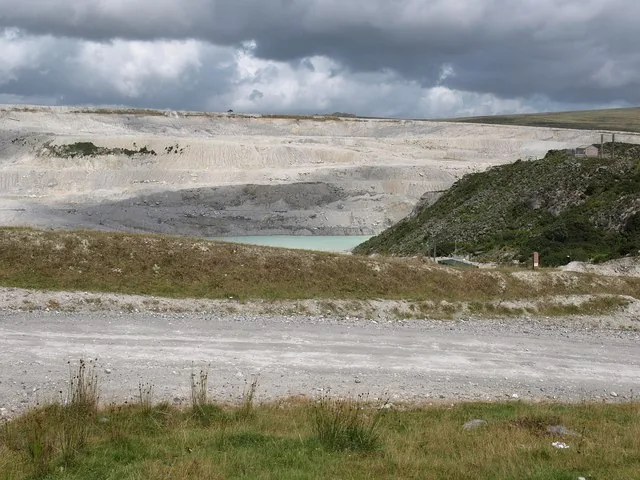
Lee Moor China Clay Works
Lee Moor, Shaugh Prior, Devon
Grid ref: SX 5709 6209 Find this on the Map Reference Finder
Main image: Lee Moor china clay works. Photo by Derek Harper, via Geograph and Wikimedia Commons, CC BY-SA 2.0
The Lee Moor china clay works lie on the hills south-east of the Trowlesworthy Tors, in Shaugh Prior parish; the part that has been heavily mined is outside Dartmoor National Park. One local history lists at least seven major works: Shaugh Lake, Lee Moor, Wotterwaste, Cholwichtown, Whitehill Yeo, Headon and Brisworthy. The Shaugh Prior parish history dates the first find to 1827, when John Warrick found clay at Whitehill Tor; other accounts put the start of production at 1830. Clay is now taken by washing the granite out with high-pressure water, and most of what is dug is waste, mainly mica sand.
William Phillips, lessee of Lord Morley's clay deposits, opened the Lee Moor Tramway on 24 September 1858 (some sources say 1859). It ran about 4.2 km down to a branch of the Plymouth and Dartmoor Railway near Plym Bridge, with a branch to Cholwichtown, worked by horses and two self-acting inclines at Cann Wood and Torycombe; two steam locomotives were added in 1899. Phillips sold out to Mrs R. Martin in 1862, and in 1919 the works became part of English China Clays. Commercial traffic ended about 1945, after which clay moved by pipeline, though a last token run is recorded on 26 August 1960. The parish history credits the tramway to the Martin Brothers, which differs from Wikipedia. Lee Moor No. 2 locomotive is preserved at Buckfastleigh.
The Lee Moor leat brings water from the River Plym near Ditsworthy Warren to the works. A walk report says it began as the Bottle Hill Mine leat, built in 1809 and improved in 1825, and was later taken over for clay; we found no source for a leat of 1859, and the dated event of 1858-9 is the tramway. Historic England records the leat reusing a stretch of medieval cornditch at Trowlesworthy and crossing the double stone row below Great Trowlesworthy Tor 53.5 m from its southern end. The Cholwichtown stone row was destroyed by clay operations in 1961.
Today the pits are an active industrial site, not a visitor attraction. A 1972 inquiry granted a large working permission and a 1978 tipping agreement set the final profile of the tips. Most of the area is closed to the public apart from occasional open days (one in October 2015, the first in six years); the tramway route, leat and the villages of Lee Moor and Wotter can be seen from public paths and roads.
Sources: www.shaughpriorparish.gov.uk; en.wikipedia.org; dartmoorexplorations.co.uk; beta.dartmoorcam.co.uk; www.geograph.org.uk; historicengland.org.uk
Suggest an edit to this listing
Contact us if you have information about this listing
Official record
Explore the area
Go deeper with Dartefacts
Dartefacts is a database of Dartmoor sites with far more close-up detail than we can show here, and it is the best place to go deeper. Dartefacts is free to use, and nobody has to pay to look things up. If you want more, a yearly subscription adds 10-figure grid references, map zoom down to 1:25,000 and lists to tick off the places you have visited, and it helps keep the site going. We would encourage you to subscribe.
Thoughts
Be the first to share a thought about Lee Moor China Clay Works.
Share a thoughtKnow another Dartmoor place, tor or landmark we should include? Suggest a listing, it is free.
Suggest a listing