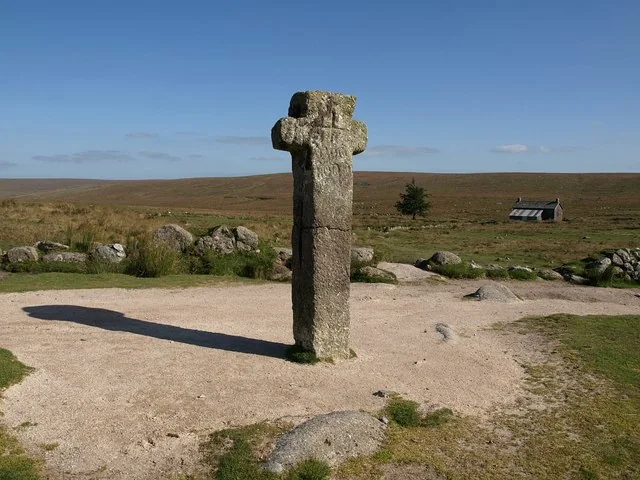
Siward's or Nun's Cross
Dartmoor's largest wayside cross, 2.07 m tall, called Siward's Cross in the 1240 bounds and Nun's Cross by 1699, at a meeting of old moorland tracks.
Showing listings tagged “Historic England” Show all listings
Dartmoor's largest wayside cross, 2.07 m tall, called Siward's Cross in the 1240 bounds and Nun's Cross by 1699, at a meeting of old moorland tracks.
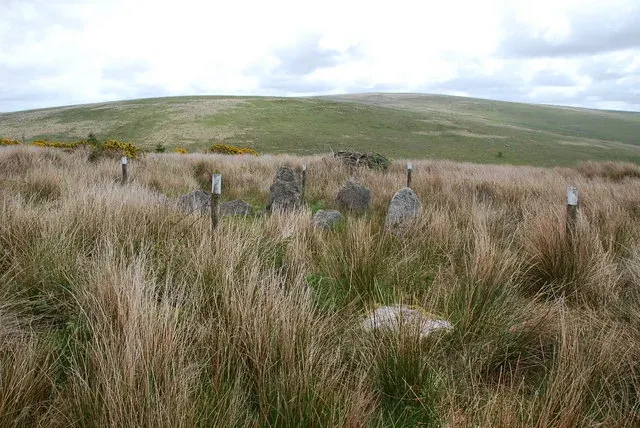
A small cairn 4 m across with a stone cist 1.18 m long, dug in 1914 when charcoal was found, above the Sheepstor leat north-east of Drizzlecombe.
A kerbed cairn with a cist on the ridge between the River Yealm and Broadall Lake: nine kerbstones up to 1.1 m high round a cist 1.2 m long.
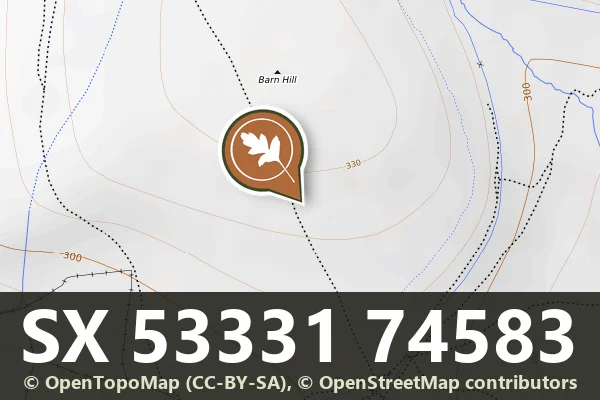
A cairn 5.7 m across and 0.2 m high with a cist 0.98 m by 0.6 m, its floor level with the ground, on Barn Hill in the Whitchurch Common field system.
“Oh, Miss, how can I ever thank 'ee? I bathed my arms same as you told me at bedtime and got right in bed and slept till nine o'clock this morning without moving. Us haven't had such a night for months.”
Who wrote this?
A cairn 5.6 m across ringed by edge-set slabs up to 0.62 m high, with a cist 1.2 m by 0.55 m partly covered by three slabs, on a saddle between Hookney Tor and King Tor.
A hut circle settlement above the O Brook: at least three enclosures and 18 huts, with a fine 0.7 m entrance flanked by slabs up to 0.75 m high, a cairn over a hut and prospecting pits.
A cairn 6 m across with a possible kerb and a cist 1.3 m long with the east end stone and cover stone displaced, south of the Langcombe Brook.
A cairn 5.5 m across containing a stone-lined cist 1.2 m long, 150 m north of Vixen Tor, at the edge of a coaxial field system.
A 44 m motte 4 m high with two baileys beside an oval Iron Age hillfort with a double rampart, 144 m by 94 m, and five more banks and ditches on its south side, in Burley Wood.
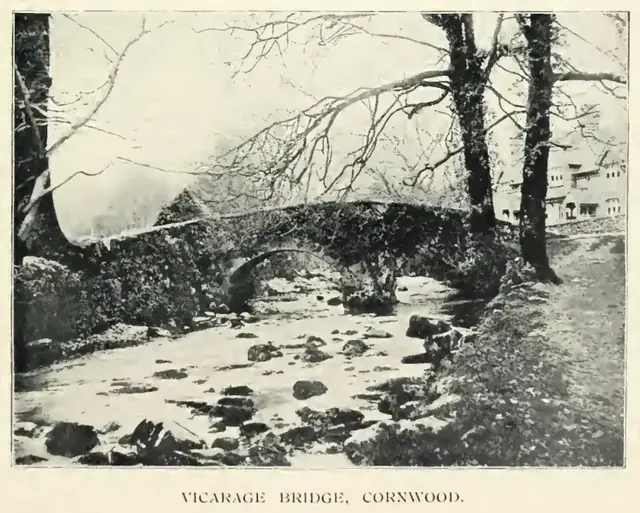
Plate from A Hundred Years on Dartmoor, page 115, 1901“Dreary, in one sense, they may be, but they yet influence and attract, for here we behold nature in her most wild form.”
Also on Our DartmoorHobhouse Farmhouse — A Grade II* listed farmhouse on Dartmoor, likely medieval in origin with later additions.