Cut Hill
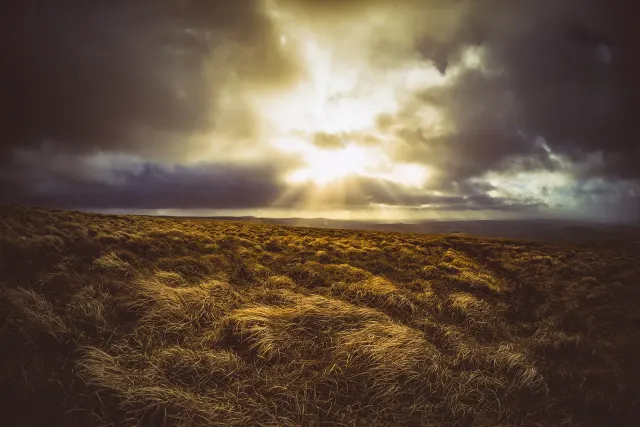
The broad, boggy summit in the north moor where the Tavy and two Dart rivers rise, with views over almost all of Dartmoor and a stone row and barrow on top.
The granite tors of Dartmoor, including the ones whose names end in Rocks, Rock or Stone.
A tor is a large free-standing outcrop of rock that rises abruptly from gentler slopes on a hill or ridge. The word comes from Old Welsh and means a cluster or heap. On Dartmoor the tors are granite, emplaced about 280 million years ago. They survive where widely spaced joints in the granite let blocks of rock outlast the weathering that turned the rest into sandy gravel (growan).
Dating of 28 Dartmoor tors found that most have been exposed for less than 100,000 years, and none for more than 200,000. They probably emerged at the start of the last major ice age.
The highest point on Dartmoor is High Willhays, at 621 metres, near Okehampton. Yes Tor stands about a kilometre to the north along the same ridge and is slightly lower.
Which outcrops count as tors is a decision for people far better qualified than this directory. We follow the Tors of Dartmoor database, the Treks and Tors list and Tor Bagger: if one of them lists it as a tor, it is listed here as one. Hills and mounds that none of them list are on the Hills and Mounds page.
This page lists the tors and other named landmarks in the directory. Use the map to see where they are, and open a listing for its grid reference and further sources.
Sources: Wikipedia, Tor (rock) and High Willhays.
The broad, boggy summit in the north moor where the Tavy and two Dart rivers rise, with views over almost all of Dartmoor and a stone row and barrow on top.
A flat-topped granite tor on the high northern moor, best known for the Beardown Man menhir beside it and its wide views to Fur Tor, Cut Hill and Great Mis Tor.
The great cliff of granite above the Plym at Shaugh Bridge, rising almost sheer from the river, with its name probably from the Celtic word for water.
A small single-mass tor on Dinger Plain, south of High Willhays, deep in the Okehampton range, with the peat track passing just beyond it.
A small tor on the edge of the Willsworthy range above the Doe Tor Brook, east of Lydford, with the Dartmoor Inn at Lydford the usual place to start.
Which Dartmoor place has also been known as "the Sepulchre"?
Lydford
Ruined Dartmoor farmstead below Doe Tor, occupied for over 200 years until the mid-1950s, with a genuine literary connection to Sabine Baring-Gould and an antiquarian puzzle over one of its granite stones.
A flat, boggy hill above the Wo Brook south of Hexworthy, crossed by the monks' path and by a track to Aune Head, with good views towards Princetown.
A tor on the western part of Walkhampton Common overlooking Burrator Reservoir, with a stone row to the north and Snappers Tor on its flank.
A modest granite tor on the central moor with open views across the high plateaux and rolling moorland.