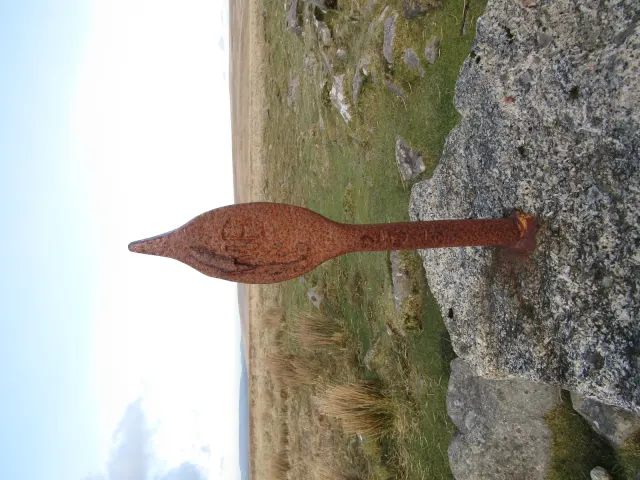
Six pillow mounds, Crockern Newtake
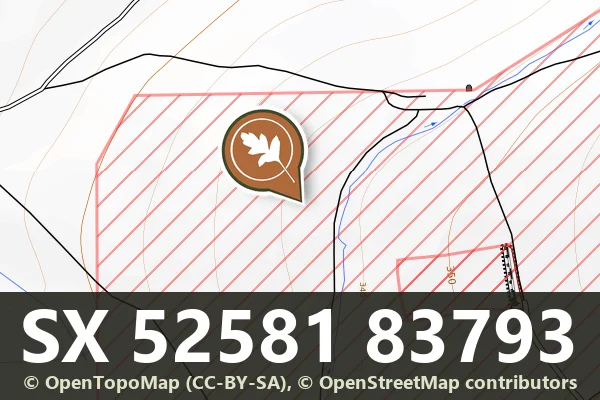
Six pillow mounds in Crockern Newtake, two end to end 31.5 m and 55.5 m long, with edges of drystone walling and edge-set stones, an outlying part of the Longaford warren.
Dartmoor's archaeology and heritage - antiquities, historic buildings and museums.
Six pillow mounds in Crockern Newtake, two end to end 31.5 m and 55.5 m long, with edges of drystone walling and edge-set stones, an outlying part of the Longaford warren.
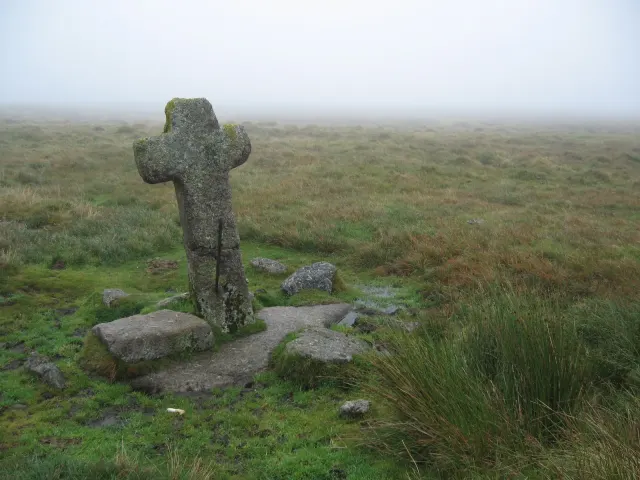
A Latin wayside cross 1.52 m high embedded in an earthfast rock and leaning 15 degrees, its shaft mended with iron bars, on Down Ridge above Holne Moor, known as Skir Cross.
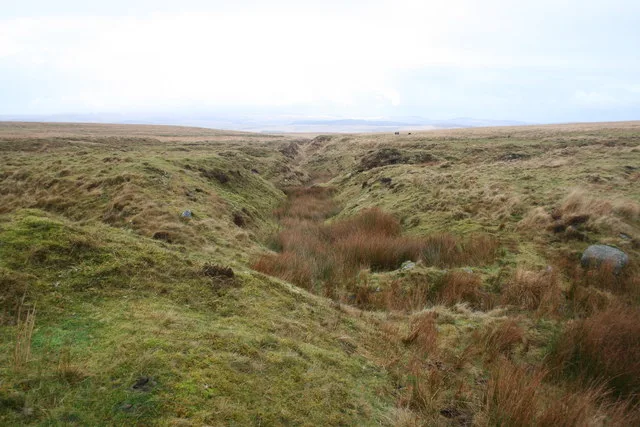
A steep granite gully scarred by centuries of tin streaming, where tinners carved their livelihood from Dartmoor's moorland.
A small oval cairn, 3.8 m by 3 m and 0.2 m high, one of twenty-six mounds in a cairnfield on the west slope of White Hill above Lydford.
“'I bant coming acrass the moor awl be myzel tü-night. I be aveāred ov the Jackie-twoads. I zeed scores aw'm when I went acrass Dartymoor last autumn.'”
Which book is this from?
A small cairn 4 m across and 0.2 m high at the edge of the Homerton Hill cairnfield, with some damage on its north-west side.
A small oval enclosure 18 m by 16 m with a bank 0.5 m wide, 200 m east of an agglomerated enclosure near Yealm Steps.
A low cairn of a few large stones, 3 m across and 0.3 m high, with a cist about 0.8 m long and no cover stone, among boulders at the west end of Lee Moor.
A cairn on the summit of Eylesbarrow, 16 m across and 1.5 m high, a few metres from the end of the watershed reave; visitors have moved its stones.
A Grade II* listed manor house, likely medieval in origin, standing on the moorland fringes of Dartmoor.
Tolmen stone. Photograph by Glavind Strachan Photography“Ten thousand years hence it will be a great peat bog.”
Also on Our DartmoorThe Vicar of Morwenstow — His biography of Robert Stephen Hawker, the poet and eccentric vicar of Morwenstow on the north Cornwall coast.