Prehistoric Settlements
Five hut circles near Yealm Steps
Five Bronze Age stone hut circles on the south-eastern edge of a larger settlement near Yealm Steps.


Dartmoor's archaeology and heritage - antiquities, historic buildings and museums.
Five Bronze Age stone hut circles on the south-eastern edge of a larger settlement near Yealm Steps.

Five hut circles, 4.9 to 36.3 square metres inside, with field walls of large slabs, in Crockern Newtake above the West Dart.
Five Bronze Age stone hut circles from an unenclosed settlement on the open moorland of Watern Oke.

A cemetery of five round cairns, 12 to 18 m across, in two groups near the summit of Black Hill, on the northern edge of Haytor Down.
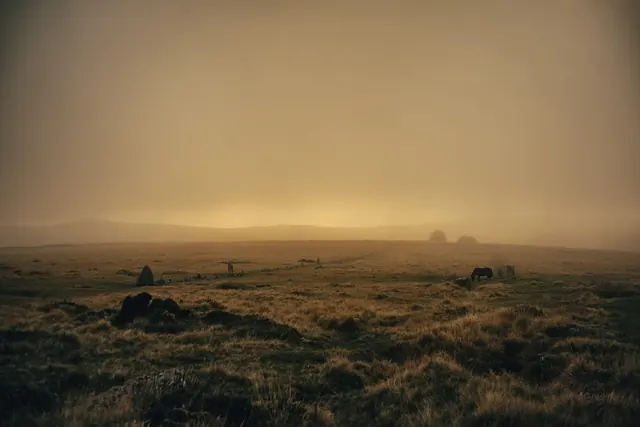
Which Dartmoor stone row is this?
Bronze Age settlement remains scattered across open moorland, where ancient stone circles and hut circles tell stories of Dartmoor's earliest inhabitants.

The former Guildhall and police station in Tavistock, Grade II*, about 1848 by John Foulston and then Theophilus Jones for the Duke of Bedford, built on the site of the abbey's Great Court and incorporating late 15th-century fabric.

Four cairns of a cairn cemetery on a south slope above the River Mardle: a ring cairn 7.8 m across and three mounds 8 to 9.9 m across, all with early hollows and trenches.

Four cairns on Holne Lee: two ring cairns 4.8 m and 12.5 m across, a 19 m mound 1.3 m high and a 5 m stony mound, all dug into at some early date.
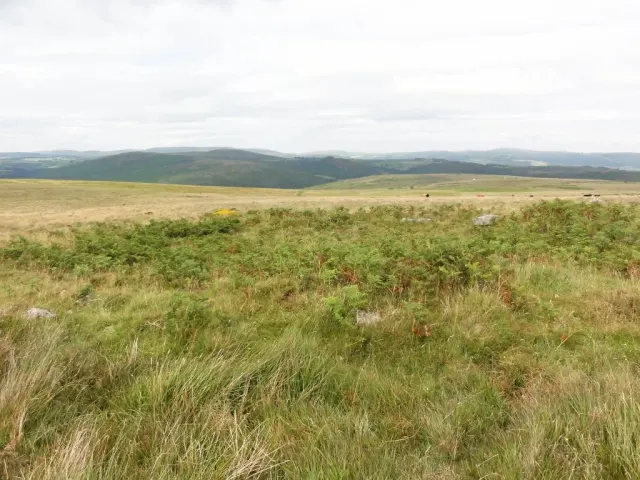
Four cairns of a cemetery on Holne Ridge south of Horn's Cross: a 16.5 m by 14 m mound 1.4 m high, a ring cairn 11.9 m across and two smaller cairns.
