Dartmoor quiz
“The peat glowed as though it were red-hot, and night brooded on the eastern face of every hill.”
Who wrote this?


← Browse Tors & Landmarks · Browse the directory
Okehampton Hamlets, Okehampton, Devon
Grid ref: SX 6158 8622 Find this on the Map Reference Finder
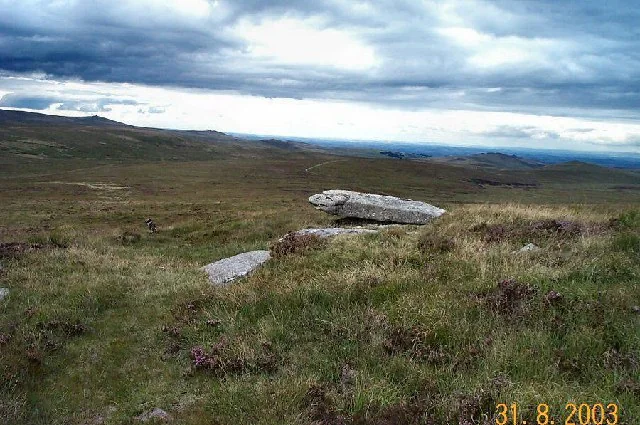
Main image: A flat-topped granite outcrop on the moor, with a wide view over north Dartmoor behind. Photo: Richard Knights (CC BY-SA 2.0) via Wikimedia Commons
The Hangingstone is a small outcrop of granite just north west of the summit of Hangingstone Hill, 596 m above sea level, in the middle of north Dartmoor. William Crossing wrote that the hill was once Newtake Hill, and that the moormen kept the name Hangingstone for this north west side only. The outcrop is the reason for the hill's name: it was a logan stone that no longer rocks.
The hill itself is 603 m, with an Army observation post and flagpole on its summit, and Whitehorse Hill about 600 m to the south. It lies in the Okehampton range, so access is limited to times when the range is not in use.
Hanging stones elsewhere on Dartmoor carry a story of a sheep thief strangled by the stolen animal on his back. Legendary Dartmoor lists this stone among them, but suggests that here the name more likely comes from a stone that moved on a pivot. Hangingstone Hill is the northern one of the three Hanging Stones in the article; the one on Lee Moor is a different stone.
This is a location on Dartmoor that has a namesake. Read more about this: Dartmoor Places With the Same Name
Contact us if you have information about this listing
Dartefacts is a database of Dartmoor sites with far more close-up detail than we can show here, and it is the best place to go deeper. Dartefacts is free to use, and nobody has to pay to look things up. If you want more, a yearly subscription adds 10-figure grid references, map zoom down to 1:25,000 and lists to tick off the places you have visited, and it helps keep the site going. We would encourage you to subscribe.
Be the first to share a thought about The Hangingstone (Hangingstone Hill).
Share a thought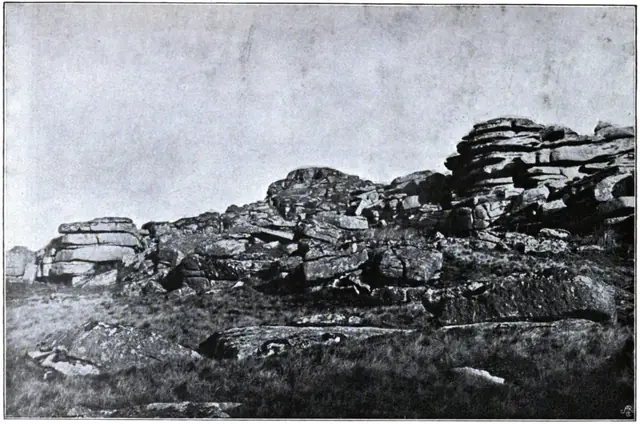 Plate from Dartmoor Illustrated, page 136, 1900
“When below are mud and mist, aloft on the moor the ground is hard with frost and the air crisp and clear.”
Also on Our DartmoorHistory of the Town and Borough of Devonport — Worth's 1870 history of Devonport, sometime Plymouth Dock, tracing the port town from its origins to its growth as a major naval and industrial centre.
“The peat glowed as though it were red-hot, and night brooded on the eastern face of every hill.”
Who wrote this?
Know another Dartmoor place, tor or landmark we should include? Suggest a listing, it is free.
Suggest a listing