

Cairnfields, field systems and a reave near Cox Tor
Four scheduled monuments on the slopes of Cox Tor: two cairnfields, part of the Whitchurch Common coaxial field system and a reave later used by troops.
Showing listings tagged “Scheduled Monument” Show all listings
Four scheduled monuments on the slopes of Cox Tor: two cairnfields, part of the Whitchurch Common coaxial field system and a reave later used by troops.
Twenty-three stone hut circles in six scheduled monuments on Cox Tor, most in a large unenclosed settlement on the north-east slope above Colly Brook.
Six cairns in five scheduled monuments on Cox Tor: two tor cairns, two round cairns and two ring cairns of a cairn cemetery, with a summit hut circle.
Six scheduled monuments on Cox Tor where prehistoric households lived inside enclosures: hut circles, walled yards and a small field system.
Five scheduled monuments east of Trowlesworthy Warren House: two hut circle settlements, an enclosure, a cairn with a cist and a V-shaped gully.
Seven scheduled vermin traps on Trowlesworthy Warren: drystone walls aimed at a gully, a boundary wall, the river or the china clay leat to funnel predators.
Three pillow mounds in two scheduled monuments in the Blacka Brook valley below Great Trowlesworthy Tor, two of them among older tin streamworks.
Eight Bronze Age round cairns in four scheduled monuments on Lee Moor, south east and east of Great Trowlesworthy Tor, one with a stone-lined cist.
Five scheduled vermin traps on Trowlesworthy Warren: drystone V, X and Y shaped walls built to funnel predators into a trap.
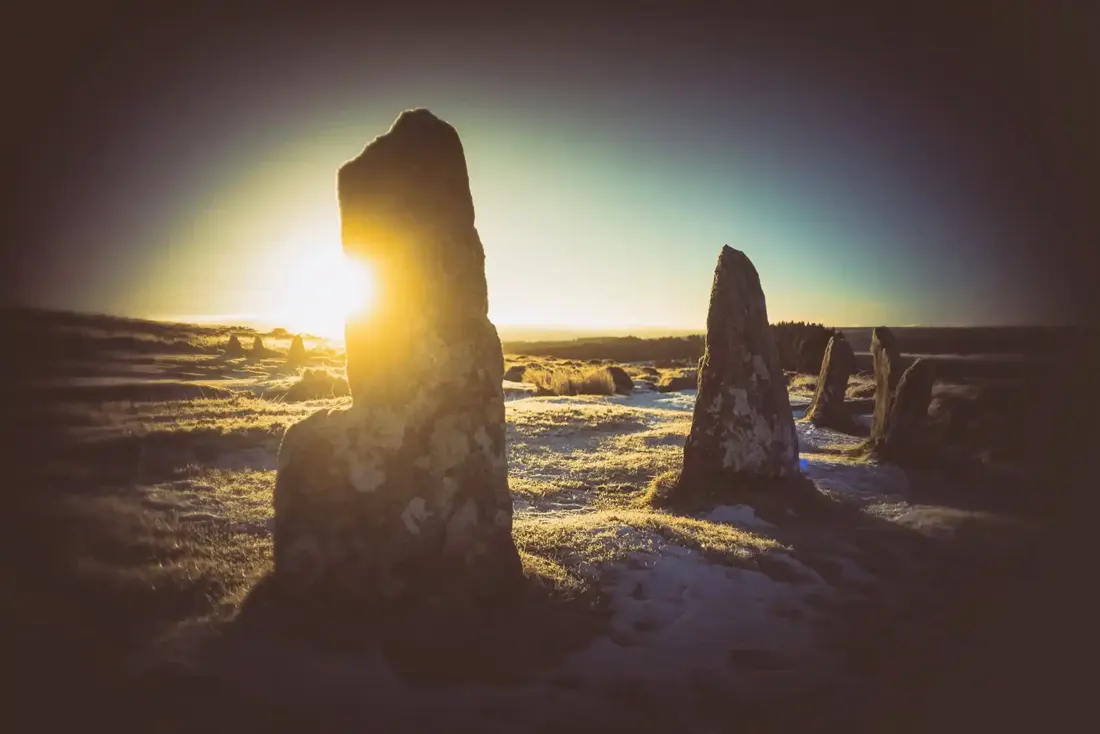
Scorhill stone circle in the snow. Photograph by Glavind Strachan Photography“Strangers who have never experienced a real Dartmoor mist are apt to imagine that a map and a compass are all that are required to enable one to make one's way across the trackless waste.”
Also on Our DartmoorAbbey Bridge, Tavistock — Granite bridge of two segmental arches over the Tavy at Tavistock, built in 1763 and widened in the 1860s on the site of the Abbey's medieval bridge, called Guile Bridge in old books.
