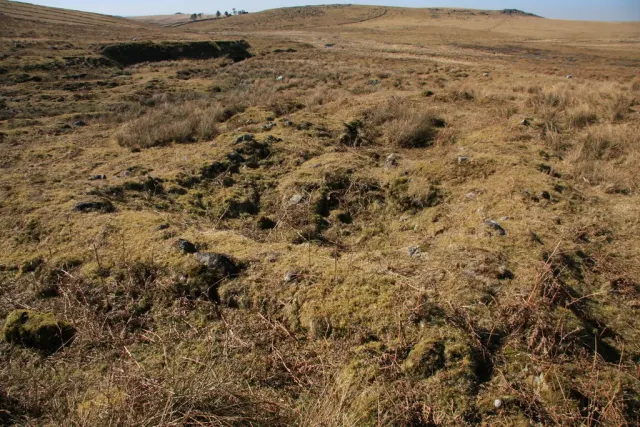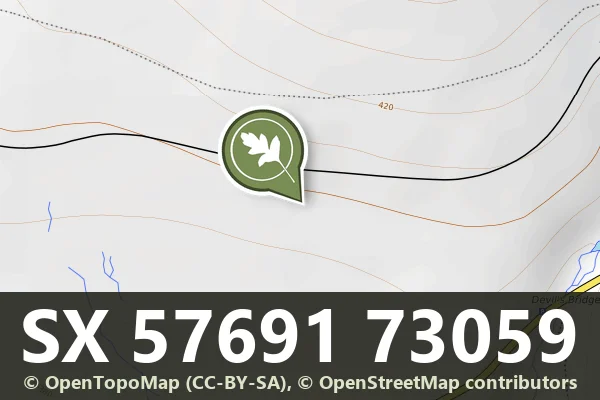
North Hessary Tor settlement: nine huts and later shelters
Nine hut circles, 3.1 to 8 m across, with later shelters built in them, on the lower south slope of North Hessary Tor above the Meavy.
Showing listings tagged “Medieval” Show all listings
Nine hut circles, 3.1 to 8 m across, with later shelters built in them, on the lower south slope of North Hessary Tor above the Meavy.
A medieval longhouse 13 m by 4 m inside with a 9 m annex and a drainage ditch, and an outbuilding 66 m north-east of it, on Peek Hill above Burrator Reservoir.
Bronze Age cairns and medieval farmstead within a reave system on Dartmoor.
A small two-roomed drystone house with two annexes and a yard, field walls and a tin openwork at Shavercombe Foot, perhaps Hentor Cot, home of a farm labourer in the early 1800s.
Old books sometimes spell "Hen Tor" differently. Which of these is one of those spellings?
A Grade II* listed farmhouse on the high moor, likely medieval in origin.
The deserted medieval settlement at Blackaton: at least eleven buildings (six longhouses), a manor first recorded in 1229 with 13th-century pottery, owned by the Pipards and later the Southcotts, with a chapel recorded in the 18th century.
Eight pillow mounds, a vermin trap and a series of ditches on the north slope of Little Trowlesworthy Tor, in two areas of protection.
A medieval longhouse of two rooms, an outbuilding and a small farmyard on the lower slope of White Hill above the Willsworthy Brook.
The deserted medieval settlement at Challacombe: at least seven buildings along a track, one with its walls intact and three rooms, first recorded in 1481 as Chalvecombe, five tenements by 1613 and lived in until at least 1880.
Photograph by Glavind Strachan Photography“I once heard a woman tell one of her daughters, in a Dartmoor cottage, " to log the child's cradle." There, thought I, is a British word ; log means to rock, hence logging, or logan stone.”
Also on Our DartmoorRound cairn near Cawsand Beacon — A round cairn 7 m across and 0.6 m high on the summit ridge of Cawsand Hill, with a robbed hollow faced with large slabs that may be the cist Falcon described in 1905.