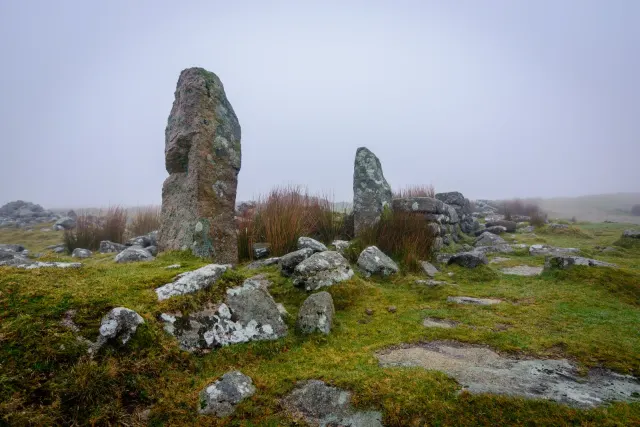
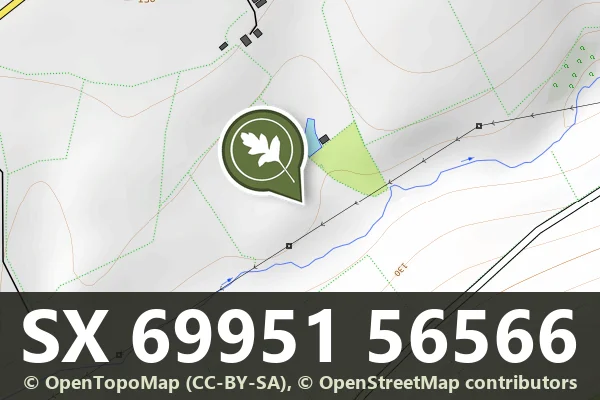
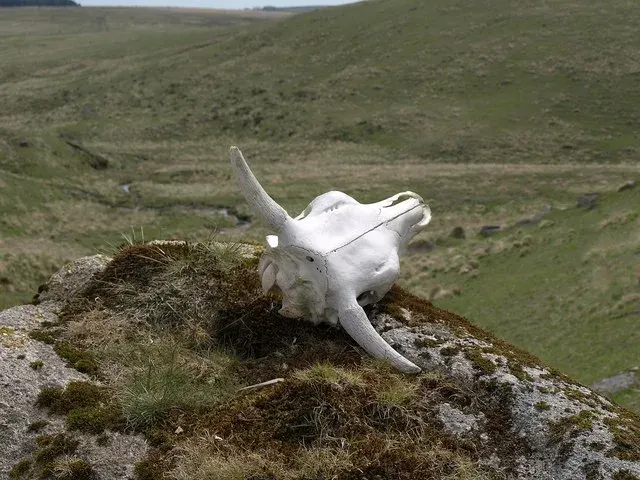
Dispersed hut circle settlement above the Lowton Brook, south-east of Silk House
A scattered settlement of at least 12 hut circles and field walls on a north-east slope above the Lowton Brook, in six separate areas.
Dartmoor's archaeology and heritage - antiquities, historic buildings and museums.
A scattered settlement of at least 12 hut circles and field walls on a north-east slope above the Lowton Brook, in six separate areas.
Five joined enclosures covering 2.7 hectares with fourteen hut circles and a later longhouse, on a spur above the south bank of the Plym.
A double stone row 128 m long, running north to south down the slope below Great Trowlesworthy Tor, with a circle of eight stones at its top.
“The only thing that brought us home on long summer evenings was the ring of a handbell by Mum standing at the field gate calling us in for supper.”
Who wrote this?
Bronze Age stone rows and a mysterious mechanical fragment weathered into Dartmoor's granite landscape.
A Grade II* listed dovecote standing near Pridhamsleigh Manor, built to house pigeons for a substantial Dartmoor estate.
Mysterious earthwork remnants scattered across open moorland, revealing Bronze Age settlement patterns on Dartmoor's high plateau.
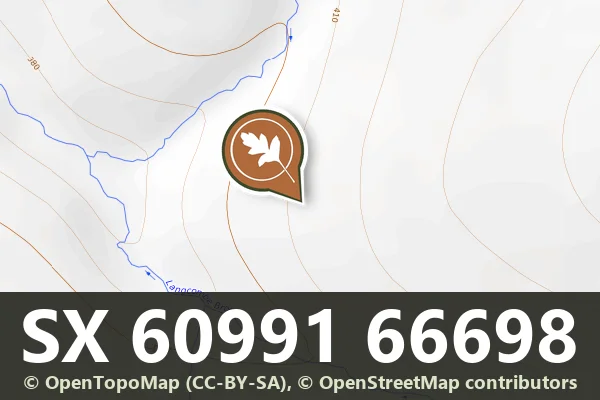
A cairn 5 m across and 0.2 m high with a square cist 1 m by 1 m, all its end and side slabs in place, on a west slope between the Langcombe Brook and Deadman's Bottom.
Eight pillow mounds, a vermin trap and a series of ditches on the north slope of Little Trowlesworthy Tor, in two areas of protection.
Bronze Age stone hut circle settlement nestled on Conies Down Tor's south-east slope, a cluster of ancient dwellings preserved on open moorland.