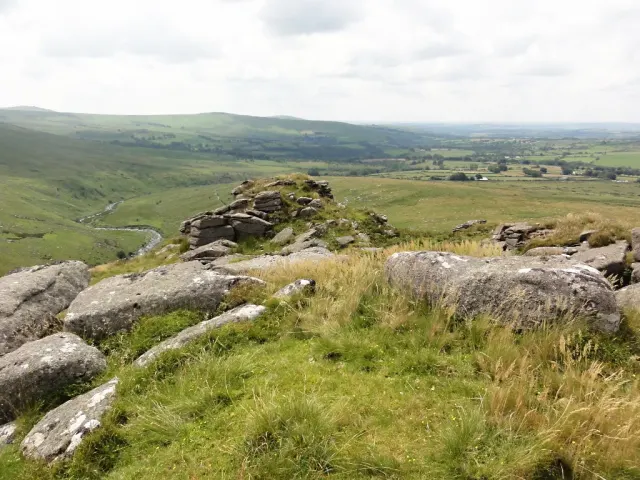
Eylesbarrow reave, two enclosures and seven hut circles
Two enclosures with huts, 65 by 55 m with two huts and 142 by 112 m with five, joined to the Eylesbarrow reave, with 340 m of the reave and a dry tinners' leat.
Dartmoor's archaeology and heritage - antiquities, historic buildings and museums.
Two enclosures with huts, 65 by 55 m with two huts and 142 by 112 m with five, joined to the Eylesbarrow reave, with 340 m of the reave and a dry tinners' leat.
“Us could tie up the knees so's the presents wouldn't drop out, couldn't us, Muther?”
Who wrote this?
A 1.05 km length of the Eylesbarrow watershed reave from the stream north of Scout Hut to tin workings, the terminal reave for the Roughtor parallel reave and another.
A 130 m stretch of the Eylesbarrow watershed reave running down the slope, a bank of earth and stone up to 5 m wide, between gaps where it cannot be traced.
A 160 m dog-leg of the Eylesbarrow reave running through clitter on the north-west slope of Gutter Tor, a low bank up to 2.5 m wide.
Cranbrook, Moretonhampstead
Eighteenth-century mill ruins nestled in the wooded valleys of eastern Dartmoor, a testament to the moor's industrial past.
Five hut circles, 5.5 to 7.4 m across, all with visible doorways, on the northern edge of the large Yealm Steps settlement.
A cluster of five hut circles, 2.8 to 4.2 m across, joined by curved boundary walls that do not close, inside the large Ger Tor enclosure.
A flat-topped round cairn 9.7 m across and 0.6 m high, with several shallow hollows, on a west-facing slope above Bridestowe.
Four Bronze Age hut circles north of Bush Down, a scheduled monument on Dartmoor's open moorland.