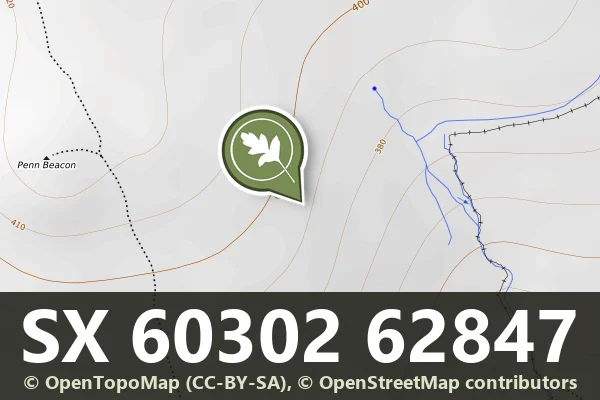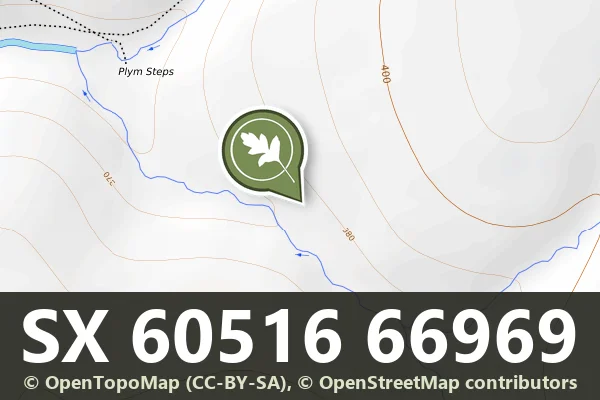
Langcombe Brook settlement, ring cairns and tin mill
A settlement of three enclosures, three ring cairns with two cists and six round cairns, with a tin mill and streamworks of the post-medieval tinners, beside the Langcombe Brook and the Plym.
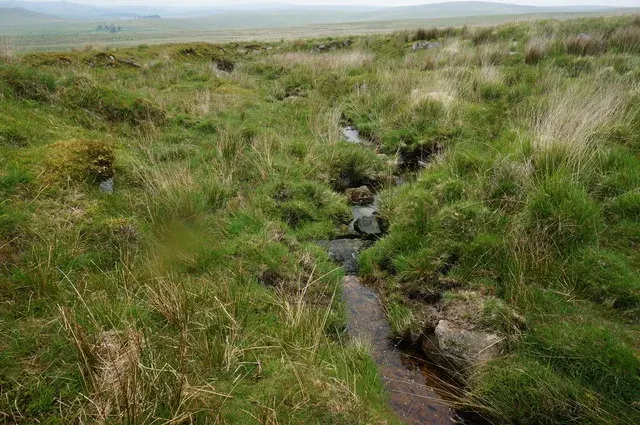
Dartmoor's archaeology and heritage - antiquities, historic buildings and museums.
A settlement of three enclosures, three ring cairns with two cists and six round cairns, with a tin mill and streamworks of the post-medieval tinners, beside the Langcombe Brook and the Plym.
A hut circle 9 m across inside with a wall up to 2 m thick and a north-east entrance, close to the north bank of Hentor Brook.
Bronze Age settlement and later farmstead east of Raddick Lane, with stone hut circles and field systems.
A hut circle 10 m across inside with walls 2 m thick and 1 m high and a probable north entrance, south of the Penn Moor settlement above Ford Brook.
A ring cairn 23 m across overall, with a kerb of edge-set stones and a central mound 15 m across and 1.4 m high, on the summit of Corn Ridge.
A prominent stony round cairn 24 m across and 3 m high on the east crest of the ridge running south from Watern Tor, with a central pit, a modern shelter and a probable buried ditch.
At least four hut circles and an irregular field system of at least 11 fields on the north-west slope of Laughter Tor, one hut with an unusual multi-slab wall.
At least five hut circles within an irregular field system of at least 11 fields on the south-east slope of Laughter Tor, with medieval banks and a later drystone wall across it.
Two double stone rows on Laughter Tor: one 164 m long with at least 23 stones, a cairn with a 2.65 m standing stone at its north-west end, re-erected in 1893 and 1911, and a 10 m double row.
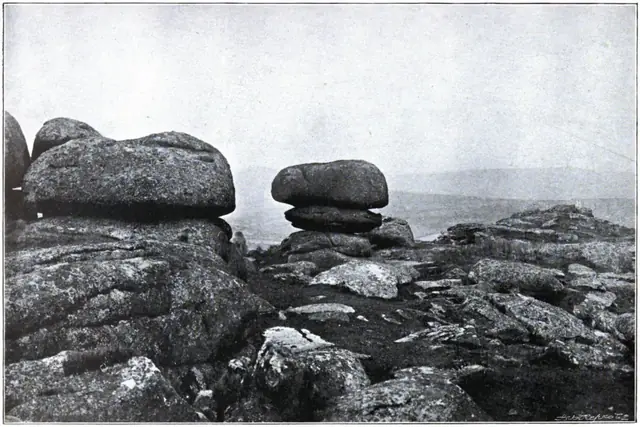
Plate from Dartmoor Illustrated, page 188, 1900“'I bant coming acrass the moor awl be myzel tü-night. I be aveāred ov the Jackie-twoads. I zeed scores aw'm when I went acrass Dartymoor last autumn.'”
Also on Our DartmoorPillow Mounds (Warrens) — Medieval rabbit warren earthworks hidden in Dartmoor's moorland, where artificial burrows once sustained a valued food source.