

← Browse Other Heritage Sites · Browse the directory

Crockern Tor
Two Bridges, Devon
Grid ref: SX 6156 7578 Find this on the Map Reference Finder
Main image: Crockern Tor panorama 2013-09-09 - 30 metres from location - image by August Schwerdfeger (CC BY 4.0), via Wikimedia Commons
- Grid reference: SX 61577 75769
Crockern Tor is the granite hill above Two Bridges where the tinners of Devon met in their Stannary Parliament. Almost nothing now stands on the summit, and most of what is known about the place comes from the people who wrote about it when more was left.
The Parliament Rock
Anna Eliza Bray, writing in the 1830s, called it "the most curious and remarkable seat, perhaps, of Druidical judicature throughout the whole kingdom". It "remained as the Court of the Stannaries till within the last century, and hence was it commonly called Parliament-rock". The chief miners of Devon were, by their charters, obliged to assemble there, and a company of two or three hundred might meet, though after the formal business they usually adjourned somewhere more sheltered.
Rowe's Perambulation says the tor "has long been celebrated as one of the wonders of the Forest" and reaches it from Two Bridges along the Moreton turnpike road. Polwhele, in the eighteenth century, thought the Stannary parliaments were "a continuation even to our own times of the old British courts", while admitting that Crockern Tor was "undoubtedly a very strange place for holding a meeting of any kind", exposed to all the severities of the weather.
What was on the hill
William Crossing wrote that the tor "has not escaped the hand of the vandal". From Risdon, he says, we learn that there had been "a table and seats of moorstone hewn out of the rocks", presumably used by the stannators at their gatherings, and that none of it was to be seen by his day. Clive Gunnell, standing on the same summit, pictured "ninety-six miners crouching, shoulders hunched against the wind, around a large flat granite slab table", listening to the Elder in the Judge's Chair.
Richard Strode
Gunnell tells the best-known story of the court. By the reign of Henry the Eighth the stannators were powerful enough that when Richard Strode, MP for Plympton, brought a bill into Parliament about the silting of harbours, which limited their working rights, they ordered him to appear before them on Crockern Tor. When he refused they had him arrested and put in Lydford Keep, the Stannary prison.
Where the sources differ
- The Judge's Chair. A granite seat at Dunnabridge Pound is often said to have been brought down from here. Crossing says that story "has evidently arisen through confusing the pound with the farm" and was never heard on the moor in the first half of the nineteenth century.
Sources
- Richard Polwhele, The History of Devonshire (eighteenth century).
- Anna Eliza Bray, Traditions, Legends, Superstitions, and Sketches of Devonshire.
- Rowe, A Perambulation of the Antient and Royal Forest of Dartmoor.
- William Crossing, Guide to Dartmoor.
- Clive Gunnell, My Dartmoor.
Suggest an edit to this listing
Contact us if you have information about this listing


Explore the area
Go deeper with Dartefacts
Dartefacts is a database of Dartmoor sites with far more close-up detail than we can show here, and it is the best place to go deeper. Dartefacts is free to use, and nobody has to pay to look things up. If you want more, a yearly subscription adds 10-figure grid references, map zoom down to 1:25,000 and lists to tick off the places you have visited, and it helps keep the site going. We would encourage you to subscribe.
Thoughts
Be the first to share a thought about Crockern Tor.
Share a thought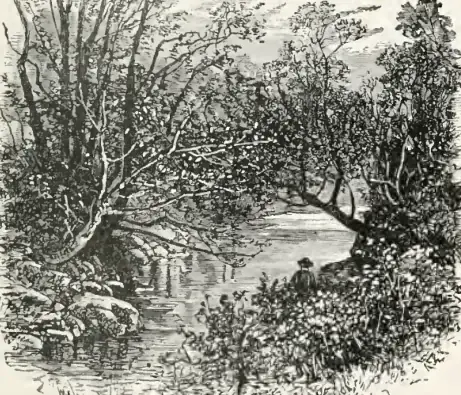 Plate from Amid Devonia's Alps, page 151, 1888
“throughout the winter it is quite a different thing ; in the darkness, fog, and often snow, there is not much to admire in the files of spectral convicts marching across the yards into Chapel.”
Also on Our DartmoorCairn on northern Harford Moor — A Bronze Age cairn on the open moorland of northern Harford Moor, a stone monument of uncertain purpose from prehistory.
Know another Dartmoor place, tor or landmark we should include? Suggest a listing, it is free.
Suggest a listing