Dartmoor quiz
What year is the original motte-and-bailey structure of Lydford Castle thought to have been built?


← Browse Peter Tavy · Browse Tors & Landmarks · Browse the directory
Peter Tavy, Tavistock, Devon
Grid ref: SX 5600 7790 Find this on the Map Reference Finder
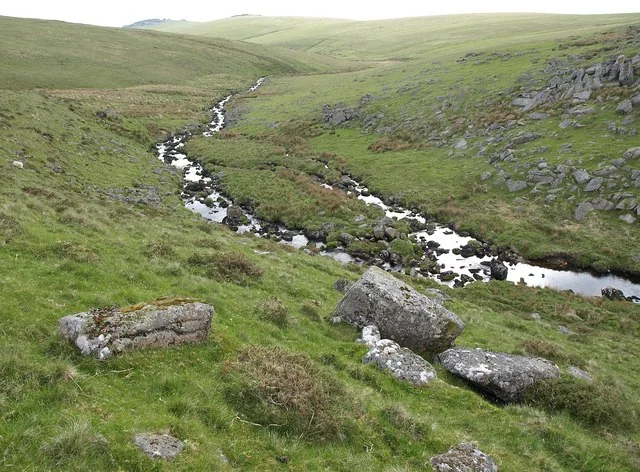
Main image: The River Walkham with a rocky slope and scattered outcrops above it, taken about 100 m from the Hemery site. It shows the setting; the caption does not name Clay Tor. Photo: Derek Harper (CC BY-SA 2.0) via Wikimedia Commons
Clay Tor is a name that Dartmoor writers have fixed on two different places, and not all of them agree there is a tor at all. This listing follows Eric Hemery and Tors of Dartmoor: scattered, split granite outcrops on the steep valley side above the River Walkham, at about 436 m in Peter Tavy parish. Hemery described a pile with no real summit, a core of solid rock and a large spread of loose blocks down its south-east slope. A tiny natural cavern on the south side has been built up a little to make a hiding place for a letterbox or similar cache. The site lies inside the Merrivale firing range.
The doubt starts with William Crossing. In his Guide to Dartmoor (1912) he named the pastures of Crowtorre and Claytorre, below Sandy Ford, and wrote that no tor exists there. Richard Hansford Worth (1953) said Clay Tor lacks a rocky crown. Terry Bound proposed a second site, almost a kilometre upstream beside the river at the foot of Cocks Hill (SX 5693 7810), a group of ruined boulders where a small plaque on a boulder remembers Bob Stewart, who died in 1994. Tim Jenkinson (1996) found Hemery's description vague but thought the site above was probably the one Hemery meant.
So the name is certain and the tor is not. Tors of Dartmoor lists both sites as plausible, and this listing gives the Hemery site because it is a real pile of rock that fits his description.
This is a location on Dartmoor that has a namesake. Read more about this: Dartmoor Places With the Same Name
Contact us if you have information about this listing
Dartefacts is a database of Dartmoor sites with far more close-up detail than we can show here, and it is the best place to go deeper. Dartefacts is free to use, and nobody has to pay to look things up. If you want more, a yearly subscription adds 10-figure grid references, map zoom down to 1:25,000 and lists to tick off the places you have visited, and it helps keep the site going. We would encourage you to subscribe.
Be the first to share a thought about Clay Tor.
Share a thoughtWhat year is the original motte-and-bailey structure of Lydford Castle thought to have been built?
Know another Dartmoor place, tor or landmark we should include? Suggest a listing, it is free.
Suggest a listing