

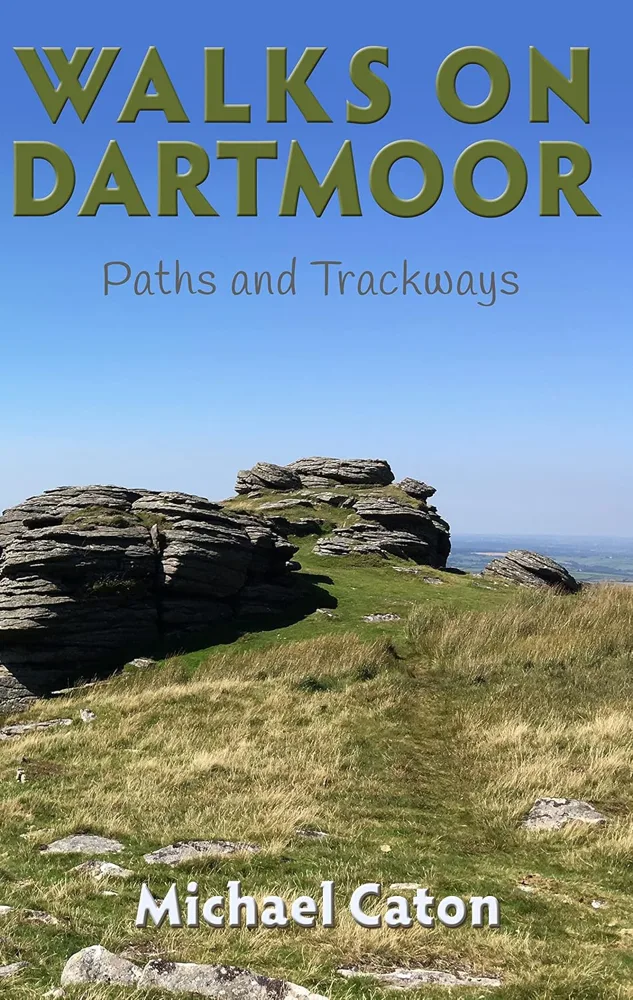
Walks on Dartmoor: Paths and Trackways is a 2018 guide by Michael Caton to 28 walks of 2 to 7½ miles on moorland paths and tracks, many of them missing from other guidebooks, drawing on his sixty years of walking Dartmoor. Michael Caton was a trustee of the Dartmoor Preservation Association. This review is by John Howell, Chairman of the DPA.
- Book
- Walks on Dartmoor: Paths and Trackways
- Author
- Michael Caton
- Published
- 2018 by Matador, 176 pages
- Walks
- 28 walks, 2 to 7½ miles, around the southern then the northern moor
- Reviewed by
- John Howell
Review: Walks on Dartmoor: Paths and Trackways by Michael Caton
Review by John Howell, Chairman of the Dartmoor Preservation Association.
When thinking about leading walks for the DPA it often becomes challenging to think of new ideas for walks which meet a range of walking abilities. I was recently visiting the DPA office and, without realising, picked up the wrong book to review. When sitting down to write my review I realised my error, but as I started to thumb through the book I recognised it was a forgotten and very useful resource.
Michael Caton was a DPA trustee, organised the DPA’s London Group, led walks and volunteered for many years. He was a lovely person to know and this book with twenty-eight walks, between two and seven miles, many of which are not included in other guidebooks, based on moorland paths and tracks, reflect his knowledge gained over sixty years of walking on Dartmoor.
There is a very interesting section on the Abbot’s Way or Jobber’s Road. Michael references the controversy over its origin, including the thoughts of Worth and Hemery, on whether its origin is a route across the moor used by monks. The first written reference to the route is by Andrews in 1794, over two hundred years after the dissolution. Hemery uses the alternative name Jobber’s Road, on the basis it was a trans moorland route for moving fleece, yarn and cloth across the moor, connection with the woollen industry based at Buckfastleigh.
The walks are arranged helpfully in an order around the southern and then the northern moor. The walks include details of starting points and a description of the landscape and features found within it. Whilst thumbing through the book I looked at some walks I am thinking of leading. One approaches Ryders Hill from Combestone Tor car park, and the walk includes sections two ancient routes. The first is the Cumston Road, which was used by farming communities to travel between Hexworthy to South Brent market and fairs. Another point of interest is Horn’s Cross which was one of a line of crosses marking the Monk’s Path or Maltern Way.
Another walk starting from Cross Furze, using the Abbot’s Way heading eastwards, crossing the Dean Burn, Lambs Down and Dean Moor to reach the Avon Dam. Michael recalls visiting this area in the 1950’s before the reservoir was filled, taking photographs of the fine tinners house with mould and mortar stones, a monastic settlement connected to the lay brothers from Buckfast Abbey, both excavated by Lady Aileen Fox, which become occasionally visible when the reservoir level drops in dry weather.
If you like to explore Dartmoor and need an excellent book to find some informative walks, then this is it. This was a pleasurable experience reading the book and next time I visit the DPA office, I will pick up the right book to review, written by his son Peter Caton, for the next Dartmoor Matters!
About Walks on Dartmoor: Paths and Trackways: where to buy or borrow it
The book is published by Matador, the self-publishing imprint of Troubador, and runs to 176 pages with photographs and walk maps sketched on the 1:25,000 OS map. Some of the walks are based on those Michael Caton led for the DPA. His son Peter Caton completed his unfinished book as My Father's Dartmoor.
Troubador (Matador) | Amazon.co.uk | Second-hand search links (book listing)
More on Our Dartmoor
- Michael Caton, the author
- Walks on Dartmoor: Paths and Trackways, the book
- Peter Caton, his son, author of My Father's Dartmoor
- Abbot's Way, the route discussed in the book
- Ryder's Hill, the start of one of the walks the reviewer plans to lead
- Avon Dam Reservoir, the reservoir covering the Dean Moor remains
- Dartmoor Preservation Association, the association Michael Caton served
- John Howell, the reviewer
Frequently asked questions
What is Walks on Dartmoor: Paths and Trackways?
Who was Michael Caton?
What does the book say about the Abbot's Way?
Which walks does the reviewer mention?
Where can I buy Walks on Dartmoor: Paths and Trackways?
Who wrote this review?
What is Our Dartmoor?
What else can I find on Our Dartmoor?
How can I contribute to Our Dartmoor?
Sources and further reading
- Walks on Dartmoor: Paths and Trackways at Troubador: the publisher's page
- Dartmoor Preservation Association: free guided walks and storywalks
- Peter Caton's website: Michael Caton's son and author of My Father's Dartmoor
Find out more about the Dartmoor Preservation Association and John Howell
- Dartmoor Preservation Association website: fighting to keep Dartmoor wild and free since 1883
- John Howell: his Our Dartmoor listing
