

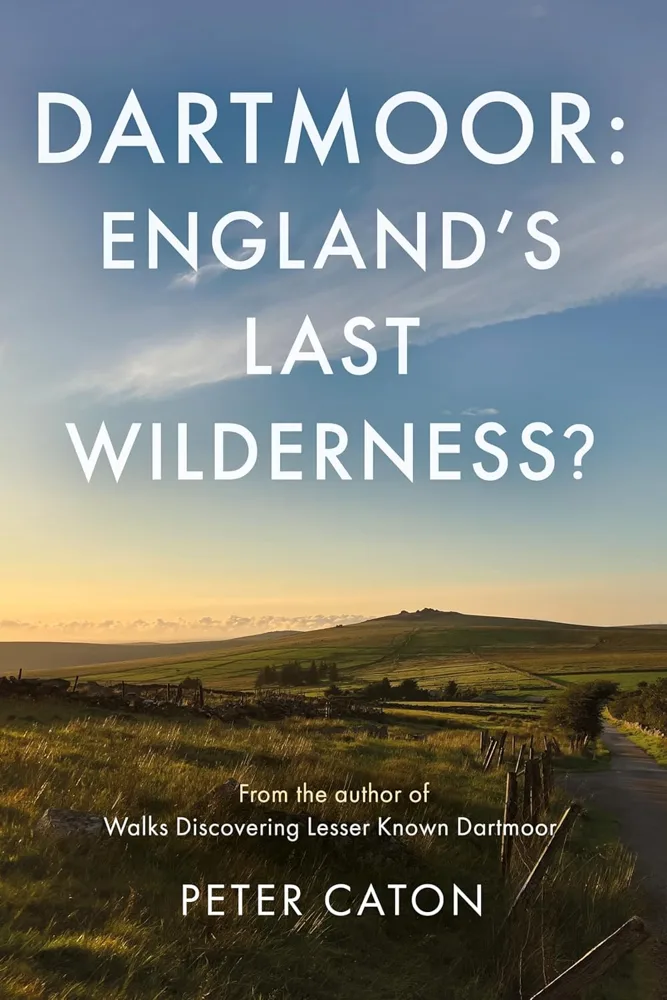
Dartmoor: England's Last Wilderness? is a 2024 book by Peter Caton that uses a series of themed walks to ask whether Dartmoor counts as a wilderness and, if so, whether it is England's last. It includes four chapters on campaigns to save the moor. This review is by John Howell, Chairman of the Dartmoor Preservation Association.
- Book
- Dartmoor: England's Last Wilderness?
- Author
- Peter Caton
- Published
- October 2024 by Troubador Publishing
- Subject
- Walks, history, legends, access, camping and rewilding on Dartmoor
- Reviewed by
- John Howell
Review: Dartmoor: England's Last Wilderness? by Peter Caton
Review by John Howell, Chairman of the Dartmoor Preservation Association.
I highly recommend Peter Caton’s latest book, which is well written and thought provoking. The book asks what defines a wilderness and should we consider Dartmoor as meeting this definition? Plus, if we think it does, do we consider it to be England’s last?
Many visitors to Dartmoor may only go to Widecombe or Haytor, which are beautiful, but maybe not as wild as could be imagined. If they subsequently visited the central northern or southern moor, they would discover areas which will seem a barren, featureless and may be seen as wilderness. However, this is far from the truth, it is a landscape which has been shaped by human hands from prehistoric times, there is of course the natural beauty of the hills, tors, rivers, woodlands and the farmed land. There are legends, some may contain elements of truth, all of which Peter describes as making Dartmoor ‘a unique and truly magical place, is somewhere I have come to know and love in almost sixty years of walking’.
The section on mishaps covers what must have been a frightening experience for Peter, surviving a heart attack near Kennon Hill, and on another walk suffering head injuries from a fall while crossing the Butter Brook on Harford Moor. These experiences and the lessons learned are clearly thought provoking for those who walk alone. It provides a challenge to my thinking, considering how I have objected to phone masts, someday in a crisis I could regret the inability to get a mobile signal.
This is followed by a series of chapters with fascinating walks exploring the landscape and the key themes. This includes an important section on four battles which the DPA fought to save Dartmoor. The Swincombe reservoir was considered in 1960/70’s as the greatest threat to Dartmoor, which was saved following a successful campaign led by Lady Sayer, the DPA and contributions by many other conservationists, including Kate Ashbrook, OSS and Ramblers. There is an excellent account of the unsuccessful campaign fought in the early 1960’s to oppose the creation of the Meldon Reservoir. Another interesting reflection is on the successful appeal, launched by the DPA in July 1964, to purchase High House Waste, to save it from commercial afforestation. The final campaign was a victory for the DPA, and other organisations and locals, in June 2001, when the china clay mining companies WBB and Imery announced they had given up their rights to work Area Y, part of the Blackabrook Valley and Shaugh Moor.
The final section of the book discusses wilderness, including access and rewilding, containing Peter’s views and those of many other contributors. The big debate remains; is Dartmoor a wilderness and if so, is it England’s last?
I am not going to spoil it by sharing these comments and observations, but I shall leave you to read the book and make your own mind up. In my view this is an impressive read, challenging and thought provoking, you will need to pick it up again every so often, to review your thinking.
John Howell
About Dartmoor: England's Last Wilderness?: where to buy or borrow it
Peter Caton is an author of walking and travel books who has walked on Dartmoor for almost sixty years. The book makes use of his father's sixty-year-old notebooks; his father, Michael Caton, wrote Walks on Dartmoor: Paths and Trackways, and Peter later completed My Father's Dartmoor from his father's unfinished work.
Swan Books (the author's shop) | Troubador | Second-hand search links (book listing)
More on Our Dartmoor
- Peter Caton, the author
- Dartmoor: England's Last Wilderness?, the book
- My Father's Dartmoor, Peter Caton's 2026 book about his father's Dartmoor
- Sylvia Sayer, led the campaign against the Swincombe reservoir
- River Swincombe, the valley the reservoir would have flooded
- Dartmoor Preservation Association, the association whose campaigns the book describes
- John Howell, the reviewer
Frequently asked questions
What is Dartmoor: England's Last Wilderness? about?
Which campaigns to save Dartmoor does the book describe?
Does the book say whether Dartmoor is a wilderness?
Who is Peter Caton?
Where can I buy Dartmoor: England's Last Wilderness?
Who wrote this review?
What is Our Dartmoor?
What else can I find on Our Dartmoor?
How can I contribute to Our Dartmoor?
Sources and further reading
- Peter Caton's website: the author's own site
- Dartmoor Preservation Association
- Meldon Reservoir: Wikipedia
- Open Spaces Society: the access campaigners also named in the review
Find out more about the Dartmoor Preservation Association and John Howell
- Dartmoor Preservation Association website: fighting to keep Dartmoor wild and free since 1883
- John Howell: his Our Dartmoor listing
