

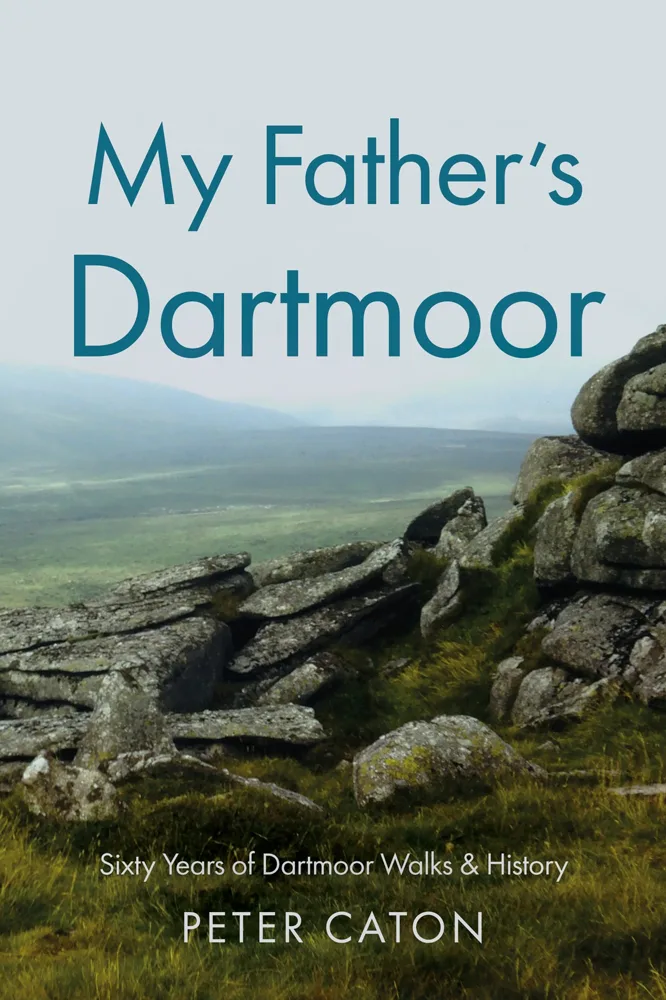
My Father's Dartmoor: Sixty Years of Dartmoor Walks & History is a 2026 book by Peter Caton celebrating the sixty years his father, Michael Caton, spent walking and campaigning on Dartmoor, with over 200 photographs going back to 1954, Dartmoor railway pictures and letters from Hansford Worth and Hemery. This review is by John Howell, Chairman of the Dartmoor Preservation Association.
- Book
- My Father's Dartmoor: Sixty Years of Dartmoor Walks & History
- Author
- Peter Caton
- About
- Michael Caton's sixty years of walking and campaigning on Dartmoor
- Published
- January 2026 by Troubador Publishing
- Reviewed by
- John Howell
Review: My Father's Dartmoor by Peter Caton
Review by John Howell, Chairman of the Dartmoor Preservation Association.
For anyone interested in exploring Dartmoor this book is a compelling read, a celebration of Michael Caton (Peter’s father) sixty years of walking Dartmoor, campaigning for Dartmoor, the DPA and, some additions to Dartmoor’s historical record.
Michael’s writing is set out in three parts. Part one, has eight chapters setting out the background to how he came to walk on Dartmoor, routes are described, with the addition of Peter’s recollections of family walks. Part two, has over 200 photographs some going back to 1954, and some comparative recent pictures taken by Peter, highlighting changes which have occurred.
Having first explored Dartmoor with my parents, using trains and buses, many of which are no longer available Peter’s book has revived many of my early memories. There is the shared love of trains and, my similar experiences of us as a family dashing to catch the last bus or train back. There is an overview of the history of the Dartmoor railway lines, trips on the trains and Michael’s collection of train tickets. Michael recounts some journeys, often in the final days of the lines, including being on the last train on the famous Princetown line.
Part three, the history section is fascinating. This includes letters and postcards, exchanged with Marjory Fielden, whom he described as a ‘little eccentric’ and ‘remarkable’ who inspired his love for Dartmoor. She suggested walks and provided information on things to be seen. By keeping her letters for seventy years, it is clear they kept alive memories and were special. There are also chapters on exchanged letters, on buildings and antiquities, with notable Dartmoor figures, including Hemery, Hansford Worth and Masson Phillips.
A photo of Michael’s taken in 1958 provided Peter with a mystery as to when Nun’s Cross Farm was abandoned. The historical sources provide a range of dates, Peter states ‘there is no criticism of the writers’, but it demonstrates that in historical research it can be difficult to obtain definitive answers and, how a primary source may not be correct, and then the error is spread through internet reference sources. There is also an account of Michael’s discovery in March 1985, of a cist with a retaining circle, on the southern slopes of Sittaford Tor, which seems to have gone unrecorded for many years.
There are also interesting chapters on the history and the occupiers of Huntingdon Warren, one of Dartmoor’s remotest houses. Of particular interest to me is Michael’s submission to The Sharp Inquiry 1975, written from the perspective of a Dartmoor walker, who did not live locally, residing in Essex at the time, who wanted to access and enjoy this special landscape. There is a reply from the then DPA Hon. Secretary where there is a paragraph which I feel remains relevant today; -
‘It is of course, extremely difficult in cases of so called ‘national interests’ to get the Minister to rightly assess the essential issues; and it is the National Park that nearly always suffers’.
The final chapter of the book considers how Dartmoor has changed. I found this book wonderfully captures Michael’s experiences of walking and campaigning on and for Dartmoor. It is a book that personally resonates with me due to my experiences of walking Dartmoor. So, for any Dartmoor explorer I would say it is a recommended read.
About My Father's Dartmoor: where to buy or borrow it
Peter Caton is an author of walking and travel books. My Father's Dartmoor completes the book his father could not finish: Part One has five chapters by Michael Caton about walks in the 1950s and 60s, Part Two has photographs from 1954 onwards compared with recent pictures, and Part Three is built around his Dartmoor letters and documents. The Dartefacts website notes that the book includes references to over 100 items in its Dartmoor database.
Swan Books (the author's shop) | Troubador | Second-hand search links (book listing)
More on Our Dartmoor
- Peter Caton, the author
- Michael Caton, the walker and campaigner the book celebrates
- My Father's Dartmoor, the book
- R. Hansford Worth, one of the Dartmoor figures Michael Caton wrote to
- Eric Hemery, another
- Nun's Cross Farm, the farm whose abandonment date is investigated
- Sittaford Tor, where Michael Caton found a cist in 1985
- Dartmoor Preservation Association, the association whose campaigns he supported
- John Howell, the reviewer
Frequently asked questions
What is My Father's Dartmoor?
What is in the history section?
What is the mystery of Nun's Cross Farm?
What did Michael Caton discover at Sittaford Tor?
Where can I buy My Father's Dartmoor?
Who wrote this review?
What is Our Dartmoor?
What else can I find on Our Dartmoor?
How can I contribute to Our Dartmoor?
Sources and further reading
- My Father's Dartmoor, by Peter Caton: Dartefacts, 24 February 2026
- My Father's Dartmoor on Peter Caton's website: the author's own page
- Dartmoor Preservation Association
Find out more about the Dartmoor Preservation Association and John Howell
- Dartmoor Preservation Association website: fighting to keep Dartmoor wild and free since 1883
- John Howell: his Our Dartmoor listing
