Cairn east of Ringmoor Cottage
A cairn 12 m across and 0.5 m high with a kerb 6 m across inside the mound, best preserved on the south side, on the brow of Ringmoor Down near the Eylesbarrow reave.
Showing listings tagged “Historic England” Show all listings
A cairn 12 m across and 0.5 m high with a kerb 6 m across inside the mound, best preserved on the south side, on the brow of Ringmoor Down near the Eylesbarrow reave.
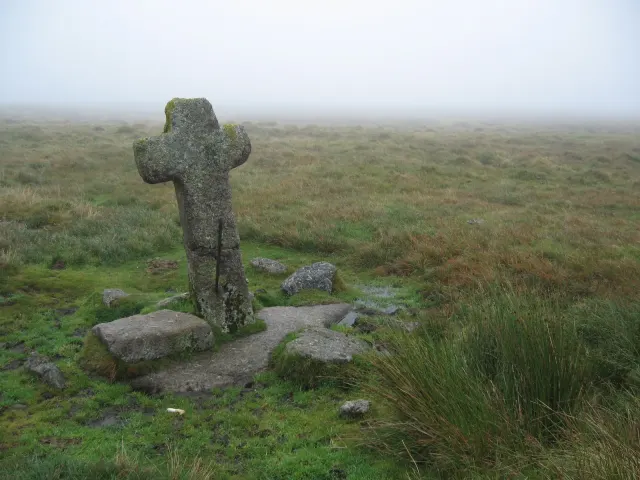
A Latin wayside cross 1.52 m high embedded in an earthfast rock and leaning 15 degrees, its shaft mended with iron bars, on Down Ridge above Holne Moor, known as Skir Cross.
A stony cairn 15 m across and 0.8 m high on Cocks Hill with a robbed hollow on two sides, a probable kerb on the north and a Second World War shell hole.
A 1.63 m medieval cross shaft set in a socket stone beside Walkhampton Church House, brought together in a 1984 restoration and given a new head in the 1990s.
Two concentric stone circles on the crest of Langstone Moor: an inner ring 20.4 m across with 16 stones, partly restored in 1894.
Thirty-one hut circles in an irregular field system with a length of the Walkhampton Common reave, an enclosure with two more huts, and a military shelter, on Leeden Tor's south-east slope.
An oval enclosure 55 m by 43 m with a double-faced wall and two hut circles, 8 m and 5.6 m across, one with a doorway facing west-south-west.
A stone hut circle 4 m across inside, with a south-facing doorway, at the edge of a settlement above Newleycombe Lake in an area worked for tin.
An agglomerated enclosure of two parts with six hut circles and a later shepherd's shelter on the south-east slope of Higher Tor above the Taw.
Photograph by Glavind Strachan Photography“Strangers who have never experienced a real Dartmoor mist are apt to imagine that a map and a compass are all that are required to enable one to make one's way across the trackless waste.”
Also on Our DartmoorDouble Waters — Where two rivers meet on the high moor, creating a confluence of water and wild landscape.