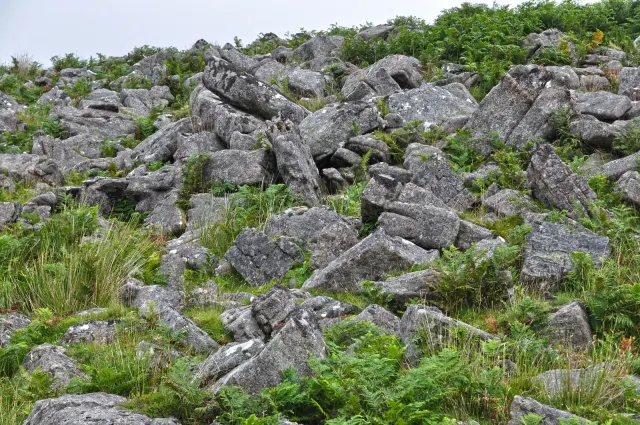
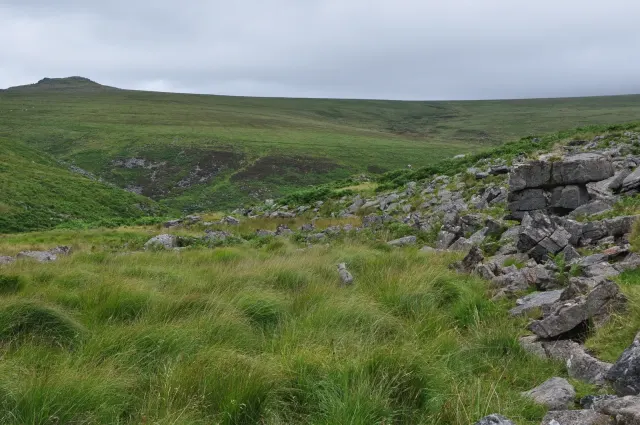
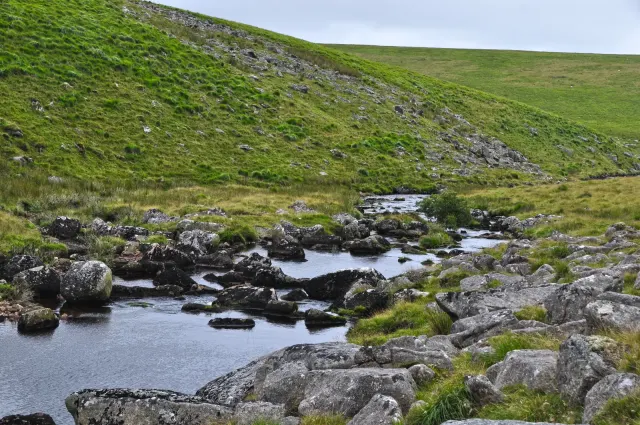
Vermin traps around Great Trowlesworthy Tor
Five scheduled vermin traps on Trowlesworthy Warren: drystone V, X and Y shaped walls built to funnel predators into a trap.
Dartmoor's archaeology and heritage - antiquities, historic buildings and museums.
Five scheduled vermin traps on Trowlesworthy Warren: drystone V, X and Y shaped walls built to funnel predators into a trap.
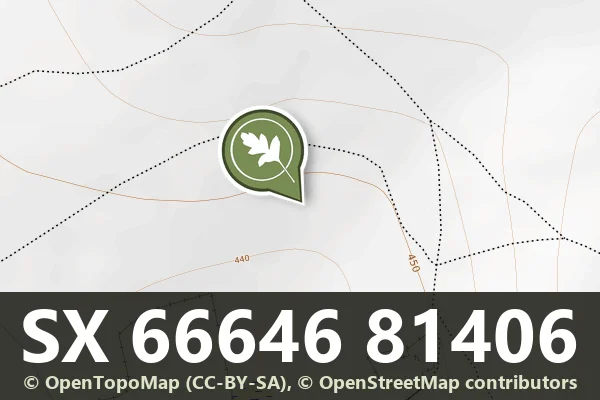
Seven scheduled vermin traps on Trowlesworthy Warren: drystone walls aimed at a gully, a boundary wall, the river or the china clay leat to funnel predators.
Two reaves on Walkhampton Common: 2 km of the straight central stretch of the Walkhampton Common reave and a 302 m cross reave, with two huts, a cairn and a 132 m stone row of 16 stones.
A hut circle settlement above the Walla Brook with 18 huts and an enclosure 19 m by 15 m, including three complex huts with a hooked porch and a courtyard, north-west of the Warren House Inn.
A pillow mound 29 m long, 6 m wide and 0.5 m high, with drystone walling on its east side, in Willings Walls Warren above Hentor Brook.
One of the largest unenclosed hut circle settlements on Dartmoor: dozens of stone huts on a south-facing slope above the River Tavy, dug by the Dartmoor Exploration Committee in 1905.
Eight hut circles and a medieval shieling at Watern Oke: seven of the huts had hearths in the 1905 dig, and the shieling, 7.4 m by 3 m, had a fireplace.
A hut circle 2.3 m across inside, which the excavators took for a cook-house, and a tinners' building 5.8 m by 3.2 m built on top of an earlier hut, at Watern Oke.
A Grade II* listed cottage with surviving garden boundary walls.