Dartmoor quiz
“Dartmoor soaked up this illumination like a sponge, and did not waken at its tepid touch.”
Who wrote this?


← Browse Standing Stones & Menhirs · Browse the directory
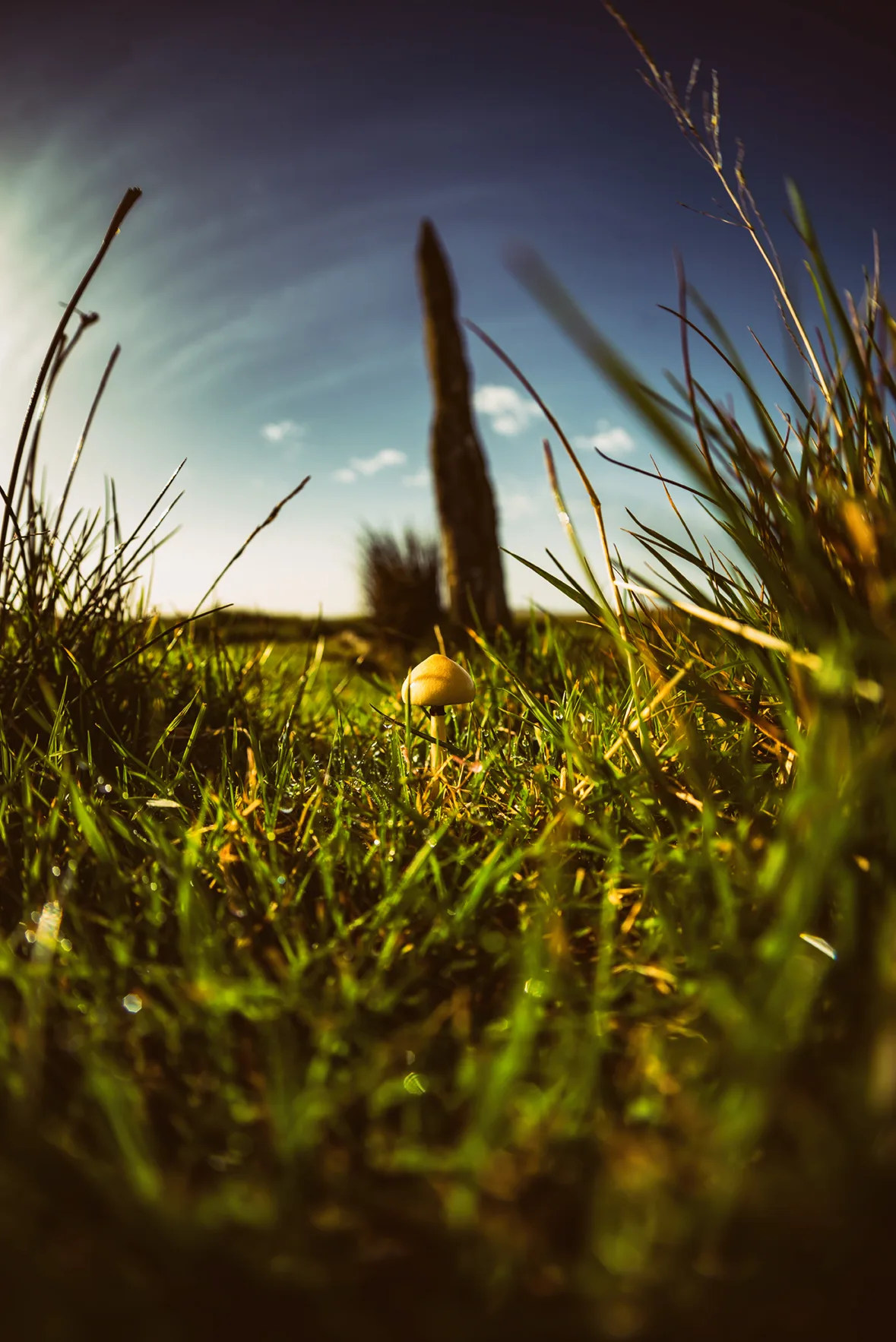
Main image: Photograph by Glavind Strachan Photography
Beardown Man is a single standing stone (menhir), on the high moorland near Devil's Tor and the head of the Cowsic River. At around 3.5 metres above ground, with more buried beneath the turf, it is the reportedly the second-tallest menhir on Dartmoor and stands at the highest altitude of any of them, 542 metres above sea level. It was probably raised in the Bronze Age, over 4,000 years ago.
R. Hansford Worth measured it for the Devonshire Association in 1940 and gave its height as 11 ft 4 in (3.45 m). Its width is about three times its thickness, so it looks very different from different sides: a thin needle from one, a broad slab from another. At ground level the four sides measure 3 ft, 1 ft 6 in, 2 ft 11 in and 11½ in, about 8 ft 4 in all round, which matches the “eight feet round” given by Mrs Bray (1836) and William Crossing (1914). The greatest width above ground is 3 ft 3 in and the thickness about 1 ft. It tapers only slightly towards the top. Worth placed it a little west of Devil's Tor, and noted a cairn about 270 yards to the south that he could not find mentioned before.
“Man” is the Dartmoor word for a standing stone. Bray, Rowe, Baring-Gould and Crossing took it from the Celtic maen, a stone. Worth (1953) found no other Celtic words alongside it and thought such stones are called “Man” because, seen against the skyline, they look like a figure. The Brays read “Bair-down” as the Welsh for the “hill of bards”; Worth preferred the Old English bearu, a grove, meaning the down opposite Wistman's Wood. A 1919 query in Devon and Cornwall Notes and Queries pointed out that Bairdown Tor is about two miles from the stone. The reply was that Rowe (1848) gives the name Bairdown Hill to the whole ridge, from Bairdown Tor to Lydford Tor and Devil's Tor, so the stone is on Bairdown Hill. Spellings vary: Beardown, Bear Down, Bair-down and Bairdown.
The Victoria County History of Devon (1906) says Beardown Man “is not associated with sepulchral remains”. Crossing could find no tradition about it either. The only story he had was one moorman's opinion that the pillar was the Devil, and that Devil's Tor “was plenty good enough vur he”.
In “The Bards of the Wood of Wistman”, a story in The Magic Mist, and other Dartmoor Legends (1901), Eva C. Rogers gives the stone an origin of her own: a pillar for a bard called Essára, known as “the stone of Essára” until the country people began to call it “the Bair-down Man”. It is fiction. The bardic setting was already in the guidebooks, since the Brays had named this hill the Hill of Bards. Mrs Bray (1836) describes the stone as the “Bair-down Man”, eleven feet high and eight feet round, and gives it no legend. Crossing, in his 1914 guide, thirteen years after Eva's book, still found no tradition at the stone. The article Looking for Eva follows how her legends spread.
Worth's appendix on Dartmoor and the Services, in the 1953 edition of his book, names Beardown Man among the monuments lying inside a battle-practice area. He wanted the menhir kept clear of machine-gun fire but doubted it could be for long, because the forces insisted on using menhirs as targets.
Suggest an edit to this listing
Contact us if you have information about this listing
Dartefacts is a database of Dartmoor sites with far more close-up detail than we can show here, and it is the best place to go deeper. Dartefacts is free to use, and nobody has to pay to look things up. If you want more, a yearly subscription adds 10-figure grid references, map zoom down to 1:25,000 and lists to tick off the places you have visited, and it helps keep the site going. We would encourage you to subscribe.
Photograph of this place: Beardown Man, Eventually. The photographer also runs Our Dartmoor, which has no funding and no adverts, so buying a print helps keep this site going.
Be the first to share a thought about Beardown Man.
Share a thought“Dartmoor soaked up this illumination like a sponge, and did not waken at its tepid touch.”
Who wrote this?
Know another Dartmoor place, tor or landmark we should include? Suggest a listing, it is free.
Suggest a listing