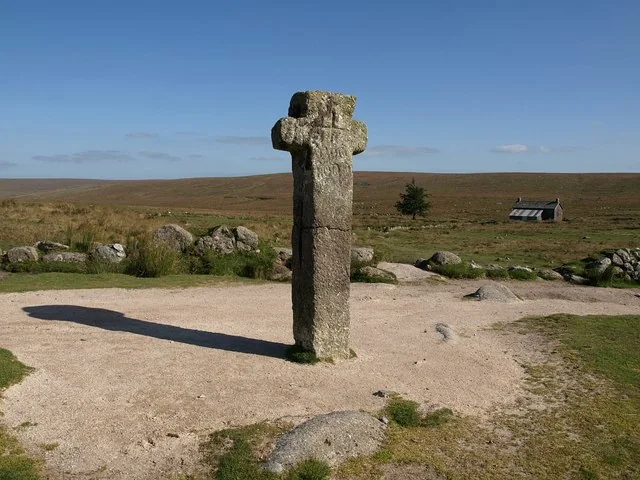
Beetor Cross: the site of a wayside cross near Beetor
The original site of Watching Place Cross, with an 18th-century granite waymarker lettered C, M and T for Chagford, Moreton and Tavistock.
Showing listings tagged “Stone crosses” Show all listings
The original site of Watching Place Cross, with an 18th-century granite waymarker lettered C, M and T for Chagford, Moreton and Tavistock.
Sourton Down Cross: a granite slab 2.13 m high with a Romano-Christian inscription, probably 6th century and reused as a wayside cross in the 14th or 15th century, with H, T, O and L letters for Hatherleigh, Tavistock, Okehampton and Launceston, moved in the 1980s.
A cross 1.62 m high on a stepped plinth outside the west gate of Sheepstor churchyard, restored in 1919 with new arms after use as a rubbing post; Grade II, also called Roman's Cross.
The 1.5 m shaft of a large medieval cross, with incised crosses and gate slots from its use as a gatepost, moved here about 1900; Grade II.
Horn's Cross: a socket stone 0.82 m by 0.89 m with a crude modern shaft 1.63 m high made after 1800 and an original head and arms, on Holne Moor.
A wayside cross, 1.4 m high, near the summit of Hameldown Tor, moved in 1854 to mark the boundary of Natsworthy Manor and cut HC DS 1854.
A restored wayside cross also called Roman's Cross, 1.79 m high on a circular socket stone, beside the old road between Lee Moor House and Cadover Bridge; the shaft was probably a window sill.
Dartmoor's largest wayside cross, 2.07 m tall, called Siward's Cross in the 1240 bounds and Nun's Cross by 1699, at a meeting of old moorland tracks.
A 13th-century wayside cross, 1.6 m high, at a fork in the road at Ouldsbroom, moved to Town Farm about 1825 and put back about 1957.
Photograph by Glavind Strachan Photography“Dreary, in one sense, they may be, but they yet influence and attract, for here we behold nature in her most wild form.”
Also on Our DartmoorEylesbarrow reave, two enclosures and seven hut circles — Two enclosures with huts, 65 by 55 m with two huts and 142 by 112 m with five, joined to the Eylesbarrow reave, with 340 m of the reave and a dry tinners' leat.