Skir Cross, Down Ridge
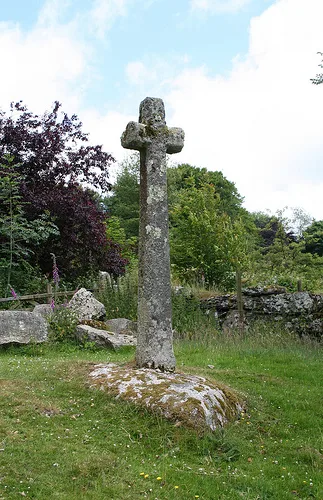
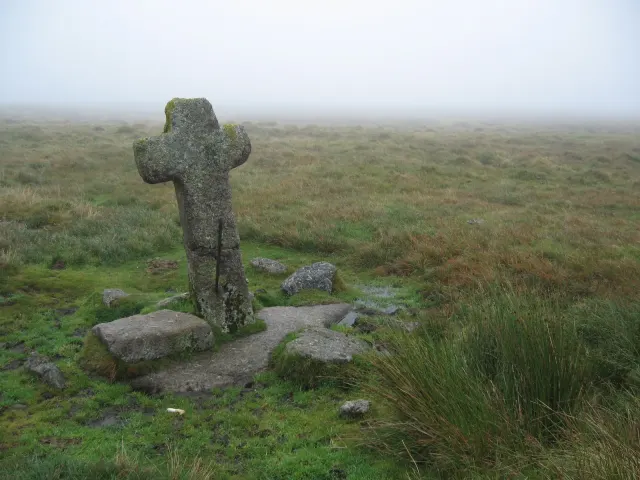
A Latin wayside cross 1.52 m high embedded in an earthfast rock and leaning 15 degrees, its shaft mended with iron bars, on Down Ridge above Holne Moor, known as Skir Cross.
Showing listings tagged “Stone crosses” Show all listings
A Latin wayside cross 1.52 m high embedded in an earthfast rock and leaning 15 degrees, its shaft mended with iron bars, on Down Ridge above Holne Moor, known as Skir Cross.

A medieval cross head 0.5 m high on a modern shaft set up in 1952, 120 m north of the old track between the Buckfast and Tavistock abbeys, above Newleycombe Lake.

Which Dartmoor place is this?
A 1.63 m medieval cross shaft set in a socket stone beside Walkhampton Church House, brought together in a 1984 restoration and given a new head in the 1990s.
A tall slender Latin cross, 2.3 m high, set in a boulder on the village green at Sampford Spiney, moved there from a hedge and listed Grade II.
A 2 m granite cross, leaning west, on the col between the Walkham and Tavy valleys beside the Grimstone and Sortridge leat, on the medieval route east from Tavistock.
A medieval cross head 0.6 m high on a 1.3 m modern shaft in its original square socket stone, 40 m south of the old track between Buckfast and Tavistock abbeys.
A wayside cross, 1.7 m high, on the western slopes of Ter Hill, thought to mark where the Abbots' Way and the Sandy Way met.
Moretonhampstead village cross: an octagonal pedestal 3.2 m across and 0.6 m high outside St Andrew's churchyard, with an old cross head set upside down on it and a lost shaft.
A medieval wayside cross standing on Wigford Down, near Cadover Bridge, marking an old route across the moor.
Plate from A Hundred Years on Dartmoor, page 95, 1901“It came with the wind through the silence of the night, a long, deep mutter, then a rising howl, and then the sad moan in which it died away.”
Also on Our DartmoorWhittenknowles Settlement — Bronze Age settlement among Dartmoor's high moorland, where ancient stone foundations still mark the hillside.