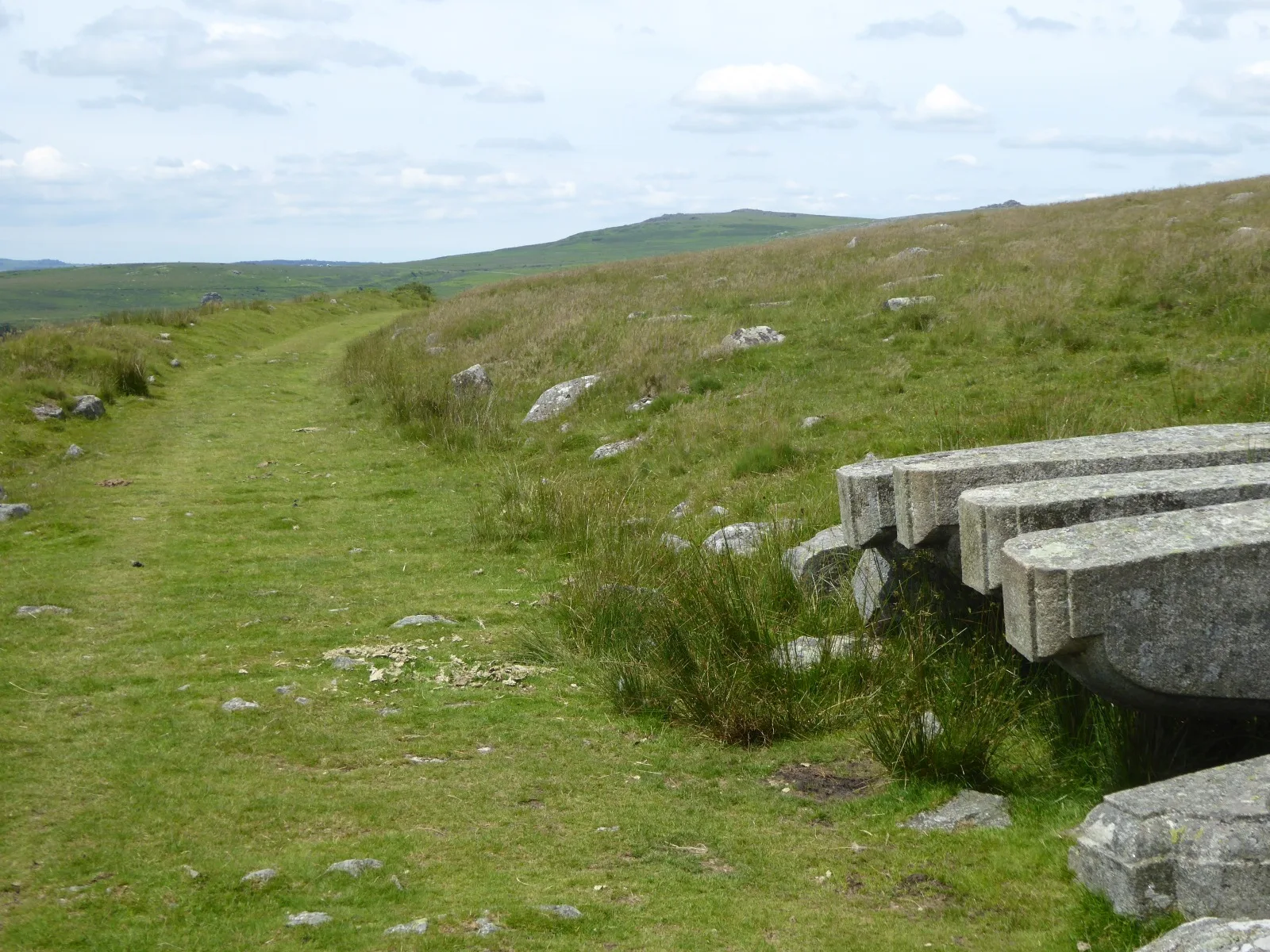
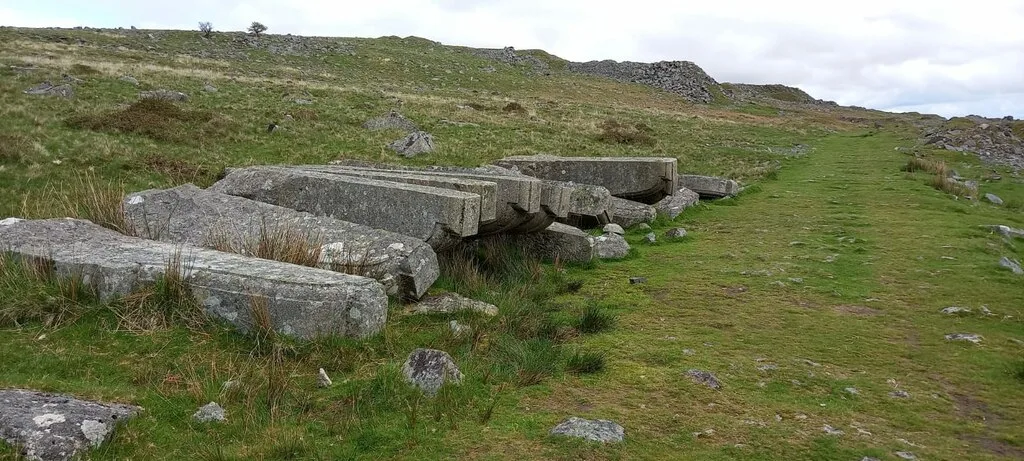
Where: beside the old railway siding into Swelltor Quarry, SX 5559 7341
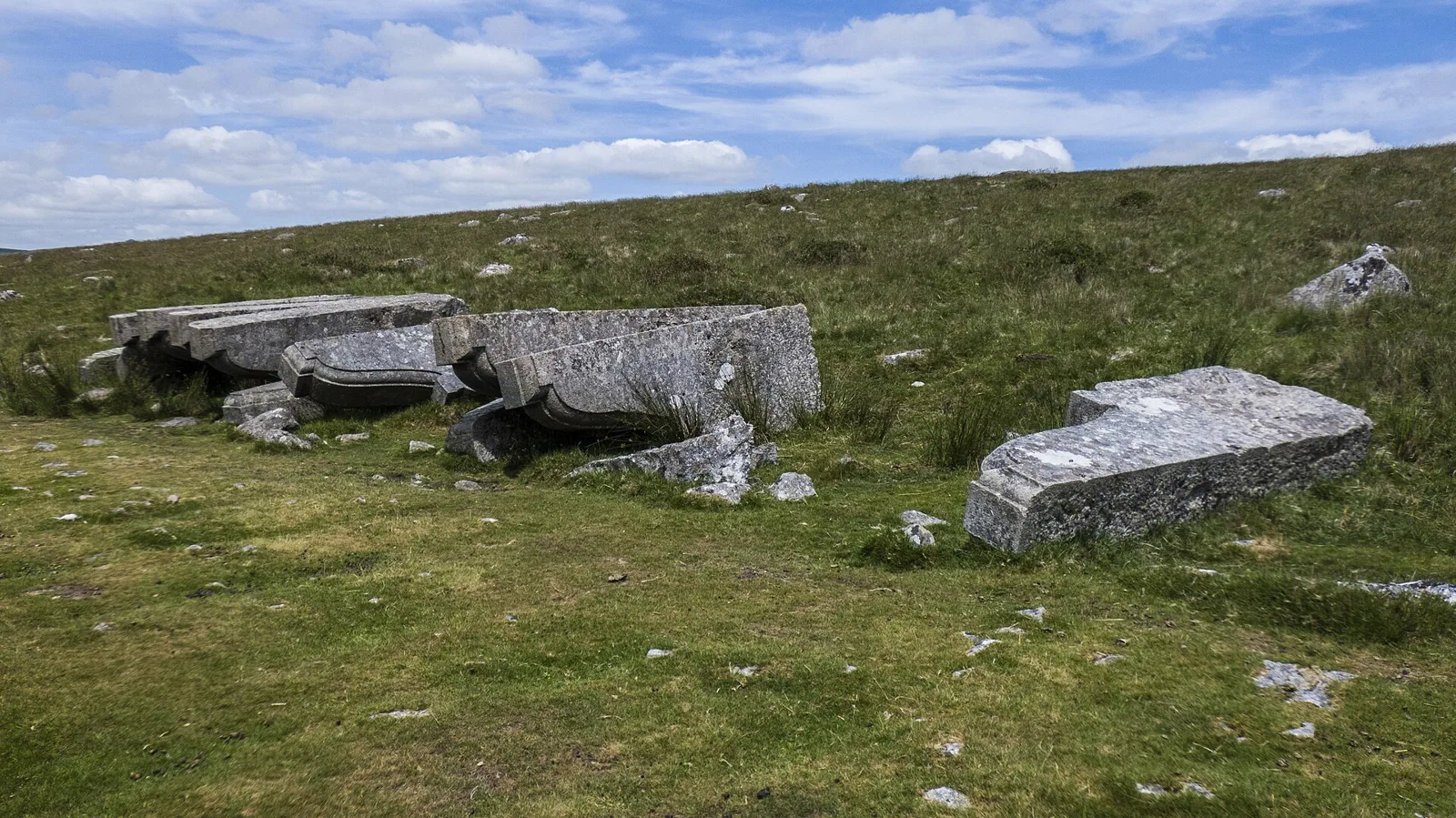
What: large dressed granite corbels, the projecting supports for a widened pavement
Number: 12 or 13, depending on the source
Made for: the widening of London Bridge in the early 1900s
These granite blocks lie beside the siding that led into Swelltor Quarries. They are corbels, cut to project from the sides of London Bridge and carry wider pavements. The bridge being widened was John Rennie's, opened in 1831.
When were they cut?
The sources do not agree. Dartmoor CAM says 650 corbels were cut in 1903, and Dartmoor Explorations dates the twelve left here to the widening of 1903 to 1904. Dark Skies on the Moor says they were worked from stone brought down by a blast of nearly 1,600 tonnes in March 1903. The 1977 edition of Dartmoor: A New Study puts the work in the late 1890s.
How many are there?
Dartmoor CAM and Dartmoor Explorations give twelve, and Dartmoor: A New Study says about a dozen. Dark Skies on the Moor counts thirteen.
Why were they left behind?
Dartmoor Explorations reports two explanations: that the stones were condemned for iron marks, as told by the late blacksmith, or that they were cut too short. It also records the view that they were simply spares. Dartmoor CAM cites Hallett, Brewer and Hemery on the question of short length or iron staining. Dark Skies on the Moor says they were apparently too short, and Dartmoor: A New Study calls them surplus.
How big are they?
Kath Brewer, quoting the Stone Trades Journal of January 1904, gives each as 10 feet long, 3½ feet deep and on average 1 foot 6 inches wide. Eric Hemery gives 9 feet 6½ inches long, 1 foot 3½ inches wide and 3 feet 7 inches high. The writer of the Dartmoor CAM page measured five at 109 to 110 inches long. Both sets of book figures are as quoted by Dartmoor CAM.
Did any go to Arizona?
Rennie's bridge was sold in the late 1960s (Legendary Dartmoor gives 1967, Dartmoor Explorations 1968) and rebuilt at Lake Havasu City. Legendary Dartmoor, citing Mike Brown, says corbels damaged in the move were replaced with spares from near Swell Tor. Dartmoor Explorations says it is believed that there were once more at the sidings, and that some went to Arizona in 1971. Legendary Dartmoor also weighs whether the stone came from Foggintor or Swell Tor, and concludes Swell Tor.
Dartefacts is a database of Dartmoor sites with far more close-up detail than we can show here, and it is the best place to go deeper. Dartefacts is free to use, and nobody has to pay to look things up. If you want more, a yearly subscription adds 10-figure grid references, map zoom down to 1:25,000 and lists to tick off the places you have visited, and it helps keep the site going. We would encourage you to subscribe.
Our Dartmoor doesn't track you and runs no adverts. We use one cookie to make the
site work, and some pages load videos, maps or optional social media panels from other sites, the panels only if you choose to show them.