Skip to content

← Browse Explore

Crosses

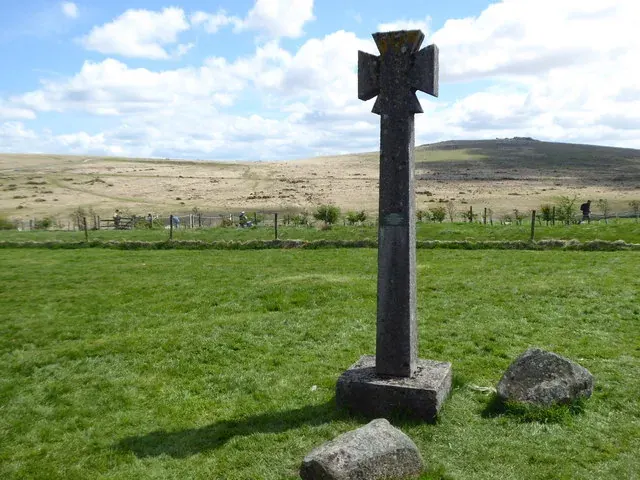
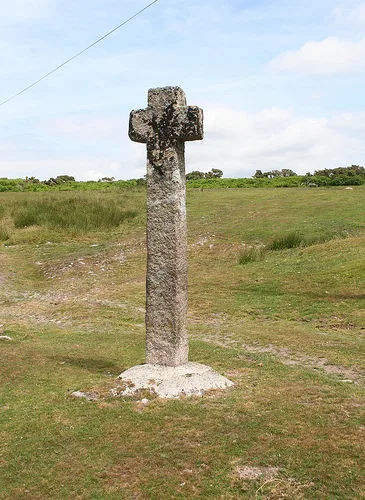
Dartmoor has more stone crosses than most people expect. Harrison counted 132 within the National Park boundary, and Wikipedia's article on the subject repeats that figure. They were put up over a long stretch of time, the earliest probably almost 1,000 years ago and some as recently as 100 years ago. The moor has no tidy count: the Dartmoor Crosses site started out in 2000 aiming to document 150, posted its 200th page in May 2021, and says new discoveries are still occasionally made.

They were not all put up for the same reason. William Crossing, in his 1902 book, wrote that on the open moor crosses were set up either to mark a boundary or as guides to the wayfarer, while market crosses and churchyard crosses belong to the villages around it. Often it is both, and sometimes nobody can say which came first. Crossing could not decide whether Bennett's Cross was meant to mark a boundary or the path, and thought it probably did both.

A few of the best known, each with its own listing:

  • Siward's or Nun's Cross: the oldest recorded, named in the 1240 perambulation of the Forest of Dartmoor as Crucem Sywardi. It stands about 2.07 metres high and is inscribed "Syward" on one face and "BocLonD" (Buckland) on the other.
  • Bennett's Cross: named in a deposition of 1702, with "WB" cut on it for Warren Bounds, the edge of Headland Warren. Nobody knows who Bennett was.
  • Hobajon's Cross: a boundary mark for the manor of Ermington. Crossing found a mutilated cross head on Three Barrows, and the name still attached to a heap of stones near the hill top. How the head came to be damaged, he wrote, is impossible to say.

Many listings below carry Historic England list entry numbers, so some are named by distance from a landmark rather than by a local name.

Share
View on map
Sourton Down Cross near Aliceford Farm
Crosses

Sourton Down Cross near Aliceford Farm

Sourton Down Cross: a granite slab 2.13 m high with a Romano-Christian inscription, probably 6th century and reused as a wayside cross in the 14th or 15th century, with H, T, O and L letters for Hatherleigh, Tavistock, Okehampton and Launceston, moved in the 1980s.
South Zeal Village Cross
Crosses

South Zeal Village Cross

South Zeal

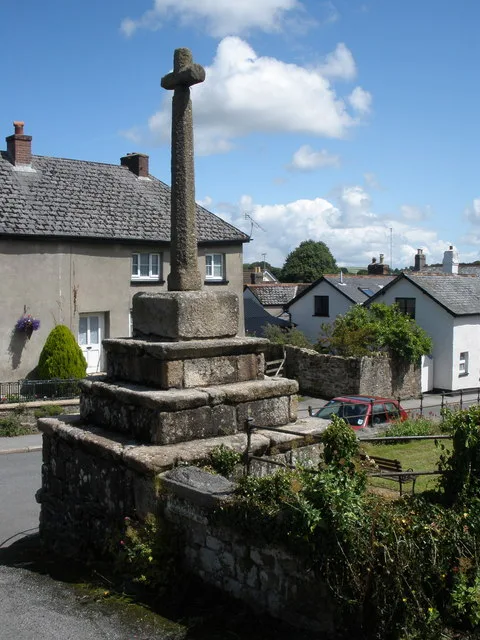
A late medieval granite village cross on a three-step plinth beside St Mary's Chapel in South Zeal, listed Grade II*.

St Gudula's Cross
Crosses

St Gudula's Cross

Dolbeare, Ashburton

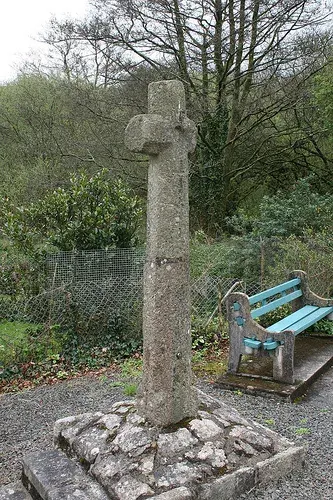
A medieval wayside cross on Dartmoor, likely marking a route or parish boundary in the open moorland.

Stone cross on Ter Hill
Crosses

Stone cross on Ter Hill

A socket stone on Ter Hill holding a replica cross; the original, repaired in 1885, is now in the High Moorland Visitor Centre at Princetown.

Ten Tors Cross (Okehampton Camp)
Crosses

Ten Tors Cross (Okehampton Camp)

Okehampton

A concrete Maltese-style memorial cross inside Okehampton Camp, given to the Royal Signals in 1960 and moved here in 1971 from the first Ten Tors base at Denbury.

Urgles Cross (Wigford Down)
Crosses

Urgles Cross (Wigford Down)

Meavy

A modern wayside cross on a tall shaft at the edge of Wigford Down, replacing a lost medieval cross whose base lay by the road opposite Urgles Farm.

Village cross, Moretonhampstead
Crosses

Village cross, Moretonhampstead

Moretonhampstead village cross: an octagonal pedestal 3.2 m across and 0.6 m high outside St Andrew's churchyard, with an old cross head set upside down on it and a lost shaft.

Walkhampton Church House cross
Crosses

Walkhampton Church House cross

A 1.63 m medieval cross shaft set in a socket stone beside Walkhampton Church House, brought together in a 1984 restoration and given a new head in the 1990s.

Watching Place Cross
Crosses

Watching Place Cross

A short-armed medieval cross, 1.44 m high, at the junction of the B3212 and the B3344, moved here in 1899 after serving as a gatepost; HE notes it may be a Christianised standing stone.

A close-up photograph from DartmoorPhotograph by Glavind Strachan Photography

“Therefore the little river divides and leaps and tumbles foaming over the mossy granite, or creeps beneath the boulders by invisible ways.”

Also on Our DartmoorWesternmost of four cairns — An oval cairn, 4.5 m by 3 m, the westernmost of four cairns in a cairnfield of 26 mounds above Lydford village.