Skip to content

← Browse Explore

Crosses

Dartmoor has more stone crosses than most people expect. Harrison counted 132 within the National Park boundary, and Wikipedia's article on the subject repeats that figure. They were put up over a long stretch of time, the earliest probably almost 1,000 years ago and some as recently as 100 years ago. The moor has no tidy count: the Dartmoor Crosses site started out in 2000 aiming to document 150, posted its 200th page in May 2021, and says new discoveries are still occasionally made.

They were not all put up for the same reason. William Crossing, in his 1902 book, wrote that on the open moor crosses were set up either to mark a boundary or as guides to the wayfarer, while market crosses and churchyard crosses belong to the villages around it. Often it is both, and sometimes nobody can say which came first. Crossing could not decide whether Bennett's Cross was meant to mark a boundary or the path, and thought it probably did both.

A few of the best known, each with its own listing:

  • Siward's or Nun's Cross: the oldest recorded, named in the 1240 perambulation of the Forest of Dartmoor as Crucem Sywardi. It stands about 2.07 metres high and is inscribed "Syward" on one face and "BocLonD" (Buckland) on the other.
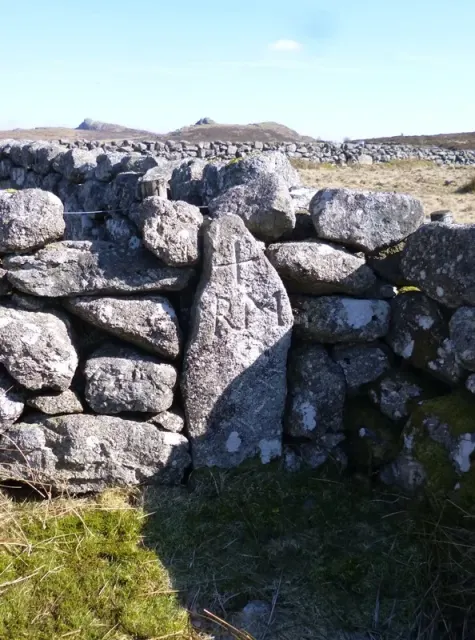
  • Bennett's Cross: named in a deposition of 1702, with "WB" cut on it for Warren Bounds, the edge of Headland Warren. Nobody knows who Bennett was.
  • Hobajon's Cross: a boundary mark for the manor of Ermington. Crossing found a mutilated cross head on Three Barrows, and the name still attached to a heap of stones near the hill top. How the head came to be damaged, he wrote, is impossible to say.

Many listings below carry Historic England list entry numbers, so some are named by distance from a landmark rather than by a local name.

Share
View on map
Dartmoor quiz

Which Dartmoor place has also been known as "Big Tip"?

Foggintor Quarry. The quarry closed in the early twentieth century, leaving the flooded pit, cut faces and spoil heaps seen today, including the huge waste tip known locally as Big Tip.

Worth a visit
Dartmoor Illustrated, page 166Plate from Dartmoor Illustrated, page 166, 1900

“One day two parsons started forth To walk to Cranmere Pool, The weather was not really hot, Nor was it very cool. They walked and talked for hours and hours As only parsons can, Until it seemed as though they'd trudged From Beersheba to Dan. At last they reached the pool and Lo! With ...”

Also on Our DartmoorBlank boundstone No.01, Sourton Tors Ice Works — An uninscribed granite boundstone on the slope east of the Sourton Tors Ice Works, the first of five blank stones recorded around the site.