

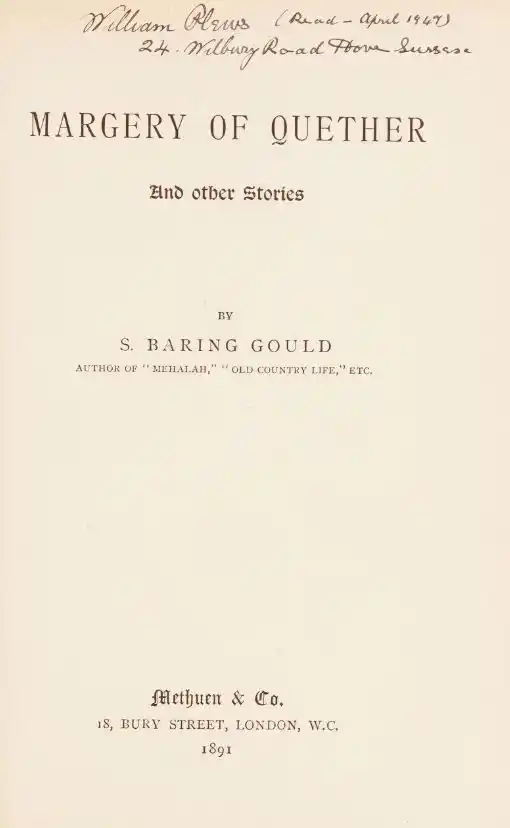
Margery of Quether
First serialised in the Cornhill Magazine in 1884 by Sabine Baring-Gould, then collected in Margery of Quether and Other Stories (Methuen, 1891), this Sabine Baring-Gould novella predates Bram Stoker's Dracula (1897) by over a decade and is now anthologised alongside it as an early example of English vampire fiction (Vintage Vampire Stories, Skyhorse Publishing, 2011).
Unlike much of Baring-Gould's Dartmoor writing, the setting is not disguised. The narrator, George Rosedhu, describes his home ground in unmistakable, real detail: "at the very highest point of the moor an extinct volcanic cone protrudes... This is called Brentor, and it is crowned with a church... dedicated to St. Michael" - and he recounts the same devil-and-archangel legend still told at Brent Tor today, of the devil hurling a rock from behind Cox Tor that still bears "the marks of the horns."
Sent to ring the church bells alone at midnight on Christmas Eve, Rosedhu meets a creature "of the size of a three months old baby," bat-like and leathery, who names herself Margery Palmer of Quether and claims to have lived in the bell tower "these hundreds of years." She fastens onto him by a single tooth "driven into my chest like the proboscis of a mosquito," and Baring-Gould is direct about what happens next: "I would not have you suppose that Margery was sucking my blood. Nothing of the sort... But she really did, in some marvellous manner, to me quite inexplicable, extract life and health, the blood from my veins and the marrow from my bones, and assimilate them herself."
Whether Stoker ever read this story is not established - the only documented link is that a Daily Mail review of Dracula on 1 June 1897 mentioned Margery as a comparable earlier work. That is a contemporary reviewer noticing a resemblance, not evidence Stoker drew on it directly. His confirmed source for physical details of Count Dracula is Baring-Gould's earlier, non-fiction The Book of Were-Wolves (1865) - see that listing for the specific borrowed passage.
Sources: text verified directly against the 1891 first collected edition (Internet Archive scan); publication history via ISFDB.
Thoughts
Be the first to share a thought about Margery of Quether.
Share a thoughtKnow a Dartmoor book or author we have missed? Suggest a listing, it is free.
Suggest a listing