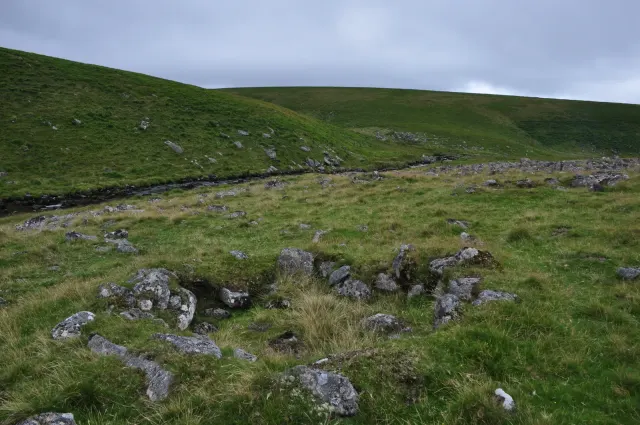
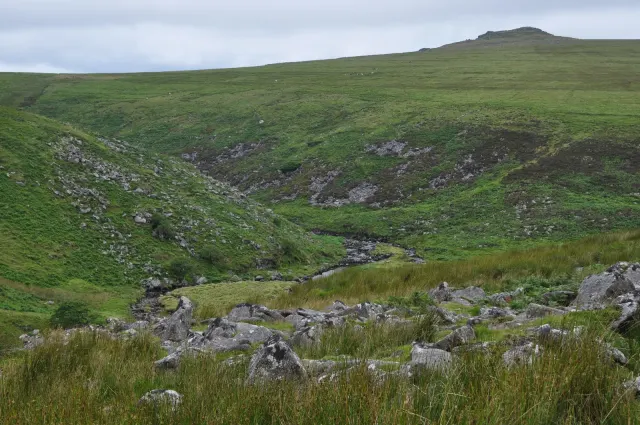
Watern Oke: ten hut circles
Ten huts at Watern Oke, six round, three oval and one two-roomed, dug in 1905 and yielding charcoal, cooking stones, sling and rubbing stones, pottery and flint.
Dartmoor's archaeology and heritage - antiquities, historic buildings and museums.
Ten huts at Watern Oke, six round, three oval and one two-roomed, dug in 1905 and yielding charcoal, cooking stones, sling and rubbing stones, pottery and flint.
The northernmost hut at Watern Oke, a small oval hut of single upright stones, 1.7 m by 1.3 m inside, with an east door and a bench found in the excavation.
A wayside cross, 1.7 m high, on the western slopes of Ter Hill, thought to mark where the Abbots' Way and the Sandy Way met.
A 14th-century type cross head on a modern 1.8 m octagonal shaft, restored in 1914, 20 m south of the old track between Buckfast and Tavistock abbeys.
A medieval wayside cross on Shaden Moor with a restored lower shaft, thought to mark the route from Plympton Priory to Sampford Spiney.
A Latin wayside cross 1.06 m high, concreted into a cleft in a granite rock and broken in two and held with iron bars, on Down Ridge above Holne Moor, locally Horse Ford Cross.
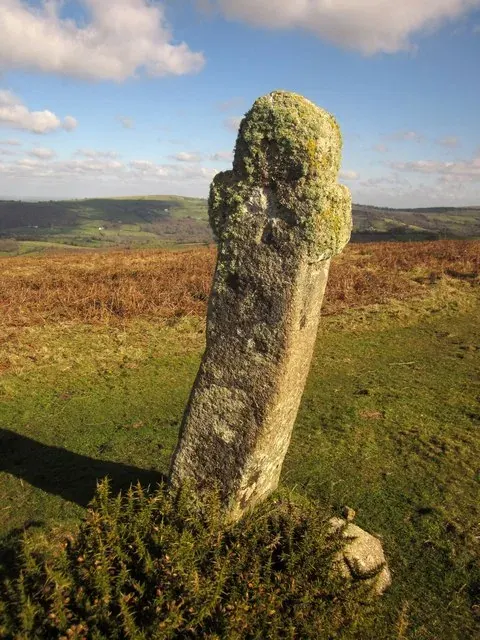
A 2 m stumpy-armed cross, leaning south-west, on open ground above a minor road with wide views, with a rounded head and the letters IA cut on one face; moved in 1867.
Chagford
A scheduled medieval wayside cross of one piece of granite with very short arms, leaning on Week Down above Chagford.
A Grade II* listed farmhouse on the Dartmoor landscape, likely medieval or early modern in origin.
Photograph by Glavind Strachan Photography“Nor can imagination body forth a place more congenial to the sights and sounds of dark and blood-stained rites, than this dreary, narrow, rock-strewn glen of the Dart.”
Also on Our DartmoorGutter Tor Cross (unfinished, near the longhouse) — A recumbent, probably unfinished granite cross lying by the path up Gutter Tor, close to a ruined medieval farmstead.