

← Browse Tors & Landmarks · Browse the directory
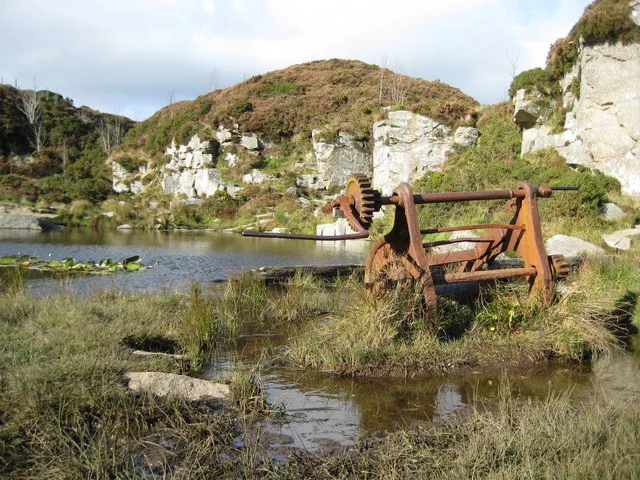
The Haytor Quarries are a group of five disused granite workings on the eastern side of Dartmoor: Haytor (Main), Holwell, Rubble Heap, Harrow Barrow (Emsworthy East) and Western (Emsworthy West). They are distinct both from Haytor Rocks, the tor itself, and from the Haytor Granite Tramway that carried their stone away. Quarrying began around 1820 under George Templer, who also built the tramway and the Stover Canal to move the granite to the coast.
Stone cut here supplied the new London Bridge, completed in 1831, travelling down the tramway and along the Stover Canal to Teignmouth for shipment. The quarries fell largely idle between 1841 and 1851, had a brief revival through the 1850s, and closed for good in 1858 as cheaper Cornish granite took the market. What remains today includes the flooded main pit, with surviving quarrying winding gear still visible at its edge.
Contact us if you have information about this listing
Go deeper with Dartefacts
Dartefacts is a database of Dartmoor sites with far more close-up detail than we can show here, and it is the best place to go deeper. Dartefacts is free to use, and nobody has to pay to look things up. If you want more, a yearly subscription adds 10-figure grid references, map zoom down to 1:25,000 and lists to tick off the places you have visited, and it helps keep the site going. We would encourage you to subscribe.
More Dartmoor resources
Thoughts
Be the first to share a thought about Haytor Quarries.
Share a thought Photograph by Glavind Strachan Photography
“The fogs are most deceptive and very tricky. They come on unexpectedly, and change the whole aspect of the surroundings. They magnify all things ; hills comparatively small appear as high mountains, and a small bird like a snipe looks as big as a pigeon.”
Also on Our DartmoorSettlement remains around Trowlesworthy Warren House — Five scheduled monuments east of Trowlesworthy Warren House: two hut circle settlements, an enclosure, a cairn with a cist and a V-shaped gully.
Know another Dartmoor place, tor or landmark we should include? Suggest a listing, it is free.
Suggest a listing