

← Browse Other Heritage Sites · Browse the directory
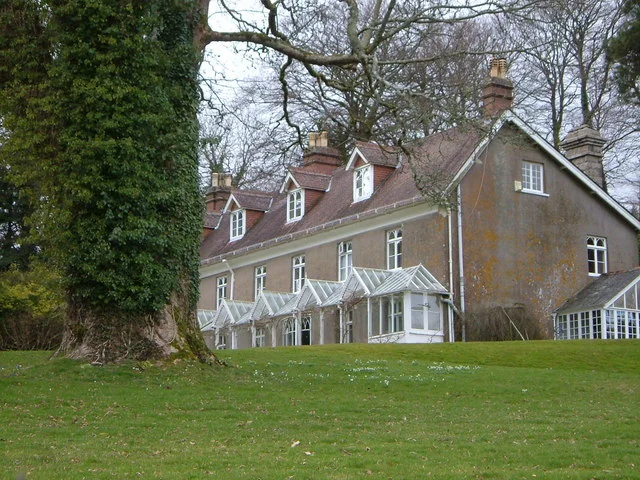
Main image: Photo: Derek Harper (CC BY-SA 2.0) via Geograph (geograph.org.uk/photo/132518). The front of Spitchwick Manor seen across the lawn, from the east.
Spitchwick is a manor and private estate on the River Dart in the parish of Widecombe, between Poundsgate and the moor above Bel Tor. Its history runs from a manor in Domesday Book, and a medieval family named after it, to a long lawsuit over the will of a Georgian clergyman, a siege of the house by a claimant and about two hundred men in 1849, and the drive that a Victorian doctor had cut round the hillside. The house and grounds are private and are not open to visitors.
- Where: On the River Dart above Poundsgate, in Widecombe parish (grid reference about SX 709 726)
- Status: Private house and estate with a working farm and about 2,230 acres of Spitchwick Commons; the two lodges are Grade II listed
- Domesday: Espice Wita (Spicewite), formerly held by Harold
- Lords of the manor: Bourchiers (Earls of Bath), the Wotton family, John Dunning (lease, from about 1769), Cresswell and Fry (reversion, 1845), Dr Thomas Blackall (1867), F. P. T. Struben (1901), the Simpson family (1934)
A Domesday manor, a family and a chapel
Domesday Book (1086) lists the place as Espice Wita, formerly held by Harold. A family took its name from it. In 1166 a Michael de Spichewic held it of William de Chirci, and he and his son Thomas witnessed deeds between 1176 and 1187. Another Michael de Spichwyke was in possession in 1248 and 1257, and a William de Spychwike witnessed deeds in 1273 and 1281. In 1280 Michael de Spichewyk held one fee here of the Honour of Stoke Curcy, and in 1285 and 1303 a Michael held it, dying in possession in 1305. In 1346 yet another Michael de Spychwike held it. By 1420 Fulk Fitz Warin had died holding the manor as part of the manor of Stoke Curcy, and in 1428 it was held in shares by Richard Hankford, William Grendon, John Kater, Roger Courteys, Thomas Attewode, John Colleton and John Gary the younger. These records are gathered in the Devonshire Association's study of the Hundred of Haytor in the "Testa de Nevil" period (Transactions, volume 40). Writing in 1875, Worthy noted that the lords of the manor were said to have had the power of capital punishment. The Dartmoor Society, visiting in 2013, was told the same. There was a chapel of St Leonard at Spitchwick, and a field behind the house is still called Chapel Park. John Dunning built his mansion on or near its site, and Dr Blackall later set a piece of window tracery from the chapel into the stable gable.
A will, a lease and a century of lawyers
The Rev. John Wotton made his will on 27 October 1746 and died on 5 November. It left the Widecombe, Holne, Ashburton and Totnes estates to trustees for 99 years, to raise £2,000 for his infant daughter Anna Maria, and then to his brother Richard, Richard's son Samuel and Samuel's heirs. A Chancery suit followed, and Dymond records that at one time at least ten suits were running together. Samuel Wotton died unmarried in 1780.
John Dunning
In about 1769 the Ashburton-born lawyer John Dunning, Solicitor General and later Lord Ashburton, bought the rest of the 99-year lease of the Spitchwick and Widecombe manors for £4,700. He built a house here, enclosed a large garden with huge blocks of granite and planted widely. Lady Ashburton's Bath, a large open pool in the woods, is named after Lady Ashburton; the Dartmoor Society's account credits Dunning with building it. Lord Ashburton died in 1783. The estate was held in trust for his son, the second Lord Ashburton, who died in 1823, and passed through the family to his mother's niece Margaret Baring.
A bat named at Spitchweek
In 1825 the naturalist William Elford Leach named a new English bat, Vespertilio pygmaeus, from a specimen taken at "Spitchweek, near the forest of Dartmoor". His letter, dated 12 October 1824 and printed in the Zoological Journal, says it was "extremely common" there; the specimen he sent was a female with milk in her mammae. Today it is known as the soprano pipistrelle. The old spelling of the name, Spitchweek, was the usual one in print in the 1820s and 1840s.
1845 to 1849: the siege
The 99-year term ran out on 5 November 1845, and the property reverted to the Wotton line. The Rev. Thomas Fry, whose late wife Ann Cresswell was the heiress of that line, claimed it under a deed of 1794. His claim was resisted by Mr Hannaford, who held one of the lodges and refused to give it up with some adjoining waste. At the Devon Assizes in the summer of 1846 Fry won the case. Counsel told the court that Hannaford, a man of humble means, was being used to make Fry produce his title deeds, so that a Mr Gliddon, a descendant of the Wotton family, could look for a flaw in them.
The old spelling matters here: the house was printed as Spitchweek in 1849, and searches for the modern spelling find nothing. Fry leased the house to William Kitson of Torquay, who took possession in February 1846. By the Western Times account, Kitson and an Ashburton attorney, Mr Abraham, first had to eject Mr Wotton Gliddon of Kensington, who had moved into the almost empty mansion, with an old man named Hext still living in the back part. They did it with twenty or thirty men under Fry's bailiff, John Ford, told not to carry sticks. Some farmers had already paid their rents to Gliddon during his three or four days there, believing him the lord of the manor.
In the first week of October 1849 placards had been circulating, cautioning the tenants not to pay rent to Fry. On Tuesday 2 October Gliddon came back. The Exeter Flying Post of 4 October reported "a large concourse of persons" at Spitchweek with "Mr. Wotton Glyddon", and the Gazette of 13 October put the crowd at about two hundred men from the neighbouring mines and factories. The sworn evidence is in the Exeter and Plymouth Gazette of 20 October and the Western Times of the same day. Bill Hannaford borrowed Mrs Maynard's horse and cart and, with her servant Solomon Axford, fetched two casks of cider from town. On the road about two hundred men were waiting. Gliddon came out of the hedge, the Hannafords handed the cider round, and he thanked the men for coming forward in his behalf. Uriah Hannaford borrowed a bar of iron at Mr Leman's, and several of the men had thick ash sticks. About eleven o'clock the crowd reached the gates of the grounds, where Sir Bouchier Wrey, a magistrate, met them. He told Gliddon he would hold him answerable. Gliddon replied that there was a law for the rich as well as the poor. The crowd opened the gates and went in.
Mr Kitson was away. The house held mostly women, a man-servant named John Barnes, and Mrs Kitson with an invalid child. Sir Bouchier, with the Ashburton attorneys R. G. Abraham and William Oldridge Cockey, who had come out for a day's shooting, stood in front of the door, and Sir Bouchier declared that if any man injured a woman he would kill him. The crowd stayed about two hours, gave "three cheers for good order" and then called out to go on. James Clarke was reported as saying that if they broke in the court could only transport them and would then have to maintain them. Nothing was damaged. Gliddon said the men were friends, but they were overheard asking him for their pay, and he told them he had not got a farthing. The crowd had dispersed by the dinner hour.
Next day Gliddon, described by the Western Times as "a decayed gentleman of good address", dined or took refreshment at Sir Bouchier's house at Holne Chase with his legal adviser and a Mr Shapley of Torquay. The Western Times of 6 October said Sir Bouchier had been impressed by Gliddon's documents and that Gliddon would start a suit in Chancery. Sir Bouchier wrote to the paper on 17 October to say that was not so: Gliddon had shown him copies of decrees in Chancery, and the impression he was left with was "rather unfavourable than otherwise to his claim". Gliddon left on the Thursday and, on the Western Times account of 20 October, had not been seen there since, although efforts had been made to apprehend him.
Eight men were committed to Exeter gaol and tried for riot at the Devon Michaelmas Sessions in October 1849. The Western Times of 13 October called them "principally agricultural labourers". The chairman, Lord Courtenay, said James Clarke, William Hannaford and Uriah Hannaford appeared to be the worst of the lot. The jury found them not guilty of riotously assembling but guilty of the two lesser counts. Clarke (34), William Hannaford (38) and Uriah Hannaford (18) got two months with hard labour and a £5 recognizance for two years; John Cribbett (given as 58 in one paper, 68 in another), John Ware (22), David Bunker (34) and William Colling (50) got one month; James Browning (25), for whom a witness and one of the magistrates spoke to his good character, got three weeks. Their counsel argued that the men were deluded, believing they had come to see Gliddon take possession, and pointed out that Gliddon had dined with the magistrate the next day and that Kitson and Abraham had used force themselves in 1846.
The cottages at Town Wood
The Western Times also reported that about half a mile from Spitchweek lay Town Wood, where about fifteen years earlier many of the poor people of Widecombe had put up huts and cottages and enclosed small allotments. While the property belonged to the Misses Baring the cottages were often visited by them, but since it had passed to Fry the occupiers had had their cottages torn down and been turned out, and were living "amidst the desolate walls of their once happy homes". On 15 December 1849 the paper noted the first rent day since a new steward had been appointed, held at Ashburton, and said the tenantry looked unusually satisfied with the change.
Dr Blackall and the Drive
On 26 September 1867 the manor was sold by auction at the Globe Hotel, Newton Abbot, and bought by Dr Thomas Blackall of Exeter (his page). He added an entrance hall, a granite porch and a Minton tiled floor, built the Higher Lodge, and had a carriage drive made round the hillside, known ever since as Dr Blackall's Drive.
Struben and the Simpsons
In June 1901 the estate was sold at the London Hotel, Ashburton, for £28,300 to Frederick Struben, who had made his money in the Witwatersrand gold fields with his brother Harry. He built Coronation Cottage in 1902 and gave the land at Leusdon on which the Memorial Hall was built; his son Leicester died in the Royal Flying Corps in 1916. Stephen Simpson, an Exeter engineer, bought Spitchwick at auction in 1934 for £16,500, and the Simpson family were the owners when the Dartmoor Society visited in 2013. The manor includes 2,230 acres of Spitchwick Commons, where the bounds are walked every five years, a walk of 18.5 miles, and where Butterfly Conservation has visited to see the high brown fritillary.
The people in the record
Most of those who shaped Spitchwick were never famous. William French, who had spent all his life at the Higher Lodge, told William Crossing in 1887, when he was 75, how the Ouldsbroom Cross had been dragged to Town Farm on a slide behind four bullocks (see Ouldsbroom Cross). Thomas Showell, an old man called as a witness in 1846, had been a tenant of the manor long before the house was built. Robert, John and John C. Hannaford of Widecombe and Spitchwick, James Townsend and William Leaman were charged with a riot in 1846 and bound over to keep the peace. The eight men convicted of the 1849 riot are named in the account above; the Western Times called them principally agricultural labourers, and they ranged from Uriah Hannaford, aged 18, to John Cribbett, aged 58 or 68 according to the paper. The cottagers turned out of Town Wood are not named. The Dartmoor Society's 2013 account names Thomas Easterbrook as the builder for much of Dr Blackall's work.
Nearby: Bel Tor, Mel Tor, Aish Tor, New Bridge.
Suggest an edit to this listing
Contact us if you have information about this listing
The 1 rings on this map are the separate scheduled monuments that make up this listing, placed from Historic England’s records. Tap a ring for its grid reference and a link to its official entry. The pin marks the middle of the group.
Official record
Explore the area
Go deeper with Dartefacts
Dartefacts is a database of Dartmoor sites with far more close-up detail than we can show here, and it is the best place to go deeper. Dartefacts is free to use, and nobody has to pay to look things up. If you want more, a yearly subscription adds 10-figure grid references, map zoom down to 1:25,000 and lists to tick off the places you have visited, and it helps keep the site going. We would encourage you to subscribe.
Thoughts
Be the first to share a thought about Spitchwick Manor.
Share a thoughtKnow another Dartmoor place, tor or landmark we should include? Suggest a listing, it is free.
Suggest a listing