

← Browse Other Heritage Sites · Browse the directory
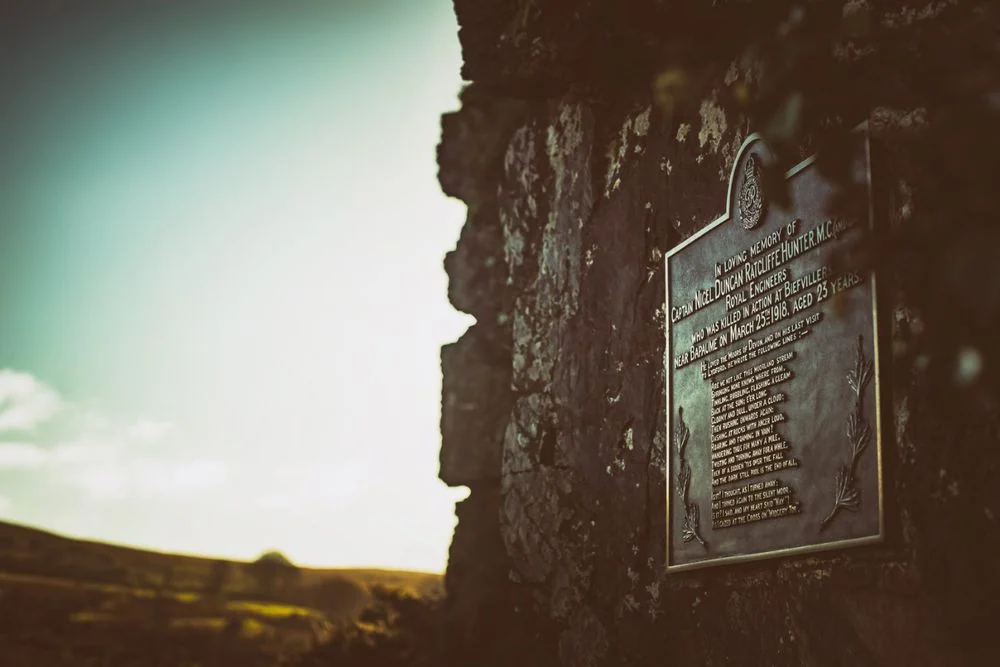
On the Black Rock above the River Lyd, a short walk from Lydford, a plaque remembers Captain Nigel Hunter of the Royal Engineers, who loved these moors and was killed in France in the spring of 1918, aged 23. It carries a poem he wrote on his last visit to Lydford, about a moorland stream that runs on over a fall into a dark still pool.
- Where: On the west bank of the River Lyd, on the Black Rock beside Black Rock Falls, between Lydford and Widgery Cross on Brat Tor
- Commemorates: Captain Nigel Duncan Ratcliffe Hunter MC and Bar, Royal Engineers (born 5 November 1894)
- Killed: 25 March 1918, at Biefvillers, near Bapaume, on the Somme, during the German spring offensive
- The plaque: Put up by his father; replaced and re-dedicated at a ceremony on 28 March 2008
- Record: Imperial War Museums, War Memorials Register, memorial 2928
The plaque
The plaque reads:
In loving memory of
Captain Nigel Duncan Ratcliffe Hunter, M.C. (and Bar),
Royal Engineers,
who was killed in action at Biefvillers,
near Bapaume, on March 25th 1918, aged 23 years.
He loved the moors of Devon, and on his last visit
to Lydford, he wrote the following lines:Are we not like this moorland stream
Springing none knows where from,
Tinkling, bubbling, flashing a gleam
Back at the sun; e'er long
Gloomy and dull, under a cloud,
Then rushing onwards again;
Dashing at rocks with anger loud,
Roaring and foaming in vain!
Wandering thus for many a mile,
Twisting and turning away for a while.
Then of a sudden over the fall
And the dark still pool is the end of all.
Is it? I thought, as I turned away,
And I turned again to the silent moor.
Is it? I said, and my heart said "Nay"!
As I gazed at the cross on "Widgery Tor".
Hunter died in 1918, so his verses are long out of copyright. They are given here as they are inscribed.
Captain Nigel Hunter
Nigel Hunter was born on 5 November 1894, the son of Duncan Hunter of the Punjab Police, who retired to Okehampton, where Nigel came to love Dartmoor. He went to Kelly College at Tavistock from 1905, then to Eastbourne College and the Royal Military Academy at Woolwich, and was commissioned in the Royal Engineers on 12 August 1914. He went to France and took part in the retreat from Mons, became a lieutenant in June 1915 and was mentioned in despatches in January 1916.
He won the Military Cross in September 1916 on the Somme, for building advanced strong points under heavy shell fire while wounded, and a Bar to it in July 1917 for laying out the front line under heavy fire at Klein Zillebeke, near Ypres. He served on the Italian front in November 1917, was promoted captain on 3 November 1917, and returned to Flanders and then the Somme in early 1918. He was killed at Biefvillers on 25 March 1918, in the first days of the German spring offensive. Kelly College's remembrance page says he is buried in the war graves cemetery at Ligny-Thilloy.
The memorial
According to Kelly College, Hunter's father put up the plaque on the Black Rock above the Lyd, as a reminder of the walks his son took on the moor while on leave. The plaque was replaced at a ceremony arranged by Lydford village on 28 March 2008, attended by representatives of Kelly College. It sits beside Black Rock Falls, on the river that rises on the moor above and runs down past Brat Tor and its cross, which the last line of the poem names as Widgery Tor. See also the River Lyd.
This is open moorland beside a river: the rocks can be slippery and the water fast after rain, and parts of this moor are used by the army, so check the firing times before you walk.
More about Captain Hunter and the memorial
More Dartmoor resources

Thoughts
Be the first to share a thought about Captain Hunter Memorial.
Share a thoughtKnow another Dartmoor place, tor or landmark we should include? Suggest a listing, it is free.
Suggest a listing