← Browse Folklore, Myth & Legend · Browse the directory
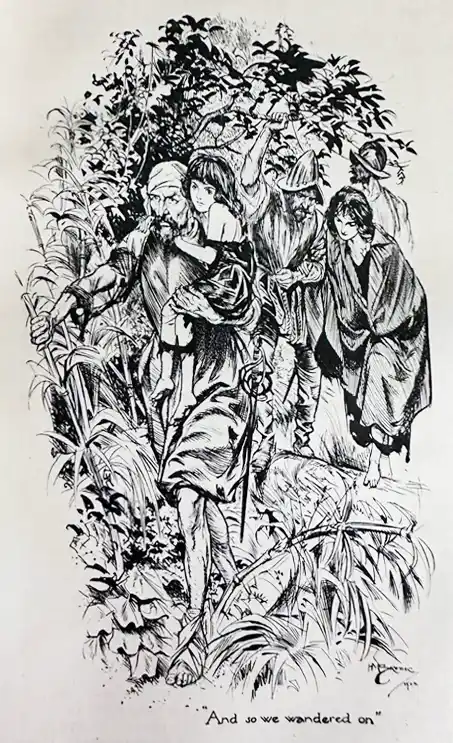
The Gubbins were a band of "footpads, sheep-stealers, beggars, cutpurses, cut-throats and highwaymen" said to have lived rough around Lydford Gorge and the slopes towards Brent Tor, on Dartmoor's western edge, in the years around the English Civil War. Tradition names their leader as Roger Rowle, remembered half as a villain and half as "the Robin Hood of Dartmoor" -- though no source records them giving anything away to the poor. A pool at the village end of Lydford Gorge is still known as Rowle's Pool.
The fullest early account comes from the antiquarian Thomas Fuller, writing in his History of the Worthies of England (1662) after a stay in Exeter in the 1640s. Fuller described their territory as "a Scythia within England", its people living in "cotts (rather holes than houses)", holding property in common, and multiplying, in his telling, "without marriage, into many hundreds". Decades earlier, the poet William Browne had already put Roger Rowle's name into verse in "A Lydford Journey", picturing travellers set upon by the gang's "naked forces in a cluster, led forth by Roger Rowle." Sabine Baring-Gould reprinted both accounts in A Book of Dartmoor (1900), and thought the underlying problem -- moorland families living outside the law and lifting unmarked livestock -- was real even if the numbers were not.
Fuller's picture did not go unchallenged even at the time. The antiquary Edward Gibson, editing Camden's Britannia in 1695, argued the Gubbins had been misrepresented "as a lawless Scythian sort of people", and Thomas Cox, writing in 1700, suggested Fuller had been fed a grudge-driven story by someone with a personal score to settle. The historian Patricia Milton has since suggested the Gubbins may have been a distinct, poor and somewhat itinerant community whose unconventional way of life was enough on its own to draw suspicion and exaggerated gossip, rather than a literal band of cave-dwelling brigands. That more mundane reading fits the only hard genealogical evidence: the 1851 census recorded nine separate families surnamed Gubbins living around Tavistock, described as ordinary agricultural labourers and miners -- a far cry from Fuller's "many hundreds" of lawless heathens, and a reminder that a surname that stuck around as folklore's villain belonged, in the real record, to working families.
The legend outlived its subjects in fiction: Charles Kingsley put a Gubbins raid into Westward Ho! (1855), and Anna Eliza Bray, who lived nearby on the Tavy, wove Roger Rowle into her novel Warleigh (1834), calling him "the Robin Hood of Devon in the times of Charles the First." The word "gubbins" itself is much older than the Lydford clan and originally meant fish scraps or fragments -- whether it was already an insult before it became this group's name, or took on its "worthless rabble" undertone because of them, is impossible to untangle at this distance.
The story sits well alongside Lydford's wider reputation for rough justice: "Lydford Law", in which a man was said to be hanged first and tried afterwards, was proverbial across England by the seventeenth century, and is remembered today at the village's Castle Inn, opposite the old stannary prison at Lydford Castle. A lawless gang supposedly operating in the gorge on the parish's doorstep, and a castle proverbial for hanging first and asking questions later, are two sides of the same fearsome 17th-century reputation.
Sources and further reading
- Wikipedia: Gubbins band
- Primary source (public domain): Sabine Baring-Gould, A Book of Dartmoor, Chapter 9 (1900), quoting Thomas Fuller (1662) and William Browne
- Independent cross-check: Dartmoor Resource - Roger Rowle and the Gubbins
- Further reading: Legendary Dartmoor - Gubbins of Lydford
- Word history: languagehat.com - Gubbins
Thoughts
Be the first to share a thought about The Gubbins of Lydford.
Share a thoughtKnow another Dartmoor place, tor or landmark we should include? Suggest a listing, it is free.
Suggest a listing