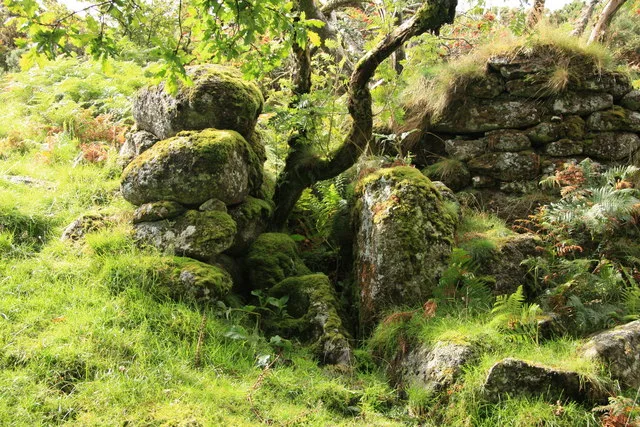
Historic England's scheduling record (list entry 1002602) describes a blowing house and a stamping mill on a steep slope in the valley of the O Brook, near its junction with the River Dart. Both survive as small rectangular drystone structures. It lies in the parish of Dartmoor Forest, about 1 km north-west of Combestone Tor and 0.7 km south-east of Huccaby.
The upper building is the stamping mill, about 6 metres long by 4 metres wide inside, with walls up to 0.5 metres thick and 1.7 metres high. There is a clear wheel pit at the east end, a stone-built raised bank to bring water from the leat off the O Brook, a rectangular recess in the south wall read as a possible furnace or hearth, an entrance on the north side, and at least six mortar stones outside, one in the tailrace. A leat joins the wheel pits of the two mills.
The lower building is the blowing house, up to 10 metres long by 4.8 metres wide inside, with walls up to 1.5 metres high. It has a small rectangular chamber to the south-east, a possible furnace recess in the south-west corner, and a higher floor at the south end that seems to mark a further furnace. The entrance is on the east side, the wheel pit on the west. Inside are one complete mould stone and many fragments, and at least six mortar stones in and around it. Burnard partly cleared the fallen stone from the lower building in the 1880s. The mills were first documented as Wikeford Mills in 1608, and were also known as Beara Mills in documents of 1703 and 1737.
A paper in the Plymouth Institution's reports describes the ruins at Week Ford and near Hartor as two sets of ruins, each made up of the blowing-house proper and a habitation and possible storehouse.
Sources: Historic England list entry 1002602 (updated 11 November 2015), which cites Butler, Dartmoor Atlas of Antiquities (1994), and PastScape 443046. The last paragraph is from the Annual Reports and Transactions of the Plymouth Institution, page 144 of the Library copy.
- Period: Medieval
- Status: Scheduled monument (Historic England list entry 1002602)
- Grid reference: SX 6617 7233 (approximate, from the listing's coordinates)
Historic England listed designation: Blowing houses at Week Ford