
← Browse Dartmoor People · Browse the directory
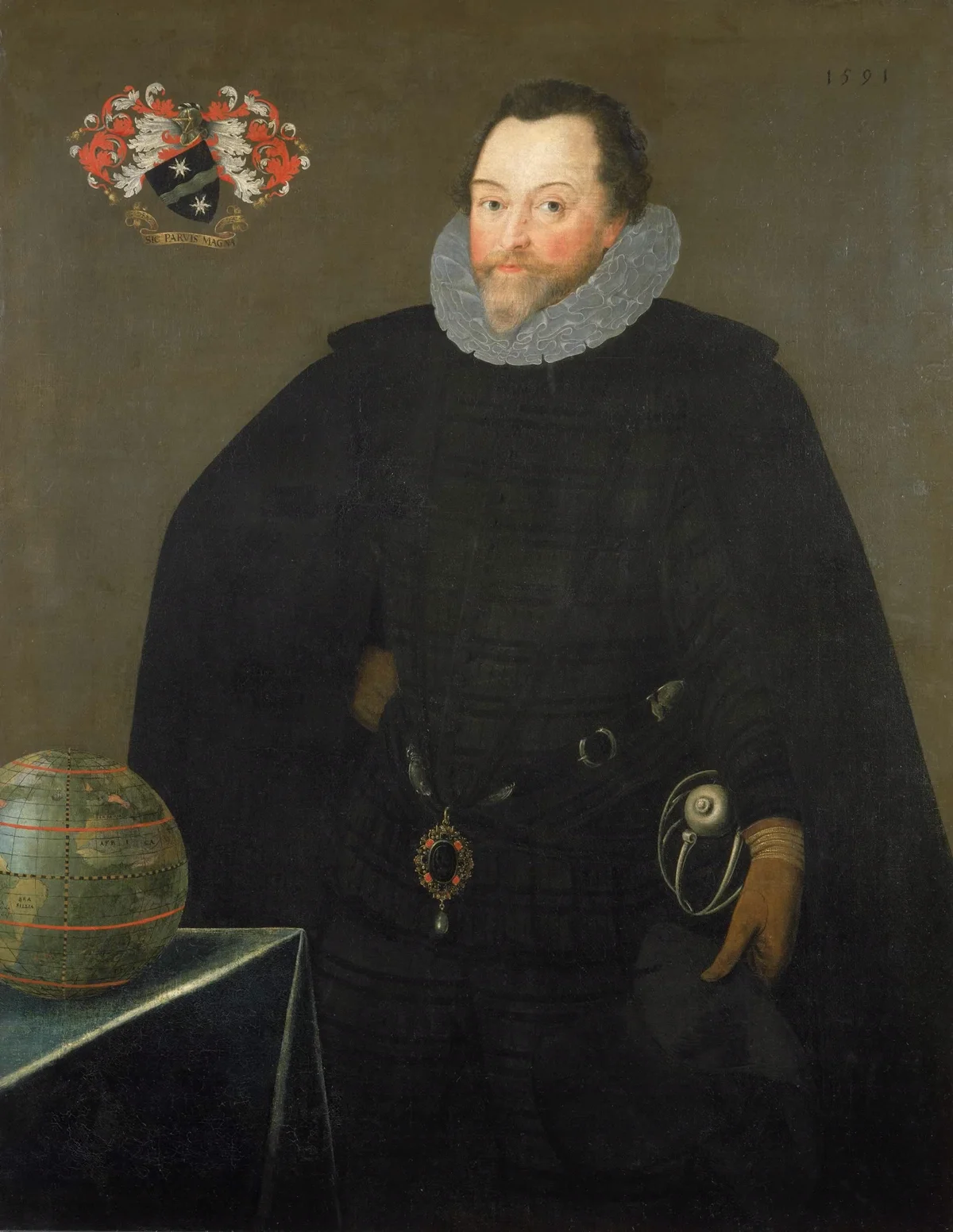
Sir Francis Drake (c.1540-1596) was born at Crowndale Farm, on the edge of Tavistock, the eldest of the twelve children of Edmund Drake, a tenant farmer, and his wife Mary. His birth year is uncertain -- estimates range from 1540 to 1544 -- and is known only because Drake himself told his contemporary biographer William Camden, since no parish record survives. The Drake family had farmed at Crowndale for generations as tenants, first of Tavistock Abbey and then, after the Dissolution, of the Russell family, later Dukes of Bedford.
Drake went on to become the first Englishman to circumnavigate the world, in the Golden Hind between 1577 and 1580, and served as Vice Admiral of the English fleet that defeated the Spanish Armada in 1588. He was twice Mayor of Plymouth and sat as a Member of Parliament. He died of dysentery off Portobelo, Panama, in January 1596, and was buried at sea in a lead-lined coffin.
Drake's two lasting marks on the Dartmoor area both date from his time as Mayor of Plymouth. In 1581 he bought Buckland Abbey, a former Cistercian monastery turned Tudor manor house on the moor's southern fringe, through intermediaries acting for him without the seller, Sir Richard Grenville the Younger, realising who the real buyer was. Drake lived there for around fifteen years; it is now a National Trust property, open to the public since 1951. Separately, as Mayor he contracted the construction of a leat, or open watercourse, to bring drinking water from the River Meavy on Dartmoor down to Plymouth. Built in 1590-91 and known ever since as Drake's Leat, it ran some 17.5 miles and also powered mills he operated; much of its course was later lost beneath Burrator Reservoir when that was flooded in 1891, though sections still survive on Roborough Down.
Buckland Abbey is also home to a well-known piece of folklore rather than fact: Drake's Drum, the snare drum said to have accompanied him around the world, and to which Drake supposedly vowed on his deathbed that if England were ever in danger, someone should beat it and he would return to defend the country. The legend was popularised in Victorian and Edwardian times, notably by Sir Henry Newbolt's poem "Drake's Drum", and has been reported "heard" at moments of national crisis ever since -- a story firmly in the realm of legend, not history. The fragile original drum is kept in secure storage; a replica is on display at Buckland Abbey.
Tavistock's bronze statue of Drake, unveiled in 1883, and the ruined farmstead at Crowndale, his birthplace, both stand within a short walk of the town centre.
Sources: Wikipedia, Wikipedia (Buckland Abbey), Wikipedia (Drake's Leat), Wikipedia (Drake's Drum), The Drake Exploration Society, National Trust.
Kind words
Be the first to leave kind words for Sir Francis Drake .
Leave kind wordsKnow a Dartmoor person we should feature? Suggest a listing, it is free.
Suggest a listing