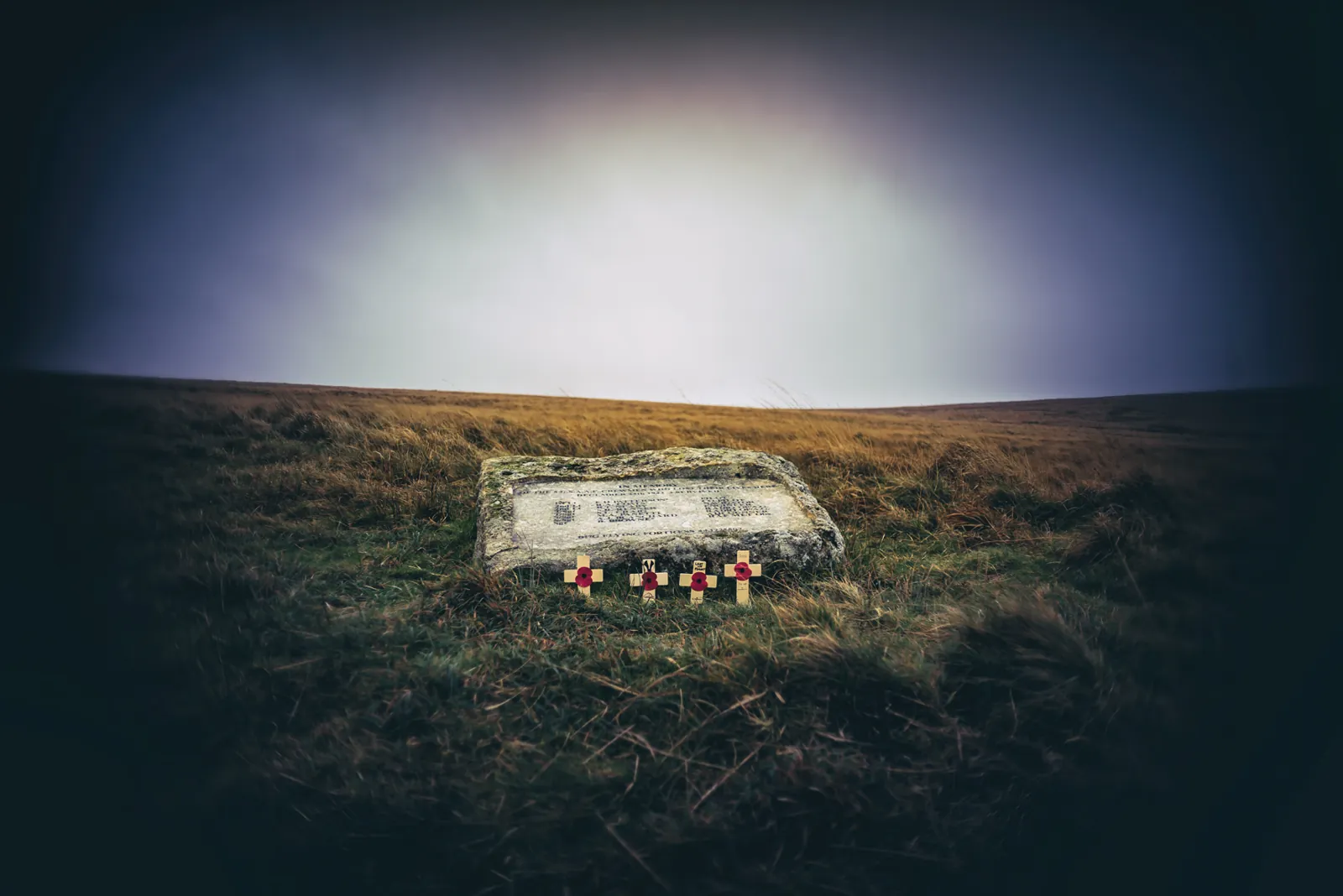
On 25 December 1943 a US Army Air Force B-17G Flying Fortress came down on a boggy hillside at Tiger's Marsh, high above the West Okement valley. Five of the eight aboard were killed and three survived with injuries, one of them an RAF sergeant. A memorial stands at the site.
- Aircraft: Boeing B-17G Flying Fortress, serial 42-37869
- Unit: US 8th Air Force, a weather reconnaissance flight, base Cheddington
- Date: 25 December 1943
- Aboard: Eight: five killed, three injured and rescued
- Grid reference: SX 55145 88412
What happened
The aircraft had flown a weather sortie, landed at St Eval in Cornwall and taken off again for Cheddington. It struck the hill in low cloud while the crew tried to keep sight of the ground, bounced up the slope and burned as the fuel tanks split. That account comes from one source (credited to two websites), so treat the detail as unconfirmed. The plaque, the Devon HER and the Royal Navy all give the date and the five deaths.
What you can see
A large blackened scar on boggy ground, with a few pieces of armour plate and melted aluminium. A brass plaque listing the crew was fixed here (the HER noted in 2008 that it may be missing), and in 2022 a memorial stone was set up beside the Liberator stone nearby.
Access
It is about 1.6 km from the Liberator crash site in the West Okement valley, which is beside two. Check the firing programme before you go.
All military aircraft crash sites in the UK are protected by the Protection of Military Remains Act 1986. It is an offence to dig, move or take anything from one without a licence from the Ministry of Defence, and many are war graves. Look, photograph, leave everything where it is.
Dates and names
One BBC page quoted in the HER gives 23 December, the plaque says 25 December. One aviation database says ten were killed, which is the toll of the Liberator three days later; the plaque, the HER, the Royal Navy and the Library's own papers all say five. Its parish is given as land common to Bridestowe and Sourton.