

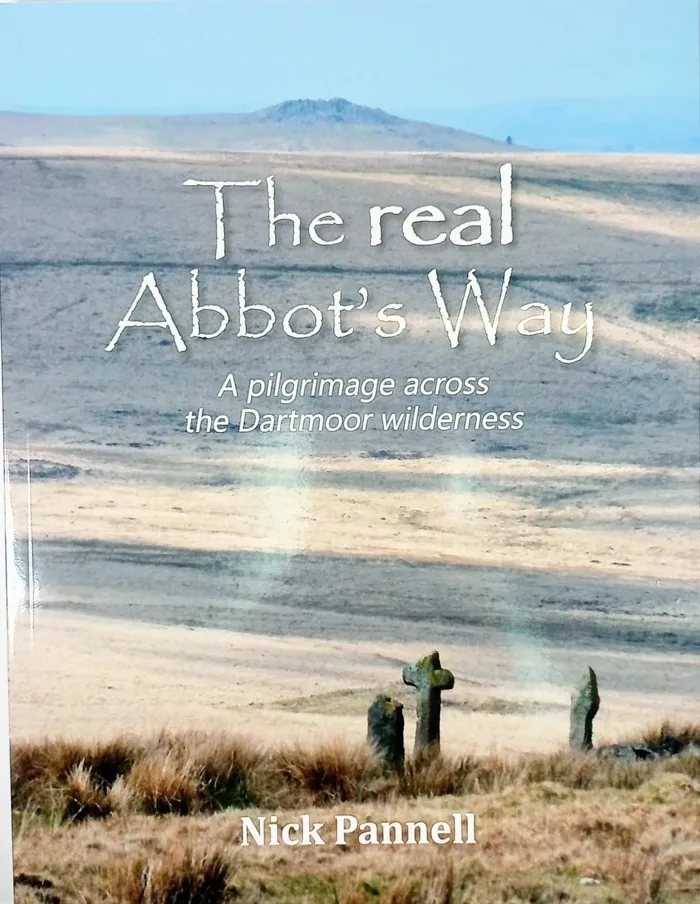
The Real Abbot's Way is a walking and history book by Nick Pannell on what he argues is the original medieval route between Buckfast and Tavistock abbeys across southern Dartmoor, about 20 miles long and marked by waymark crosses, with 18 sketches by artist Kate Andrew. This review is by Helen JR Bruce.
- Book
- The Real Abbot's Way
- Author
- Nick Pannell
- Illustrations
- 18 sketches by Kate Andrew, plus colour photographs
- Route
- Buckfast Abbey to Tavistock Abbey, about 20 miles
- Reviewed by
- Helen JR Bruce
Review: The Real Abbot's Way by Nick Pannell
Review by Helen JR Bruce, Communications Officer for the Dartmoor Preservation Association.
For centuries, medieval monks used a succession of waymark crosses to travel between Buckfast and Tavistock abbeys but a mapping error in the 19th century led to a different route for the ‘Abbot’s Way’ becoming established. Inspired to follow the original path, author Nick Pannell spent four years researching what he calls the REAL Abbot’s Way, bringing together the accumulated knowledge of many antiquarians.
Accompanied by numerous colour pictures, as well as 18 sketches by artist Kate Andrew, this book invites the reader to join Nick as he walks the ‘real’ Abbots’ Way route he has mapped. The journey is vividly described, with the 20 mile entirety of the route broken down into small sections, populated by vivid descriptions of nature and reflections on the emotions and memories that being in the landscape evokes.
‘When we step into the wilderness the journey takes charge and we are not in control, we are forced to slow down, reflect and problem-solve. The landscape will inspire and challenge us and in that wonder and vulnerability we follow in the footsteps of those who have gone before us and maybe, like them, find purpose and meaning.’
With two decades of experience as a social worker, Nick has developed a deep appreciation for the healing power of nature, describing the open moor as his ‘cathedral.’ The awe he conveys when describing the scents and colours of wildflowers in the hedgerows imparts an irresistible joy that many regular walkers will no doubt relate to, and those who aren’t familiar with Dartmoor yet might find themselves longing to experience. His tone is engaging and lightly humorous, with thoughtful consideration to the lives and customs associated with the archaeology he encounters.
Walking with a pilgrimage mindset, that can be appreciated by lovers of nature and history, regardless of religion, Nick shares that ‘here I can “achieve” nothing. I can just be, absorb the beauty of the setting in all its detail and grandeur, follow threads of curiosity, feel, smell and listen with growing wonder at the Dartmoor wilderness all around me.’ His reverence for the complexity of Dartmoor’s ecosystems, history and cultural memory is conveyed through an attention to detail that invites the reader to ask their own questions and follow their own trails of thought. What’s more, there’s a handy map of the whole ‘real’ Abbot’s Way at the front of the book, complete with a sketch of each carved cross in its location on the route. The Real Abbot’s Way is an excellent companion for planning mindful walks and delving into the history behind this ancient path.
The Real Abbot’s Way can be found in local independent bookstores and online at www.bridgebookshop.co.uk.
About The Real Abbot's Way: where to buy or borrow it
The book is published by Blackstone Publications. It grew out of four years of research into the route and the claim that the line shown on modern maps is a nineteenth-century mapping error. Local newspapers have covered the argument: see Tavistock Today and the Mid Devon Advertiser. Our listing for the route that appears on maps today is Abbot's Way.
Bridge Books | Second-hand search links (book listing)
More on Our Dartmoor
- Nick Pannell, the author
- The Real Abbot's Way, the book
- Abbot's Way, the route as mapped today
- Buckfast Abbey, one end of the route
- Tavistock Abbey, the other
- Helen JR Bruce, the reviewer
Frequently asked questions
What is the real Abbot's Way?
How long is the route in the book?
Is the book a walking guide?
Who is Nick Pannell?
Is this the Abbot's Way shown on the map?
Where can I buy The Real Abbot's Way?
Who wrote this review?
What is Our Dartmoor?
What else can I find on Our Dartmoor?
How can I contribute to Our Dartmoor?
Sources and further reading
- Ex-councillor challenges 140-year-old Dartmoor footpath map error: Tavistock Today, 12 July 2025
- New book crosses the moor: Mid Devon Advertiser, 29 December 2025
Find out more about the Dartmoor Preservation Association and Helen JR Bruce
- Dartmoor Preservation Association website: fighting to keep Dartmoor wild and free since 1883
- Helen JR Bruce, folklorist and author: her own website
- Helen JR Bruce on Facebook: her Heat of the Hunt page
- Helen JR Bruce on X (Twitter)
- Helen JR Bruce: her Our Dartmoor listing
