Our Dartmoor started life as a zine: an attempt to bring together people with a shared connection to the moor, regardless of their particular corner of it. Two editions later, the idea had outgrown what a zine could hold, and it eventually became this. A directory at first, because that was the useful, buildable thing. But the directory was always meant to be a start, not the destination.
It always felt like it should be much more. The problem is, you can claim a thing before it exists (well, you can, but you have to be wealthy or well know or both - or deluded).
So, now the website has almost 3000 listings (of vastly different types) several attempts to draw together rather varied sources and some madly disparate data. It's time to be more open about the ultimate goal of this website.
The website needs to be a hub for anything Dartmoor - and I mean anything.
What's already here
The directory itself has grown a long way past a list of businesses. Alongside it there's now a genuine record of Dartmoor's heritage: tors, stone circles, cairns and ancient monuments, cross-checked against real sources rather than copied from one another. There's Myths & Legends, retelling the moor's folklore with an eye on where each story actually came from. There's a growing shelf of Dartmoor writing in Publications, working toward a proper bibliography. And there are the maps: rivers and waterways, wild camping, firing times, historic maps you can fade back through a century, sun and golden hour for planning a shoot, and a LiDAR view that shows hut circles and reaves hiding under the heather.
Is it perfect? no. Is it ever going to be? probably not - but if you read my other article about the reasons for building the wesbite in the first place, you'll see that these things are not very high on my priority list!
None of that happened because it was planned as a grand structure from day one. It happened because each piece turned out to be worth building properly once it existed at all.
It's very much an evolving structure all of it's own. Unconstrained by deadlines and committees and budget restraints (There's no budget - end of conversation) I'm watching this happen in real time - spotting something that needs to be part of the whole and finding a few spare hours to bodge together a way of building it.
What's coming next
A few directions worth naming:
- Collections that cross categories. Right now everything sits in its own type: business, heritage, route, place. Some of the most interesting things about Dartmoor cut straight across those lines: a stream, a ruin, a pub and the road between them; the people who worked with granite; places you can reach without a car. Editorial collections like these would let the site tell those stories without inventing a new category for each one.
- Showing what's nearby, not just what's related. A heritage site might genuinely connect to a route, a river, a book, a local business and a piece of folklore, not just other things of the same type. Making those real connections visible would make the size of the site easier to actually explore.
- Routes worth trusting. Turning a walk from "a line on a map" into something with the practical detail that actually helps: surface, access, parking, when it was last checked.
- Historical Dartmoor People. A strand for the people behind the moor's written history: Baring-Gould, William Crossing, Mary Maria Colling and others, seeded from what's documented and built out properly over time.
- A "then and now" layer. Historic map overlays and old photographs on the places that have genuinely changed, starting with a handful of the richest examples rather than trying to historicise every listing at once.
Where the record still has gaps
How you can help it grow
None of this works as one person's list of ideas. The things that have made the directory genuinely useful so far, corrections, photographs, a memory attached to a place, a business we'd missed, have all come from people who know a corner of the moor better than I do. If any of the above sounds like something you'd want to help with, or you've spotted a gap only you would know about, I'd love to hear from you.
There a obvious gaps in some of the data and I'm working to fill those gaps as quickly as I can, but I need people to get involved (you'll not be put to work, I promise! Just send me links, or write me an article - everything is welcome.
Suggest a Listing
A Vast Solitude
I had a conversation the other day where the person I was chatting with mentioned that people forget that Dartmoor (and other National Parks) are predominantly manufactured landscapes - this isn't the main thrust of this article, but it's worth noting considering the way the writer in this article from almost 140 years ago views the moor.
It appears that there is a moment, somewhere in the 1880s, when Dartmoor stops being a place people apologise for and starts to become a place they celebrate, or even boast about. You can watch it happen in this one cutting, a simple book review from the Morning Post in the summer of 1889.
The reviewer starts out, almost defensively, borrowing a line from Carrington (who wrote Dartmoor: A Descriptive Poem published in 1826), calling it "a spot almost unknown, untrod."
Sixty years on from the famous poem, he admits, little had changed: the tourist still "looks upon the moor as a weird, wild waste, to be gazed at and passed by," and even in Devonshire "it remains an unknown land." And then, quote by quote, the piece falls in love. I've reproduced it here, exactly as it was in the newspaper. Read it now or skip past and come back to it; both ways, works.
The Morning Post
Monday, June 24, 1889
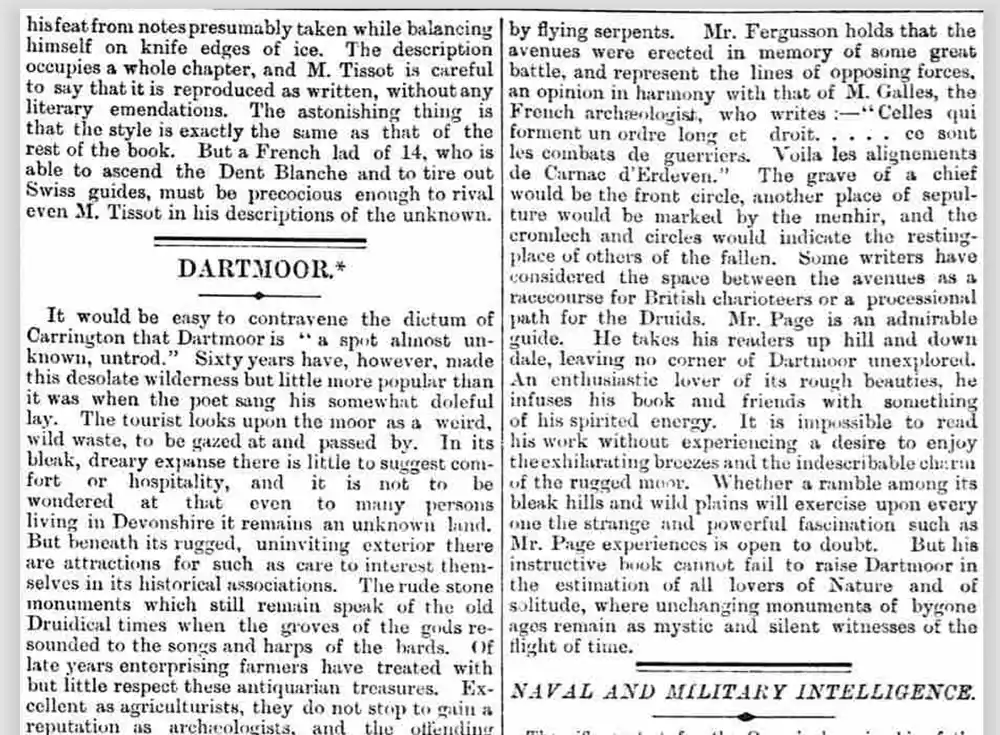
Dartmoor.
A review of "An Exploration of Dartmoor and its Antiquities," by John Lloyd Warden Page.
It would be easy to contravene the dictum of Carrington that Dartmoor is "a spot almost unknown, untrod." Sixty years have, however, made this desolate wilderness but little more popular than it was when the poet sang his somewhat doleful lay. The tourist looks upon the moor as a weird, wild waste, to be gazed at and passed by. In its bleak, dreary expanse there is little to suggest comfort or hospitality, and it is not to be wondered at that even to many persons living in Devonshire it remains an unknown land. But beneath its rugged, uninviting exterior there are attractions for such as care to interest themselves in its historical associations. The rude stone monuments which still remain speak of the old Druidical times when the groves of the gods resounded to the songs and harps of the bards. Of late years enterprising farmers have treated with but little respect these antiquarian treasures. Excellent as agriculturists, they do not stop to gain a reputation as archaeologists, and the offending stones are ruthlessly removed to make way for the modern instruments of land reclamation and prosaic farming. Against the depradations of these peaceful marauders some action has, however, been recently taken by the establishment of a Dartmoor Preservation Society, whose primary object is the protection of these mysterious relics of remote antiquity. The railway has penetrated to the metropolis of Dartmoor, and the granite wilderness may be attacked from Okehampton, Tavistock, Plympton, South Brent, and Ashburton. A champion of the grand old moor has arisen in the person of Mr. Warden Page, who, in a volume prepared with evident care, relates much that will be new to the majority of readers with regard to its traditions, as well as to its form, extent, and present characteristics. In some measure Mr. Page's work is founded upon the Rev. S. Rowe's "Perambulation," which has been accepted as the standard book upon Dartmoor, an article written by Mr. Richard John King, and the Reports of the Transactions of the Devonshire Association and Plymouth Institution. But the chief value of the treatise is due to the author's personal acquaintance of many years with the moor. The Forest of Dartmoor, as it is still called, has an area of one hundred and thirty thousand acres situated in the heart of Devonshire. Trunks and leaves of trees dug out of its morasses show that at a remote period it has been to some extent wooded. It must be remembered that the term "forest" referred more directly to a hunting ground than to a dense growth of trees such as the word generally suggests. Certain it is that there is no such forest at Dartmoor now. Possibly the tinners who formerly worked there exhausted the supply of wood, as they were allowed to supply themselves with fuel necessary for fusing the ore. Of the present aspect of the place Mr. Page thus writes:—
It is a vast solitude. Save the convict settlement of Princetown and a few scattered cottages abutting on the roads which cross the central district, scarce a human habitation greets the eye. In the northern quarter, where the great morass about mysterious Cranmere lies, a dark blot on the surface of the landscape, nothing but an occasional cart-track, faint and broken, hints at the presence of man, and the traveller may walk from the outskirts of Princetown to Okehampton — a good fifteen miles — without meeting a soul. Long ridges rise in dusky sweep against the sky — line beyond line, like the waves of ocean, to which, indeed, they have been not inaptly compared — and from these waves — to carry out the simile — rock-strewn crests start forth capped with grotesque piles of granite. These are the 'tors,' a word whose etymology is discussed elsewhere; and it is to these rugged peaks that Dartmoor in a great measure owes its fascination. Lions couchant, sphinxes, and other strange monsters are the order of created (and uncreated) being more commonly assumed by the disintegrated granite; but not unfrequently man himself is represented, carved by the slow but sure hand of time from the grim rock. Down the slopes are scattered in wild confusion huge blocks of splintered granite, locally known as 'clatters' or 'clitters.' Some of these blocks must weigh scores of tons, and the eye is bewildered by their picturesque disorder and varied forms. Frequently the loveliest ferns fill the interstices, and lichens, grey, white, and orange, contrast with the almost black patches of moss which, watered plenteously by the mists, cling to their rugged sides.
An idea is widely held that Dartmoor is a kind of Salisbury Plain, but the tors in which it abounds give it a totally different aspect. Their average height is said to be 1,400ft., but this altitude is largely exceeded in the northern quarter of the moor. High Willhays and Yes Tor measure respectively 2,059 and 2,029ft. Standing upon one of the loftier hills, mile after mile of heathey expanse may be seen, and the distant heights display an ever-changing variety of hues as the clouds drift over them. The charm of scene is enhanced by the dashes of colour in the green bog, the purple heather, the red and brown rushes, and cotton grass. In the valleys clear streams ripple in their rapid race to the far-off fertile country. That which must strike the visitor more forcibly than all else is the almost painful silence that reigns supreme on the hills:—
A light murmur, says Mr. Page, may float up from the torrent hundreds of feet below, a faint rustling as the breeze sighs through the heather may strike upon the ear; but all else is not. And if the time be evening, the sense of weirdness is intensified, for against the setting sun looms up the shapeless ruin of some ancient keep, or the form of a great stone monster who has kept watch and ward over this solemn land since the Deluge.
Many rivers find their source in the central morass, but of lakes Dartmoor can boast nothing more ambitious than Classenwell, a pool no larger than a Westmoreland tarn. Mr. Page warns his readers against attaching too much credence to the many stories of hairbreadth escapes from Dartmoor bogs. The element of danger doubtless exists, but if the pedestrian avoids the treacherous bright green patches he need fear no harm. These bits of "seething and quaking bog" consist of a thin layer of sodden moss over a substratum of black slime and water. A slight thrust with a pole causes the mass to emit a seething or hissing sound, and the surface will then commence to quiver in most unmistakable manner. The late Bishop Hannington had an unpleasant experience in a Dartmoor bog, and readers of Miss Edna Lyall's "Donovan" will remember how the hero nearly lost his life in Fox Tor Mire; but Mr. Page assures us that such danger is very much more imaginary than real. He walked hundreds of miles upon the moor, and, like the driver of the Wild Irishman, is "a living man yet." Of the cromlechs and stone avenues, which constitute an important part of the ancient treasures of Dartmoor, the author has much to say. He describes them in words and illustrates them in map and picture. He does not accept the rough-and-ready theory that they are all Druidical relics. The origin of these curious monuments of ancient times is so surrounded by doubt and difficulty that he does not pretend to give a certain solution of the problem. There are many near Merivale Bridge, where the Staple Tors and the great Mis Tors are separated by the Walkham, of which he gives the following graphic account:—
These interesting antiquities will be found close to, and for the most part on, the south side of the road which passes through what appears to have been part of an aboriginal village. Close to these hut-dwellings are two avenues, running nearly due east and west, the one 780ft. in length, the other 590ft. The stones are about 2ft. apart, and of most irregular height, though seldom exceeding 3ft. They vary much, too, in shape; evidently no tool has been used upon them, so that some are thin and pointed, others thick and truncated. A circle, with a diameter of 11ft. 8in., and which appears to have contained a kistvaen, stands about the centre of the larger avenue. Proceeding down this avenue from the east end, we shall, after traversing some 250ft., find at a distance of less than 100ft. to the south the remains of a cromlech. The cover-stone, of which the centre part has evidently been removed by some granite robber, is 6ft. 7in. by 5ft. 1in., and 15in. in thickness. Towards the west end, at a distance of 36ft. and 72ft. respectively, are the ruins of two cairns. We now steer for the tall menhir, still further to the south. On the way we pass an almost perfect sacred circle, consisting of ten low stones, the largest being about 1ft. 10in. high by 2ft. wide. Its diameter is 54ft. From this the menhir is distant 105ft. It is a remarkably fine specimen, and the tallest on the moor, having a height of about 13ft. Surrounding it is an imperfect circle of small, round stones about 6in. high. The hut-circles and supposed pound to the north of the avenues call for no especial mention.
Among the various theories that have been advanced in respect to these parallelitha, that of Mr. R. J. King tends to regard them as relics of ancient British serpent worship, and compares them with similar remains at Stanton Drew in Somersetshire, and at Karnac in Brittany. Legends still linger that the Dartmoor Tors were haunted by flying serpents. Mr. Fergusson holds that the avenues were erected in memory of some great battle, and represent the lines of opposing forces, an opinion in harmony with that of M. Galles, the French archaeologist, who writes:—"Celles qui forment un ordre long et droit .... ce sont les combats de guerriers. Voila les alignements de Carnac d'Erdeven." The grave of a chief would be the front circle, another place of sepulture would be marked by the menhir, and the cromlech and circles would indicate the resting place of others of the fallen. Some writers have considered the space between the avenues as a racecourse for British charioteers or a processional path for the Druids. Mr. Page is an admirable guide. He takes his readers up hill and down dale, leaving no corner of Dartmoor unexplored. An enthusiastic lover of its rough beauties, he infuses his book and friends with something of his spirited energy. It is impossible to read his work without experiencing a desire to enjoy the exhilarating breezes and the indescribable charm of the rugged moor. Whether a ramble among its bleak hills and wild plains will exercise upon every one the strange and powerful fascination such as Mr. Page experiences is open to doubt. But his instructive book cannot fail to raise Dartmoor in the estimation of all lovers of Nature and of solitude, where unchanging monuments of bygone ages remain as mystic and silent witnesses of the flight of time.
* "An Exploration of Dartmoor and its Antiquities." With Maps and Illustrations. By John Lloyd Warden Page. London: Seeley and Co.
What was surprising was that a 1889 book review becomes a story about conservation. The reviewer notes, with some obvious anger, that "enterprising farmers have treated with but little respect these antiquarian treasures," the stones "ruthlessly removed to make way for the modern instruments of land reclamation." The remedy, newly on the scene, is "the establishment of a Dartmoor Preservation Society, whose primary object is the protection of these mysterious relics of remote antiquity." The society that still fights the moor's corner today is right there in the cutting, brand new and already needed. The argument we are still having, about who the moor is for and what may be cleared off it, was already in the newspaper in 1889.
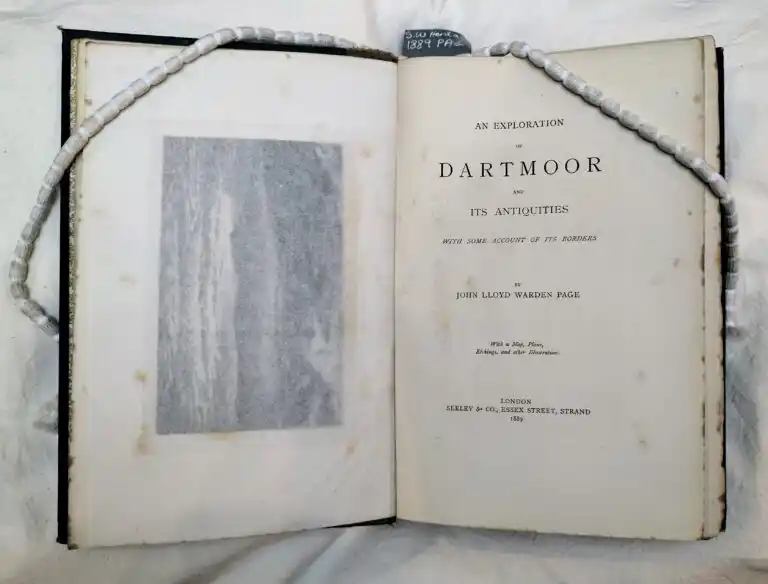
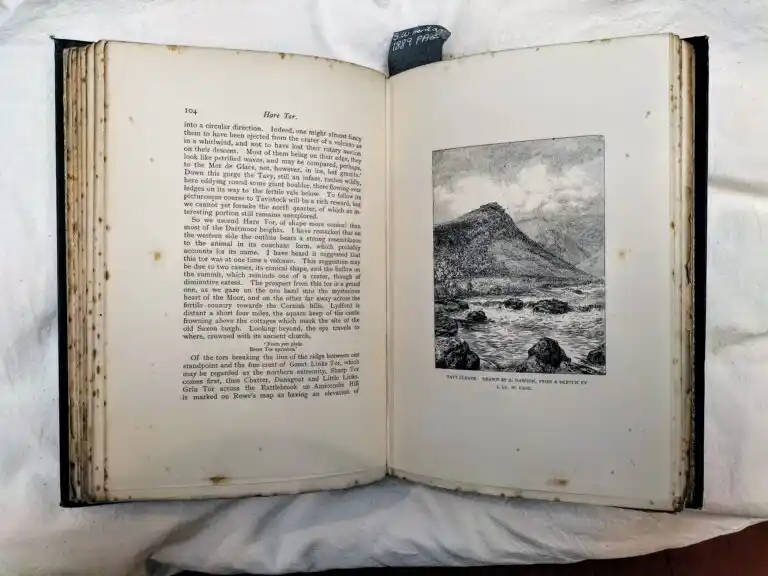
And then here is the part that turns a nice old newspaper cutting into a walk you can still take on Saturday morning. When Page reaches "these interesting antiquities... near Merivale Bridge," he's describing stones that are still there. This is Merrivale Stone Rows (the paper spells it Merivale), the brilliant (and easily accessible) ceremonial complex beside the B3357 between Princetown and Tavistock. The "two avenues, running nearly due east and west, the one 780ft. in length, the other 590ft.". The "tall menhir... the tallest on the moor, having a height of about 13ft." is the Merrivale standing stone, still about thirteen feet, still exactly 105ft from the little sacred circle just as Page paced it. You can stand on that spot today, this transcript in your hand, and check his measurements against the granite. I'm fairly sure nothing in the passage has changed in the hundred and thirty-six years since he wrote it, which is the reviewer's closing phrase made physical: they really are "unchanging monuments of bygone ages."
There is even a whisper of the Dartmoor that Conan Doyle would make famous a decade later. The reviewer soothes the danger of the bogs by reaching for fiction: the late Bishop Hannington had "an unpleasant experience in a Dartmoor bog," and "readers of Miss Edna Lyall's Donovan will remember how the hero nearly lost his life in Fox Tor Mire." Fox Tor Mire. Grimpen was not invented from nothing.
What I really like about this snippet is that it is not really just a book review at all. It's the sound of a whole culture deciding, on the page, that the vast empty quarter of Devon is not an embarrassment but a treasure. The tourist is still being told to gaze and pass by. Warden Page, and his reviewer, are among the first to say: stop, and take a closer look.
As I said at the start, the landscape may have been shaped by humans, it may not be everyones 'cup of tea' but it is always interesting and being outside is never wasted time.
Will the real Mary Maria Colling please stand up?
(A Dartmoor Story about a lowly Tavistock resident in the Nineteenth Century)
Did Anna Eliza Bray edit Mary Colling's poems?
Recently I've been using AI more and more to aid me in my research around the many interesting stories to be uncovered about Dartmoor (both the famous ones, and the almost forgotten ones). Often it leads me down some very interesting rabbit holes, and sometimes some very dead ends 😁
As a side note, I would say that in my limited experience, AI is great at collating research, it is wonderful at cross referencing, keeping track of notes and ideas, but it still comes up short on occasion (and in fact several times, different iterations have outright lied to me).
Consequently, whatever it might tell me I will still (as much as I can) rigorously check sources and will always attempt to find corroborating evidence wherever I can.
It’s not going away, so as somebody who really enjoys learning new things, I’m embracing it’s usefulness.
Using it to replace truly creative pursuits I frown upon greatly.
Back to the question in hand.
Whilst reading some of the work of the famous Mrs Anna Eliza Bray, I came across (not for the first time) “Fables and Other Pieces in Verse”, published in 1831 by Mrs Bray.
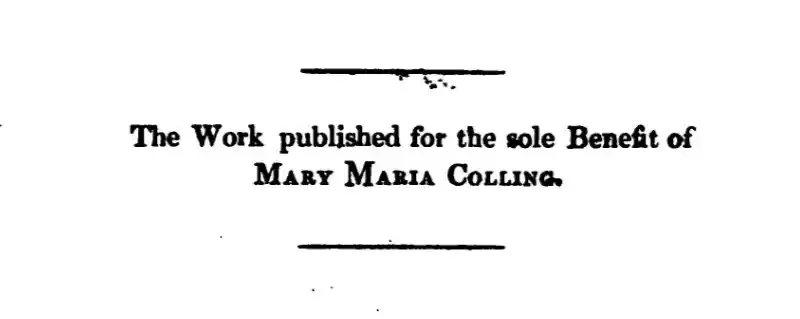
Interestingly (and one of the reasons for this article) on one of the opening pages the work is attributed to and "published for the sole Benefit of Mary Maria Colling."
When I searched back through the cobwebbed, dusty corners of my memory I vaguely remembered reading about Mary several years ago and making one of those many mental notes to look into her life when I had time. Like most of my brilliant plans, it’s sat on a shelf (gathering dust) for way longer than was good for it.
In my attempts to remain curious about Dartmoor (but not in a way that merely feeds the algorithms) I’ve decided to pursue things that interest me. Creativity is about being curious, not about writing the very same thing again in a slightly different way, so your SEO is better 🤣
I have to be honest before continuing with this analysis of Mary’s poetry.
Miss Dart (our English teacher who specialised in poetry) would be unimpressed.
I don’t really get on with poetry.
I’m sure if I was born in 1867 I’d be a much more fervent fan, however in this technological age, it’s not my “go to” art form.
Still, to ignore this interesting discovery would be (at least) amiss and it might give somebody who knows what they’re talking about a jumping off point for more research.
Like most adolescent boys who grew up in the late 70’s and early 80’s I tried my hand at writing poetry (I was a big Jim Morrison fan; and yes; my stuff was terrible).
Do young people still write poetry or are they all wannabe rappers now? A question for another time, I’m sure.
Here’s my favourite “proper” poem of all time: (so you might garner at least a little of my limited appreciation)
I know monks masturbate at night, That pet cats screw, That some girls bite, And yet What can I do To set things right?
Whilst pondering this question further; and having distractedly left the attic hatch of my memory open; I began to reminisce my ‘A’ Level English Literature lessons, that I had rather enjoyed Tennyson’s “Morte d'Arthur” and Pope’s “The Rape of The Lock” and (although my relationship with the bard is somewhat complicated) I do love me a bit of Shakespeare now and again.
One of the tenets I like to live my life by (and this investigation into a working class housekeeper from rural Devon fits nicely into that way of thinking) is that you should have no boundaries to what you consider interesting, what is thought of as worthy, what is “art”.
I love a good shouty punk song as much as I enjoy a beautifully crafted ballad. I’ll listen to Run The Jewels and then some Grieg. Human beings spend too much time cultivating reasons why their view of something is best.
The attitudes of the Victorian critics to Mary’s work, whether supportive or scathing, is always indicative of the time and the whole “God given position”. We should judge on results. Results are subjective.
You and I can disagree, but we should always remain open minded.
… Then (out of the blue) The Millers Tale popped into my very odd head :
This Nicholas was risen for to pisse,
And thoughte he wolde amenden al the jape;
He sholde kisse his ers er that he scape.
And up the wyndowe dide he hastily,
And out his ers he putteth pryvely
Over the buttok, to the haunche-bon;
And therwith spak this clerk, this Absolon,
’Spek, sweete bryd, I noot nat where thou art.’
This Nicholas anon leet fle a fart,
As greet as it had been a thonder-dent,
That with the strook he was almoost yblent;
And he was redy with his iren hoot,
And Nicholas amydde the ers he smoot,
I absolutely loved that our English teacher, Mr Burrows, let us study The Millers Tale. Written by the 'father of English literature' it uses words like “pisse” and “fart” and “ers” (and even the Middle English equivalent to the “c” word).
The father of English Literature swore!
He wrote bawdy and funny stories.
He tells us more about the time he lived in than any history book ever could.
This is why I find Mary interesting.
So, Who was Mary Maria Colling?
Mary Maria Colling was born in Tavistock on 20 August 1804 (though it appears her date of birth is sometimes mis-quoted by Bray and others as 1805) and was baptised there on 2 September.
Her father, Edmund Colling, was a husbandman and assistant to the surveyor of the highways. Her mother, Anne (née Domville - the spelling is disputed), and there is some thought that this might be a derivation of an old French name.
At the age of ten, Mary was sent to a dame school to be taught needlework, and learned to read and write. At thirteen she taught her own father to read, as "it grieved her that his Bible could not speak to him."
At fourteen she entered domestic service as a lady's maid, eventually becoming housekeeper to Colonel Hughes and his wife. Her master gave her a strip of garden, which she liked so much that before long the whole garden ended up in her care and its beauty was widely commented upon.
Somewhere along the way she started writing poetry.
How Mary Colling came to be in print
By all later accounts she was something of a local curiosity in Tavistock once it was discovered that a "low-born" girl could produce unusually heartfelt verse.
She had first attracted my notice in the church, where she usually sat with some of the poor women under the pulpit; I had been struck with the uncommon beauty and intelligence of her countenance; and a little servant of mine, who was herself acute and clever, told me that the young woman I so much admired, was a person of excellent character and poetical gift; that she lived as housekeeper and servant with an old gentleman of this place. This account raised my curiosity greatly, and I told my little maid that I should be glad to show Mary Colling any kindness in my power. This led to her sending pieces of poetry and to my becoming acquainted with her.
The turning point comes in March 1831, when Mary posted a small parcel of her poems to the Vicarage and asked Mrs Anna Eliza Bray; the rather well known (at least locally) novelist and wife of the Vicar of Tavistock; to give her opinion on them. Bray's response was elaborate.
She took down two of Mary's fables, sent them to Robert Southey (the then Poet Laureate), and arranged the publication of Fables and Other Pieces in Verse with Longman in 1831, by subscription. This meant that the patrons and their network effectively pre-paid for the book (more on this later).
The network Anna set up was substantial to say the least.
Mrs Bray travelled to London (to find a publisher) and, while there, was introduced to Letitia Elizabeth Landon ("L.E.L."), one of the most prominent literary women of the moment. Landon subscribed, and …
the gifted L. E. L. honoured it with an ably-written review, which appeared in the ‘ Literary Gazette.’
Personally, I believe this kind of “knowing the right people” is still an important part of the reason we don’t see greater variety in not only the arts, but also in business, industry, politics …
There’s a great deal of “marketing” going on here. There was already a history of promoting “uneducated poets”. We’re unused to seeing the over commodification of things by stuffy Victorians, however it’s merely a macro of what is happening with the monetisation of the internet.
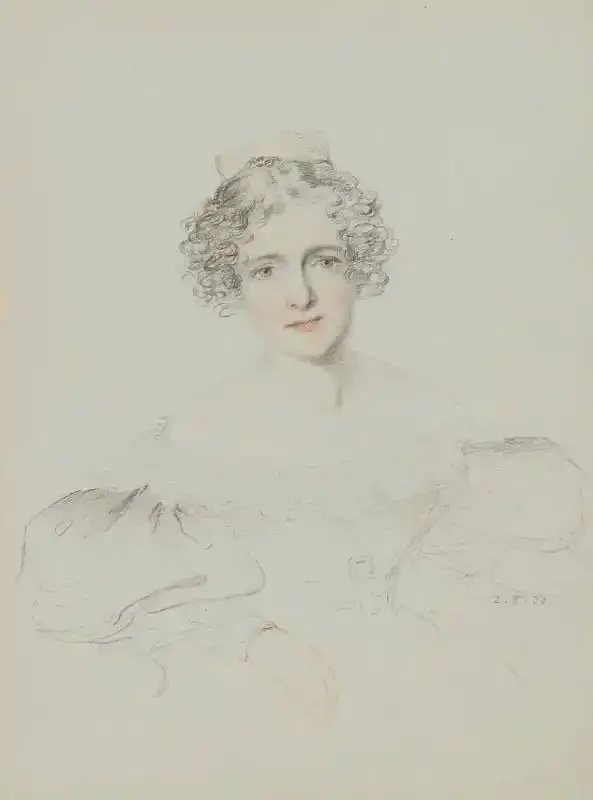
Her station in life and her few opportunities of developing her mind considered, she was altogether the most extraordinary person I ever met. Her mind was of masculine strength and her memory great; she possessed a natural eloquence, a pouring forth from the heart, with a ready, playful wit, somewhat inclining to the satirical. Those powers she improved, as opportunities for obtaining books enabled her to cultivate her mind, and she soon became familiar with the finest passages of Milton and Shakspere, for whose beauties she had the highest relish. Mr. Bray was as much struck with her genius as myself, so that, when at the beginning of the year Mr. William Patten was with us, we got him to make a drawing of her. He succeeded perfectly in the likeness, preserving all the delicacy of her regular and beautiful features, and rendering also that intellectual character which so strongly marked her countenance.
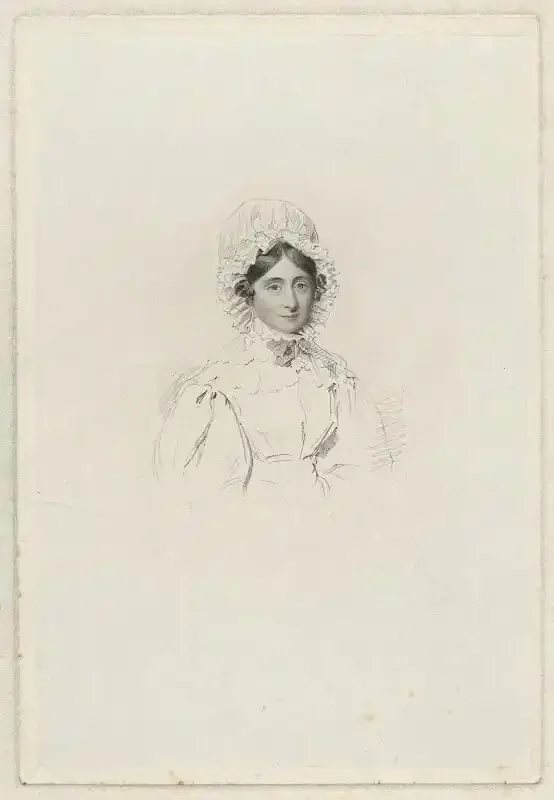
Southey himself rounded up subscribers including William Wordsworth, Thomas Crofton Croker (best known for his Fairy Legends and Traditions of the South of Ireland), and Chauncy Hare Townshend (English poet, clergyman, mesmerist and collector - basically a posh rich bloke with some hobbies). Southey went on to write a very favourable review of his own in the Quarterly Review.
Cultivation destroys wild flowers as civilization destroys wild animals. The greater number of those who are called uneducated poets in the present age, have actually received more education in their favourite art than those upon whom the utmost pains of regular culture were bestowed fifty years ago.
I’m actively avoiding the whole “elitist” and “classist” way nearly all of these so-called “educated” people refer to Mary (it’s not irrelevant, but it isn’t directly a part of the argument I’m making here). Time changes attitudes, that doesn’t mean we should ignore them - I’ll address and expand these in later articles (perhaps).
Dennis Low in his book The Literary Protégées of the Lake Poets, has written possibly the most useful modern account of the publication, characterising the combined efforts of Mary’s patrons, thus :
Considering that Colling was an unknown and uneducated maid-servant from Devonshire, the combined influence of Southey, Bray, Landon and Jerdan was a particularly fine example of the ‘puffery’ that was commonplace amongst the 1820s’ literati.
(Jerdan was the editor of The Literary Gazette and I’ve been unable to ascertain if it was him or Letitia Elizabeth Landon [as Mrs Bray suggests] that wrote the review).
Not everyone in Bray's own circle was convinced. Her nephew John Kempe (who eventually edited her autobiography after she died), wrote from Clare College Cambridge in March 1832 (quoted in Dennis Low’s 2006 book) …
And now, Aunt, I am going to confess a heavy conviction forced upon me by the sifting which Mary Colling has undergone among my Cambridge friends - it is this, that she is not worthy of the Quarterly (not that I think now she will get in) nor likely to obtain any reputation beyond the circle of the ‘splendid dish’. To me & to those who know her & all about her the book is very interesting, but put it into the hand of an unprejudiced observer & he is sure to call it ‘humbug’.
That was the verdict of Bray's own family.
The book itself is roughly half Mary's poems and roughly half Bray's letters to Southey about Mary. Three of those letters open the volume, detailing Mary's "familial background and unblemished character."
The patron basically qualifying the moral acceptability of the working-class poet, in writing, at the beginning of her own book.
The question that emerged about M. Colling’s Poetry
Reading around the subject of Mary, I came across more than one writer who'd questioned the “validity” of Mary’s work as well as whether or not the poems in Fables were really hers. Did the Brays "help" with the construction?
The fullest modern reading of the volume is Erica Obey's 2010 essay in the Keats-Shelley Journal, “‘The Poor Girl's Talent’: Romantic Mentorship and Mary Colling's Fables”.
Obey reads Fables not as condescending patronage but as something much more clever and way more sympathetic, a covert critique of the masculine myth of Romantic genius scribbling away in splendid isolation.
She has assembled out of the very multi-voicedness, the heteroglossia, that a patronised labouring-class volume creates by its nature, with Southey, Wordsworth, Bray and Colling all talking through and past one another on the page.
It is a persuasive reading on its own terms; but the intelligence it credits is Anna Bray's.
In Obey's account the editorial mediation is not a problem to be cleared away but the method itself, and Mary's self-effacement, the fables stripped of their morals, the meaning handed to a rose or an owl to speak, becomes a deliberate, even radical, gesture of Mary's own.
My investigation runs underneath that argument rather than against it. Obey worked from the same Bray papers and independently dates one of the notebook poems to 1820, the West Sussex Record Office brackets the book at 1820–25, several years before Bray "found" her, but she reads it for what it tells us about Bray's arrangement, not for what it preserves of Mary's text.
Setting that manuscript line by line against the printed page, I find that a good deal of the self-effacement Obey reads as Mary's choice was in fact the editor's hand: stanzas cut and added, theology softened, and in at least one instance a correction Mary made to her own verse simply overruled.
The poem Obey treats as the wellspring of Mary's authentic voice, "The Storm," is among the most heavily reworked of all.
None of this refutes her; it answers the narrower, more literal question she sets aside - how much of the book is actually Mary's?
Bray’s conservatism registers in her preface’s application of the term “genius” to her patron, not to her protégée. She praises Southey’s “generous feeling toward the luckless children of the muses” as well as his “transcendent genius”. Bray characterizes Colling as merely “clever” and “talented” - qualities that are apparently on a par with the poet’s “good practical sense” in housekeeping. Bray emphasizes Colling’s prodigious memory, a trait that aligns her with the superior imitative capability attributed to native geniuses and diametrically opposed to the originality imputed to Romantic, masculinized genius.
Low's work (his 2003 thesis and 2006 book on Southey's female protégées) gives a nod to the Bray/Colling case, however by his own admission on page six of his rather splendid book, he leaves Bray herself as "one glaringly obvious omission".
In short, there is no comprehensive account of Anna Eliza Bray's editorial relationship to Mary Colling.
I’d be the first to admit I’m no academic and I’m hardly in a position to claim any authority in this area, I’m just somebody with an inquisitive mind. Curiosity might have killed the cat, but it also made the cat a way more interesting companion.
If I’m completely honest, the thing that drove this whole deep dive into a long forgotten nobody from Tavistock, it was the very tiny thought that Large Language Models thrive on analysing text, and here we had some text worthy of analysing.
So I set about asking Claude to “read” what was available online of Mary's published verse and Bray's published prose, look for stylistic patterns, and then (more usefully as it turned out) to help me work through a few examples of Mary’s manuscripts themselves I found by searching the West Sussex Record Office.
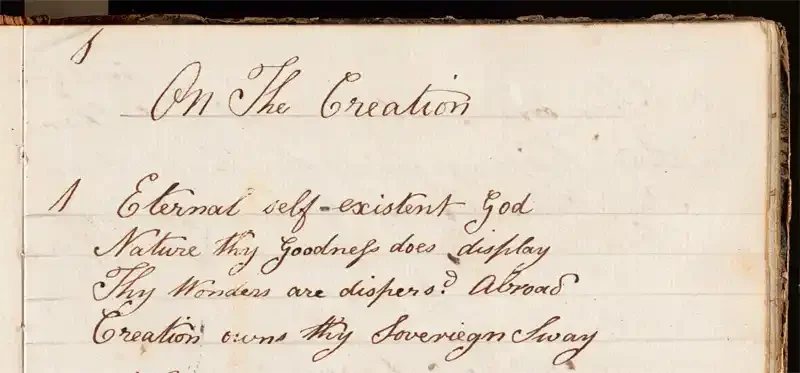
I had absolutely no expectations and no preference as to what the results might yield. Driven purely by curiosity I was happy to realise that I might have found a useful task for AI.
The short answer from Claude is … yes, Mary wrote the poems.
However, (and this is where my rabbit hole was dug way deeper and exponentially wider) it would appear that the published versions in “Fables and Other Pieces in Verse” are measurably edited reworkings of what Mary actually wrote in her hand written notebooks.
I should possibly restate now that I am neither an expert in linguistics or poetry, nor am I even a particularly good writer, I didn’t do the difficult legwork for this research, the AI did and I’m happy to be told it’s workings are dubious; or even wrong; whatever the reason, the published works are substantially different from Mary’s handwritten work.
Substantial enough to materially alter her voice, the structure, and in some places the theology of the words (it can be easily established that Mary was rather religious).
I can see for myself that the hand written poems I asked to be sent from the West Sussex Record Office Home are different from those published in 1831.
It would be pointless to discount that Mary herself may have reworked her words (possibly numerous times over many years) I’m just proposing a hypothesis and remaining curious.
Let us first look at the idea that Mary and her poetry were (for want of a better phrase “well packaged”.
Mary was literate, and demonstrably wrote things down.
I mentioned, I believe, in a former letter, that she had not been in the habit of writing down her compositions, and that when I asked her how she managed to preserve them, she gave me a truly Devonian reply, assuring me that ‘ she could mind them,’ meaning she could retain them in her memory.
I think this is a very important fact, and it cuts through a great deal of the romance and the clever marketing. Mary could read and write (her spelling might not have been spot on) but she wrote her poems down in a notebook signed in her own hand and dated 1825. It’s held at the West Sussex Record Office.
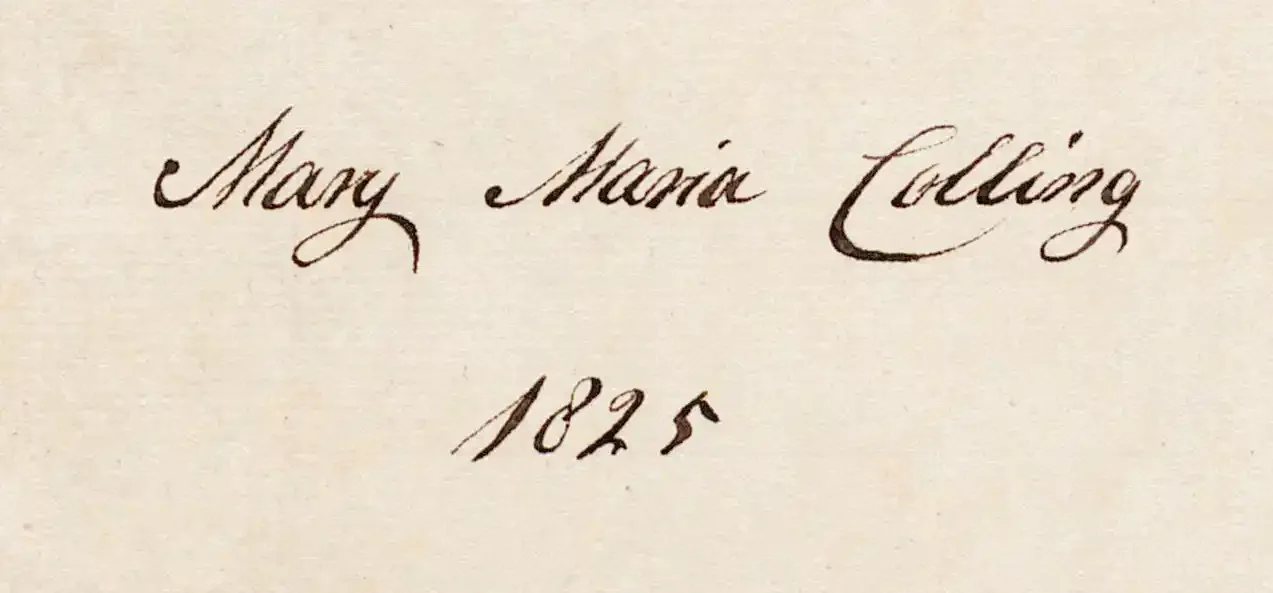
The date matters here.
It places this notebook several years before Bray's "discovery" of Mary in 1831, the West Sussex Record Office brackets it at 1820-25.
The poems in it; including "On the Creation," the poem the standard account says was inspired by Edward Atkyns Bray's sermon and was supposedly Mary’s first attempt at poetry is written out in Mary's own handwriting, long before any documented editorial relationship existed.
.. and as to her language, she had gained that from hearing Mr. Bray preach. To listen to him was her greatest delight, and she thought she owed much to his sermons. As a proof of it,” she said, “ he had inspired her to attempt poetry.” It was on the following occasion, about six years ago, he preached a sermon on the power of God manifested in the creation of the world ; she was struck with it, and, on her return home, composed the following, being her first essay in verse ...
A girl who teaches her own father to read at thirteen, and who keeps a dated notebook of her own poems at twenty, is definitely not composing in the manner of an illiterate folk bard.
The "she didn't write them down" framing is older than Mary.
The “simple working class country girl”, composed-in-her-head story, which I believe is partly responsible for some of the critical backlash which Mary endured, comes directly from Bray's letters to Southey.
It’s then merely recycled in the “Spectator's” puff piece of January 1832:
Mary Colling is a spirited and a pretty girl, whose reputation even the envy she so lashes has not touched; and, like Mr. Jones the butler, Mary the housemaid has never yet permitted her devotion to the Muse to interfere with the duties of making beds and scouring floors. With, however, a most laudable consideration of her tastes, and as an appropriate compliment to her powers, her master has put the flower-garden under her care; and here, and in her old kitchen-chair, she chiefly composes her verses,—not committing them to paper, but “minding” them, as she calls it, in the manner in which it may be remembered of Mr. Jones, who, when the bell rang, used to imprint his unfinished stanzas on his memory, by repeating his verses to the music of the stairs.
The "she didn't commit them to paper" line is, in the end, a clever packaging device.
It fits into a very established Victorian literary market: the brilliant “natural genius” from the working classes, untutored, uneducated, composing by inspiration.
Stephen Duck (the “threshing” poet, taken up by Queen Caroline in the 1730s); John Clare, whose publisher John Taylor apparently heavily edited him; Mary Collier, the Petersfield washerwoman who answered Duck in 1739; John Jones the Butler.
All of them came with similar framing. Composing-in-the-head had become a trope of the genre, not a Colling speciality. It’s almost unthinkable that so called “real poets” wrote absolutely everything down.
It’s also very likely the writer in The Spectator knew this perfectly well. They note, with a fairly dry sideways glance, that Southey seems to be considered “the general father of the illegitimate muse”.
They’re not taking the “natural genius” packaging entirely at its face value.
I’m at pains here to point out that just because something isn’t true, doesn’t mean that automatically negates any value it might hold (this is a very important distinction I hope to investigate in future articles).
Southey's verdict, and what it licensed (The Poet Laureate and The Romantic Novelist)
In the letters between Bray and Southey:
To use your own words, she has “the eye and the ear, and the feeling of a poet” though in her — more than in Mr. Jones — “the art may be wanting;” but with her, in the bloom of youth and health, it is not too late to acquire it.
It’s worth paying particular attention to that sentence. It’s the patronage of “lowly poets” perfectly distilled. Mary has raw talent but the “art” is wanting.
Which means, conveniently, that the patron “class” can supply what's missing. The Poet Laureate of England, the most authoritative literary voice of his moment, has diagnosed a deficiency that justifies the intervention. The patron diagnoses the gap. The patron then fills it.
While researching this I discovered a less than pleasant review of Mary’s work in the Monthly Review from 1st December 1831 which very pointedly makes note that Southey had not (at this juncture) made any comment on Mary’s work:
There is no disputing about tastes: we suppose that Mrs. Bray knows her man, and was probably courting Southey for an article upon her novels in the Quarterly; otherwise common delicacy must have prevented her from penning such trash.
A year later, when Southey came to write his own Quarterly Review article on the volume, he was open about who had filled it. He refers, more than once, to Anna Eliza Bray as "the benevolent editor of this volume." The word he uses is “editor”.
Not patron, not friend, not introducer. Editor.
Even in The Spectator article:
The lady who has undertaken to edite (sic) Mary’s fables is Mrs. Bray (formerly Mrs.
Southey, The Poet Laureate of England, in the principal Tory literary periodical of the day, acknowledged in print that Bray was Mary's editor, even as the volume's title page kept the relationship deliberately ambiguous.
What Southey was actually responding to when he wrote his initial assessment to Bray we don't know exactly. He probably didn't see the manuscripts in front of me. He had seen what Bray had shown him.
That's important, because what Bray was preparing to print is, as it turns out, substantially different from what Mary had written in her leather bound books.
Mr. Southey spoke warmly in praise of Mary Colling; and observed that in the eyes, forehead, and upper part of the face she was perfectly beautiful. ‘ What a sweet creature she would have made,’ said he, ‘had she but been brought up in a little higher sphere of life.’
Going back to Mary Colling’s Handwritten Manuscripts
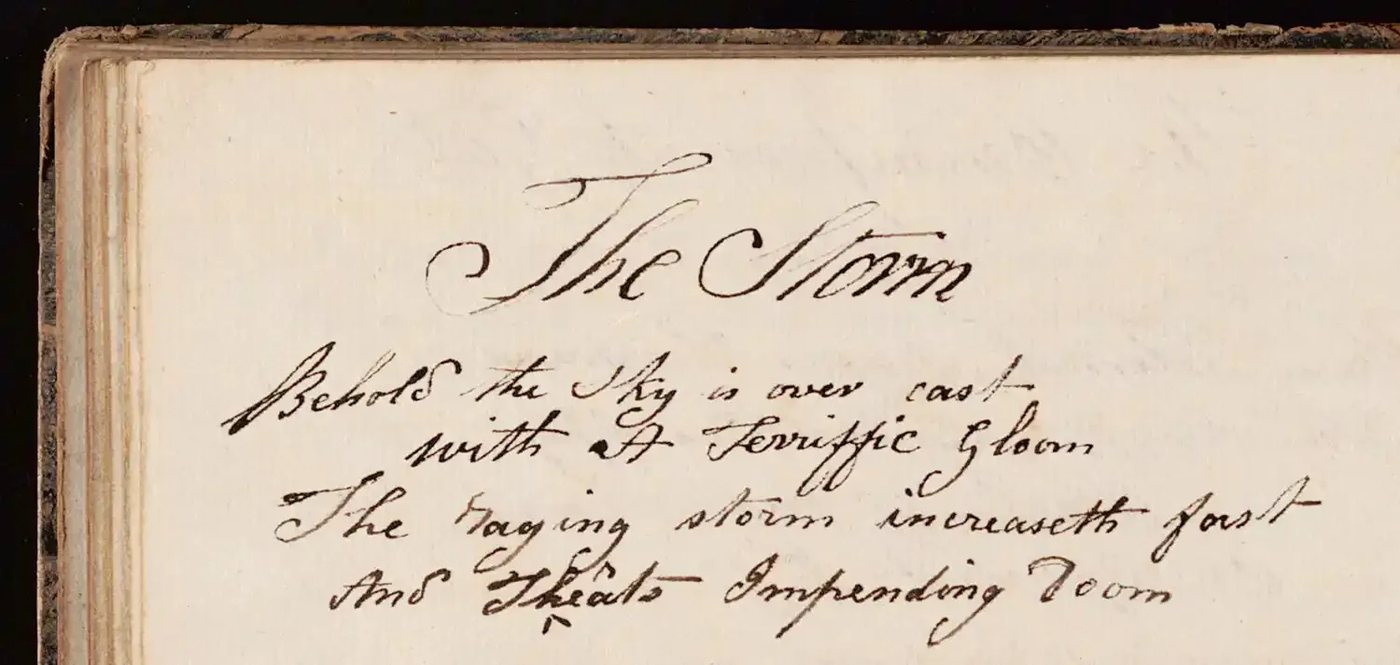
As I mentioned previously, after an inordinate amount of digging around, served up with a very large side portion of Internet Trawling, I have in my possession scans of two poems in Mary's own hand: "The Storm" and "On the Creation." (Thanks to the lovely archivist at West Sussex Record Office)
Both can be set alongside the printed text of Fables and Other Pieces in Verse (1831), and against the Spectator's January 1832 reprint of "The Storm."
The book and the Spectator have basically the same text, the same stanzas, the same wording. Logic tells us that the editorial work was done at the book stage, by whoever edited it for the publishers, Longman.
That whoever is, by every available indication, probably the Brays. The result of the comparison is a more substantial reworking than the standard account allows.
"The Storm"
Mary's manuscript "Storm" has fourteen stanzas.
The published version has eleven.
Four of Mary's stanzas were cut, one new stanza was added that doesn't appear in the manuscript at all, two stanzas were swapped in order, and individual lines throughout were significantly rewritten.
Here’s a side by side (unless you are on a phone, where one is below the other) comparison of the manuscript and printed versions, before we analyse the differences. I’ve left in Mary’s spelling mistakes and not (at this point) added in her corrections or hand written edits.
Manuscript
Behold the sky is over cast
with A Terriffic Gloom
The Raging storm increaseth fast
And Threats Impending doom

The Atmospheres in Tumults Hurl'd
And From the Frowning North
The Storm upon the watery World
In Fury Marches forth

Behold the Shivering Vessel Rocks
Upon th' Ambitious wave
The Seamans Art and Skill it Mocks
And threats A Watery Grave

Still Still with Unrestrained force
The Raging Billow lifts
Its Waves and over flows its Course
And Sweeps the Lofty Cliffs

Stanza Added ←
Stanza Added ←
Stanza Added ←
Stanza Added ←

The Lightening Darts with Awfull Glare
Fast Flie(s) the Vivid Flakes
The Thunder Roars and Rends the Air
The Vault of Heaven it shakes

While Toss'd upon that deep Abyss
The Hapless Seamen Give
The Mournfull Signal of distress
But None Can them Relieve

No Tracks of Safety can they Trace
How dreadfull is the Gloom
And Each with Horror in his face
Anticipates his Doom

They Cannot there for Shelter hide
Nor Shun the Ruthless foe
Danger looks big on every Side
And fears Increase the Woe

Now Each his fruitless Art doth drop
Nor doth the Storm impair
They take farewell of Every Hope
And plunge in deep despair

O Righteous Heaven in Mercy Deign
Their hapless State to view
Thou Canst the Raging winds Restrain
And Calm the Ocean too

Now in this Most Distressing time
They Earthly help have None
Bereft of Every help(aid) but Thine
Of Thine O Lord Alone

Danger Her direfull Yell Repeats
Thy pity Now they Crave
O Let them know the power that [threats]
Is Still as strong to save

Let them be Led to see that thou
O'er all things bears Command
That with Submission they May bow
Beneath thy Mighty Hand

Thou Givest the Stormy winds decree
Thy judgments to fulfill
These Heralds of thy Majesty
Obey thy Sovereign Will
Published (1831)
Behold, the sky is overcast,
With a terrific gloom ;
The doleful night is hastening fast,
And brings impending doom.

The atmosphere's in tumults hurl'd.
And from the frowning north,
The storm upon the watery world.
In fury marches forth.

The bosom of the mighty deep.
Is swell'd, and day departs ;
As bursting from a silent sleep.
Gigantic horror starts.

Its darkening waves with fearful force,
The angry ocean lifts ;
The billows overflow their course,
And sweep the lofty clifts

On high the shivering vessel rocks,
Upon the ambitious wave ;
The seaman's art and skill it mocks,
And threats a watery grave.

The lightenings dart : with awful glare
Fast fly the vivid flakes ;
The thunder rends the boundless air,
And Heaven's high vault it shakes.

While toss'd upon the deep abyss,
The hapless seamen give
The mournful signal of distress.
But none can them relieve.

Stanza Removed →
Stanza Removed →
Stanza Removed →
Stanza Removed →

They can no where for shelter hide,
To shun the ruthless foe ;
Danger looks big on every side.
They fear increase of woe.

Stanza Removed →
Stanza Removed →
Stanza Removed →
Stanza Removed →

All gracious Heaven, in mercy deign,
Their hapless state to view !
Thou can'st the raging winds restrain,
And calm the ocean too.

Stanza Removed →
Stanza Removed →
Stanza Removed →
Stanza Removed →

Danger her direful yell repeats,
Thy pity now they crave :
Oh ! let them know the power that threats
Is still as strong to save.

Stanza Removed →
Stanza Removed →
Stanza Removed →
Stanza Removed →

To stormy winds, thou giv'st decree,
Thy judgments to fulfil :
As heralds of thy majesty,
They all obey thy will.
A handful of examples will give the flavour.
Mary's opening stanza:
Behold the sky is over cast with
And in the printed book:
Behold, the sky is overcast,
With a terrific gloom;
The doleful night is hastening fast,
And brings impending doom.
The first two lines come through.
Lines three and four are completely rewritten.
Mary's raging storm becomes the editor's doleful night.
The image is no longer of a storm intensifying but of darkness approaching ,a very different picture altogether.
Later in the poem, a single word goes from plain to archaic.
Mary's manuscript:
Its Waves and over flows its Course And Sweeps the Lofty Cliffs
Published:
The billows overflow their course, And sweep the lofty clifts.
“Clifts” with a “t” - this is a venerable old poetic word, used by Spenser, Milton, and the King James Bible (as in "the clift of the rock").
The editor reached back into Renaissance and Augustan diction to make Mary's plain cliffs sound more literary. They didn't tidy her plain English; they replaced it with antique English.
Before I push the "they archaised her" line too hard, I have to be fair to the evidence, because it cuts both ways.
Mary's manuscript is not plain, modern, vernacular English.
It is already reaching for a literary register. In "The Storm" alone she writes "the Raging storm increaseth fast," with the old -eth ending; she shortens the into "th' Ambitious wave" the way eighteenth-century poets did to keep a line scanning; she inverts her syntax for effect.
"The Storm upon the watery World / In Fury Marches forth."
In "On the Creation" she reaches again and again for the archaic second person:
"Thou speak'st the Word," "Thou mad'st the Earth," "Thou Brought'st in Man." These are Mary's own words, in Mary's own hand, six years before any Bray took a pencil to them.
So the picture isn't the tidy one of a plain-spoken country girl whose honest vernacular was gentrified by her betters. Mary “wanted” to sound more like she believed a poet should, and the poets she had to hand, the ones she'd have heard from the Vicarage pulpit and met in whatever books reached her, were the poets of the previous century.
The olde worlde writing was, in part, hers.
What the editors did was not invent that register but finish it. Where Mary wrote does, they wrote doth.
Where she wrote cliffs, they wrote clifts.
Where she reached for an eighteenth-century effect and didn't quite land it, they landed it for her.
Mary writes the archaic "increaseth" in her manuscript, and the editors cut that whole line in the printed text (your opening stanza becomes "The doleful night is hastening fast"). So one of Mary's genuine archaisms was discarded while new archaism (does → doth, cliffs → clifts) was imported elsewhere, which tells me the “editors” weren't preserving Mary's old-fashioned flavour, they were substituting their own.
Which, awkwardly, lands us right back on Alford: "Her language is not that of her own home, but of her friendly patrons." He meant the printed verse.
But the manuscript suggests it was true even of the words Mary wrote herself, she had absorbed the patrons' register before they edited a single line. The voice was being borrowed at both ends. And that makes the authorship question more tangled, not less: even where the hand is unmistakably Mary's, the ear behind it may already have been the Brays'.
The theological alterations are subtler but, I think, more telling.
Mary's stanza begins:
O Righteous Heaven in Mercy Deign
In print this becomes:
All gracious Heaven, in mercy deign
Mary's God in "The Storm" is “righteous”, judging, sovereign, awesome. The editor's God is “gracious”, merciful, kindly, consoling.
That's not a smoothing change. That's the kind of revision someone makes when they have a definite view about what English religious verse ought to sound like in 1831. And then, three stanzas later, the closing couplet:
These Heralds of thy Majesty
Obey thy Sovereign Will
becomes:
As heralds of thy majesty,
They all obey thy will.
“Sovereign”; possibly the strongest word in Mary's couplet; describing the divine authority her shipwreck poem is finally addressing, is gone. Mary's basic narrative survives. Her core imagery survives. But the published "Storm" is, in many ways, a more conventionally devotional, theologically gentler, and stylistically older sounding (Romantic) poem than the one she actually wrote.
"On The Creation" - Mary Maria Colling in her own hand
If "The Storm" is suggestive, "On the Creation" is direct. Mary's manuscript version, dated 1825, has five stanzas.
The published 1831 version has seven.
Two stanzas were added, the manuscript shows no sign of.
One of those added stanzas opens:
The spacious firmament was rear’d,
— Soon as the dread command was given;
Unnumber’d worlds at once appear’d.
And gemm’d the azure arch of heaven.
Obey observes that the first line is almost certainly an echo of Joseph Addison's hymn "The Spacious Firmament on High" (1712), one of the most famous English religious poems of the period.
Bray, in her preface, attributes Mary's knowledge of the phrase to Mary hearing it quoted by Edward Atkyns Bray.
Obey though, clearly states :
One has to be careful, however, about attributing Colling’s diction to such adventitious circumstances as personal acquaintance with the Brays. As Coleridge observes in chapter 17 of the Biographia , regular exposure to the Bible and the Anglican liturgy improves the diction even of the working class. Left to her own devices, Colling might well have gone on to write even more poems like the “Hymn on the Nativity” and “From Isaiah,” appended to the Fables volume.
Obey even acknowledges that “Anna Bray's papers contain Colling's original copy book of poems.” though doesn’t seem to consider that maybe Colling wasn’t the author of those lines at all.
Manuscript
Eternal self-existent God
Nature thy Goodness does display
Thy Wonders are dispers'd Abroad
Creation owns thy Sovereign Sway

These Products of Creating Skill
To Speak thy Praise they all combine
They are Subservient to thy will
And all proclaim thine Hand Divine

Stanza Added ←
Stanza Added ←
Stanza Added ←
Stanza Added ←

Thou speak'st the Word and they obey'd
If Angels did with Praise employ
Ten Thousand Forms at once were made
The Morning Stars they Sang for Joy

These Wonders of thy mighty Hand
Show us thy Wisdom is immense
And There display'd thro' every land
Memorials of Omnipotence

Stanza Added ←
Stanza Added ←
Stanza Added ←
Stanza Added ←

Thou mad'st the Earth with Charms [Replete]
And Blessings fill'd this lovely Frame
And When thy System was Complete
Thou Brought'st in Man to praise thy Name
Published (1831)
Eternal, self-existent God!
Nature thy goodness doth display;
Thy wonders are dispersed abroad;
Creation owns thy sovereign sway.

These products of creating skill.
To speak thy glorious praise combine;
They are subservient to thy will,
And all proclaim thine hand divine.

The spacious firmament was rear'd,—
Soon as the dread command was given;
Unnumbered worlds at once appear'd.
And gemm'd the azure arch of heaven.

Nature thy sovereign voice obeyed;
Angelic songs it did employ;
Ten thousand forms at once were made;
The morning stars they sang for joy.

The wonders of thy mighty hand
Show us thy wisdom is immense;
For there 's display'd through every land
Memorials of Omnipotence.

From heaven, thine own eternal seat,
Thine eye surveyed this lovely frame,
And when the system was complete,
Man was brought in to praise thy name.

The new-born day rose at thy word;
'Twas usher'd in with seraphs' lays;
They tuned their harps, and forth was pour'd
A universal tide of praise.
The entire stanza containing the phrase isn't in Mary's 1825 manuscript at all. Possibly Mary added it to a later draft, or possibly the stanza was supplied editorially and the attribution to Mary's "hearing the phrase" is part of the extended fallacy of the “uneducated poet”.
“Azure arch of heaven, gemm'd” seems to me, to belong to the Addison hymn tradition, not to a labourer's daughter in Tavistock. If anything they are in the tradition of the Vicarage.
Within the stanzas Mary did write (we can see them in her own hand), the same kind of intervention recurs.
Her line "Thou speak'st the Word and they obey'd" is a plain biblical echo of Genesis and the Gospel of John — becomes the editor's "Nature thy sovereign voice obeyed."
The Word is gone; in its place an abstracted Voice. The biblical resonance has been quietly turned down. And then there is the single piece of evidence that, on its own, settles the question of what the editorial relationship actually was in practice.
In stanza five of Mary's manuscript, she has written: Thou mad'st the Earth with Charms And Blessings fill'd this lovely Frame And When thy System was Complete Thou Brought'st in Man to praise thy Name
As written, the rhyme doesn't work (at least to my mind) - Charms and Complete don't rhyme.
Mary noticed. She wrote the word “Replete” in the upper margin of the page, indicating the correction: the line should read "Thou mad'st the Earth with Charms Replete."
That gives a clean ABAB rhyme: Replete / Frame / Complete / Name.
It is Mary's correction to her own poem, in her own hand, on her own manuscript.
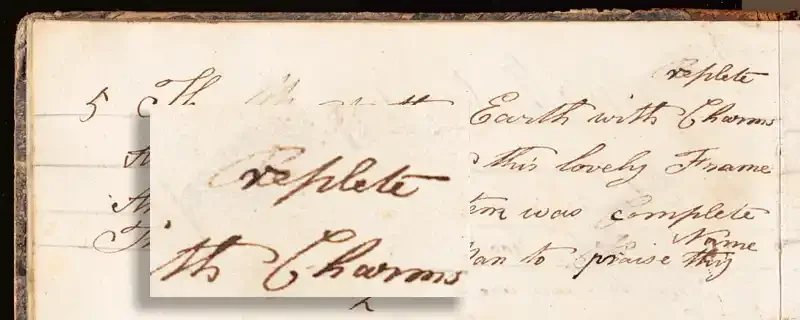
The published version did not use her correction. Instead, the editor rewrote the first two lines entirely:
From heaven, thine own eternal seat,
Thine eye survey'd this lovely frame,
Mary's image of God making the earth with charms, blessings filling its frame, is replaced with God's eye surveying creation from his eternal seat in heaven. Conventional. Devotional. Eighteenth-century-hymn. Whoever edited this saw Mary's correction in the margin of her own manuscript, and overruled it. That, I think, is the patron-mediation relationship caught in the act on a single page.
Which Bray held the pen?
There's a quiet assumption running through almost every account of Mary’s work, including my own, until now. It kind of goes without saying that when we say "Bray" edited Mary's poems, we mean Anna Eliza Bray.
What if she didn’t?
Anna Eliza Bray was a novelist. A very prolific and pretty successful one but a writer of prose. As far as I can see, in a career spanning sixty odd years she never published a single poem of her own.
The one book of verse her name is attached to is “Poetical Remains” (1859), and that is her late husband's poetry, selected and edited by her after his death. Anna's whole relationship to poetry was editorial. She arranged other people's verse; she didn't write it.
Her husband did.
Rev. Edward Atkyns Bray (1778–1857), Vicar of Tavistock and perpetual curate of Brent Tor, had been writing poetry since boyhood, he circulated two small collections of his verse amongst his friends before he was twenty-three. He was schooled almost entirely at home, came to the Church by way of the bar, and belonged, very much by birth and habit, to the eighteenth century.
His poetic models were the models of the previous age. When Alford's witnesses spoke of "Mr. and Mrs. Bray" correcting and polishing Mary's verse, they named him first, and I don't think that's an accident.
Others tell me it was a general impression that Mr. and Mrs. Bray corrected and gave a finishing polish to M. M. Colling’s published verses.
Because every editorial fingerprint in "The Storm" and "On the Creation" points the same way.
“Cliffs” reaches back to “clifts”; plain biblical English is lifted into Augustan hymn diction; a whole stanza arrives echoing Addison's "The Spacious Firmament on High" (1712).
That is not the instinct of a Regency novelist. It is the instinct of an eighteenth-century clergyman-poet, a man who'd have known the Addison hymn off by heart, and for whom "the azure arch of heaven, gemm'd" was not an affectation but his first language.
A smoking gun?
The standard account says "On the Creation" was inspired by a sermon of Edward Atkyns Bray's, on "the power of God manifested in the creation of the world."
So the one poem we can watch being expanded with borrowed hymn-diction is the very poem the vicar himself set going. The sermon was his. The theology of the additions is his. The eighteenth-century diction is his.
Obviously I can't prove Edward held the pen, it’s all speculation and short of a marginal note in his hand surfacing somewhere, it will only ever remain speculation.
But "the editor" has all this time been quietly assumed to be the famous Mrs Bray, when the evidence, the diction, the theology, the sermon, the order in which Alford's witnesses named the names, points at least as firmly at the less famous Mr Bray beside her.
At the least it was a joint operation. At most, the woman whose name carries the story did the discovering, the letter-writing and the marketing, while her husband did the versifying.
A small correction, but the kind that matters: maybe we've been crediting the wrong Bray?
What was actually happening between Southey, The Brays, Mary Colling ?
None of this softens the two hardest pieces of evidence, though. A whole stanza of Addison-flavoured hymn diction that appears nowhere in the manuscript is an addition, not an amplification, I feel like you can't absorb your way into a stanza you never wrote.
And Mary's own corrected rhyme, overruled in favour of the editor's line, is a plain overruling whatever register she was writing in.
If you take the two manuscript poems together, one cut and rewritten, the other expanded and rewritten, what emerges is not a "finishing polish" (the phrase used by Rev. D. P. Alford, a later Vicar of Tavistock who saw a different set of Mary's manuscripts in the 1890s and concluded the published verse essentially matched).
What emerges is something larger and more interesting: a consistent editorial process that took Mary's raw text and remade it to fit the literary register of her patrons.
Alford's observation holds up perfectly against the manuscript evidence: Her language is not that of her own home, but of her friendly patrons.
Anna Bray herself says:
Not long after the successful appearance of Mary Colling’s book, I began to taste the sweets, or rather the bitters, of patronizing and editing uneducated poets, for applications were made, and MSS forwarded to me, from a variety of quarters; all hopeful authors requested the same favour that had been bestowed on her. It was annoying in the extreme.
Note the use of the word “edit”.
Anna is already regretting the choices she has made.
Obey's reading of Fables as a heteroglossic feminist text is largely compatible with what the manuscripts show, and where she goes way beyond what I've done here; for instance, in her sharp reading of the frontispiece portrait, where the housemaid's bonnet overpowers Mary's face, or in her account of how the Mary Philp grandmother narrative deviates from the standard "annals of the poor" Southey had asked for.
But on the specific question of how much Mary's voice survived intact into print, the manuscripts tell a more pointed story than the published volume alone can. The "heteroglossia" in which Mary supposedly participated turns out, at the level of individual stanzas, to be more often Bray's voice than Mary's. The Replete moment in particular is the kind of evidence Obey's framework can't fully accommodate. Colling is making her correction; the editor is overruling it; the relationship is one-directional in this specific instance, whatever it may have been in the abstract.
Who is to say Mrs Bray suggested edits and Mary’s position merely made it easier to agree.
The critics in the room - Mary Maria Colling analysed
The patronage circle was not blind to what they were doing, and they were not the only ones watching. Read across the five major periodical reviews of Fables from 1831 and 1832, the same concern surfaces in different voices, from different political and aesthetic positions, and with very different degrees of sympathy for Mary herself.
The Athenaeum in 1831 (the review almost certainly by the Lake Poet protégée Maria Jane Jewsbury) admired the volume but warned that bringing Mary "forward as a poet, drawing public attention to her as an intellectual marvel, another of the race of prodigies, is not too perilous a price for a temporary benefit." Already, the reviewer noted, Mary "appears to have suffered from the envy and ill-will of her equals in life, but inferiors in mind." The writer offers the sharpest single diagnosis of Mary's situation in 1831:
She occupies an anomalous position: sufficiently gifted to be above her born associates, and not sufficiently so to break down, or have broken down for her, the factitious barriers that lie between herself and those above her, she is placed in a position similar to that of a person looking up at the stars.
The Gentleman's Magazine in December 1831 framed the volume as a courtroom case in which Mary was "arraigned at the bar charged with trespassing on Parnassus" and acquitted only after Mrs Bray testified on her behalf.
Even the favourable verdict reads Mary's writing as inherent trespass. The reviewer's own warning was theological rather than social: if the literary attention should "lead her from the path of duty, she will have eaten of the tree of knowledge but to the increase of her own responsibility."
The Fall narrative, applied to working-class education.
The Spectator in January 1832 was knowingly arch about the whole patronage tradition, sliding in its sideways remark about Southey as "the general father of the illegitimate muse."
And Southey himself, in the Quarterly Review of 1832, opened his twenty-three-page article on Mary by explicitly pairing her with Lucretia Davidson (an American girl-poet who had died young after being overstimulated by literary attention) and who Southey himself had eulogised in his own 1829 essay as a cautionary tale.
Six months earlier, in a private letter to Bray dated 14 July 1831, Southey had warned that Mary's "nervous disposition" required careful handling, citing exactly this Davidson parallel: "That sweet American girl Lucretia Davidson was beyond all doubt killed by excitement of this kind."
Then he goes ahead and writes a twenty-three page puff piece that basically puts Mary in the same frame.
The warning was in the room. He printed the warning. And he proceeds with the marketing plan anyway.
Sharpest of all was the Monthly Review in December 1831, whose anonymous reviewer was openly hostile to Mary, to Bray, and to the whole genre of patron-mediated working-class verse.
The contempt for Mary herself is undisguised ; her fables are "trash," her satirical pieces evidence of "natural malignity and bad temper," her best fate would be to "sell fruits and flowers from her own garden" rather than write.
The class snobbery is unmistakable. But underneath the snobbery, this reviewer named the structural mechanism more clearly than any of the others.
The article opens with a thought experiment: that they could, if they chose, take up the hymns of "a very worthy man"; a gardener of their acquaintance; "polish them up" for the religious public, collect subscriptions, obtain "a most grateful dedication," gather "various particulars of his life," and "gain a little fame for ourselves, but very little money for the poor man; and end in giving him so much disgust for his present honest and industrious mode of living, as to render it necessary for him, in a short time, to solicit... the assistance of his parish."
That is the patronage operation laid bare, in print, in 1831 along with a prediction of the harm done to Mary.
The reviewer goes on to identify "the vanity of the patron, or the patroness" as the engine of the whole genre, and to call Bray, like Southey before her, the editor of the volume — "the poetry is worthy of both parties, the inditer and the editor."
And the review closes by saying Bray "alone must stand accountable to this poor girl, for the disappointment of hopes that ought never to have been encouraged, and most probably for rendering her discontented with the humble station in life, in which it was the will of Providence to place her." A hostile critic, in print, in 1831; and, as we'll see; fourteen years ahead of Mary's own circle reaching the same conclusion.
There is one further irony worth flagging across the five reviews. Both the Athenaeum and Southey's Quarterly Review article identified the same flaw in Mary's verse: the archaic verb constructions, she uses too many doths, dids, the Stuart-era expletive verb.
The Athenaeum noted them as "few inelegancies of rhythm." Southey ascribed them to the "colloquial language of humble life."
Both reviewers were criticising Mary for the archaisms in her published text. But the manuscript shows that not all those archaisms are Mary's. Cliffs in the manuscript becomes clifts in print.
Plain biblical English becomes Augustan hymn diction. The Stuart-era flavour the reviewers identified as Mary's labouring-class voice is, by direct manuscript comparison, the editors' importation.
The most authoritative literary critics in England, in 1831 and 1832, were criticising a working-class poet for sounding too archaic, when at least one of the archaisms had been introduced by the patron class for exactly that effect.
The five contemporary periodicals I’ve found; Athenaeum, Gentleman's Magazine, Spectator, Quarterly Review, Monthly Review; span the whole political range of 1830s, from Tory establishment to Whig opposition to liberal independent.
Their reviews of Mary's poetry range from cautious praise to open contempt. On the question of whether this “patron-and-protégée” operation was good for Mary herself, the five voices converge. The sympathetic reviewers worried about it. The hostile reviewer predicted catastrophe. The system was visible to its contemporaries, from every angle, and described by them in their own words.
The Rev D.P Alford (himself vicar at Tavistock) wrote about Mary, thus:
All that remember M. M. Colling speak of her refinement of manner and appearance, and say that the portrait in Mrs. Bray’s book is very true to life. Others tell me it was a general impression that Mr. and Mrs. Bray corrected and gave a finishing polish to M. M. Cotling’s published verses. Certainly they do seem very smooth and correct for a person of Mary’s very slight education. But I have seen many of her poems left in MS., and now in the possession of Miss Leamon of this town, which have just the same character of correctness and smoothness of language and rhythm, with scarcely anything worth altering, only a word or two not used in quite its right meaning. Mary’s poems would, in fact, be more interesting, because they would seem more original, if they were not quite so smooth and correct. They have much of the careful propriety, and something of the artificiality, of the poetical language of the last century. Though Wordsworth had waged war against all this in theory, and Coleridge and other great poets ill practice, it prevailed with people of the old school far into the present century. I know the Brays must have held to these old poetical traditions, and Mary, who looked upon the Brays as literary oracles, naturally followed their traditions both in theory and in practice. Her language is not that of her own home, but of her friendly patrons.’
A note on Mary's later life
Mary's mental decline came at the very end of her life, in the 1840s and early 1850s; two decades after the poems were written and more than a decade after the book was published.
On Rev. Alford's account her symptoms were restlessness and compulsive swearing, "a sad picture of one naturally so gentle." Friends sent her to Bude for a change of air; it did no good. She spent a short time in an asylum, recovered, and came home "quite well in mind, though feeble in body." She died of dropsy on 6 August 1853, aged forty-eight, at her married sister Mrs Nicholls's house in Bannawell Street.
Her mother had died at seventy-eight, the previous August. Her father would follow her, eighteen months later, at eighty-five.
The illness has nothing to do with the authorship question. Or does it?
She wrote the poems twenty years before her mind began to slip. By the time she could no longer hold a thought together, the book had been on Longman's list for a decade. But the illness is interesting for another reason. The proximate trigger Low identifies in his book is that Mary's employer Colonel Hughes died, and his heirs declined to keep Mary on, despite her having spent her working life in their father's service. Within months of that dismissal she was unwell.
There are suggestions of alcoholism (which I've found no evidence of) and of Tourette's Syndrome (on account of the swearing). The Tourette's idea seems very unlikely: it's essentially a childhood-onset disorder, and verbal tics that surface in adulthood would almost always have shown up in childhood first. Coprolalia; the involuntary swearing; is in any case rare, and tends to get fixed on precisely because it's the most noticeable and memorable feature of the condition rather than the most common. Far more likely is that the sudden cessation of what had become her life (and one she obviously enjoyed) left her adrift, and that the neglect of her own physical health which followed dragged her mental health down with it.
*I’ve also recently come across the article by Tim Burke which states:
Under the pressure, she made a suicide attempt, and was admitted to an asylum for a time.
Again, I can only presume this is mentioned in the letters between Mrs Southey and Mrs Bray (see next section).
And it was at this point, some fourteen years after the publication of “Fables”, that Caroline Bowles, by then Robert Southey's widow and a poet in her own right, wrote to Anna Eliza Bray to express her sympathy:
Dear Mrs Bray [would] you be surprised if I say I was not, or but little so - at what you told me of this poor thing - one of the very, very few subjects on which there was a shade of difference of opinion between my Beloved & me - was in relation to Mary - I could never divest myself of a doubt whether in her station of life, there was not more of damage than promise in a sort of distinction which in a manner isolated her - Such conduct as you describe on the part of her old Master’s relatives were too much to be expected — well did Grey write ‘A favourite has no friend —‘ and poor Mary’s mind had not been preparing tor endurance [properly?] by the cultivation of her imaginative faculty -
That is the inner Southey circle, admitting in writing that the literary patronage may have done Mary more harm than good. Bowles's reference to Thomas Gray’s poem “Ode on the death of a favourite Cat” by quoting "a favourite has no friend" is actually more telling than Low (who transcribed the letter in his book “The Literary Protegees of the Lake Poets”) might have realised.
Low has written “Grey” it should be “Gray”, however, more telling is the poem is a mock-elegy on Walpole's cat, drowned in a goldfish bowl with no one watching. Bowles has turned a line about a petted creature that dies the moment its protector looks away as an observation on Mary and Anna. It’s quite vicious.
Set against the Athenaeum and Gentleman's Magazine reviews of 1831, the Bowles letter of 1845 is not a piece of belated insight. It is confirmation of a worry that was visible in print from the start. The patrons were warned, in public, by their peers. They proceeded anyway.
In 1873 (by which time she was living in London) Anna Bray, in editing her memoirs for publication, came across a letter she had written, forty years before to Robert Southey, describing Mary Colling in glowing terms as her ‘friend’. Anna with hindsight revised this letter before publication, deleting the inappropriate sentence referring to Mary as a friend. However, during that snowy Christmas week of 1836 the ‘natural’ class order was temporarily forgotten.
From The Quarterly Review 1837 -
There cannot be a more feeling, affectionate, or humble mind, or a more perfectly natural and engaging character. I am proud to call Mary my friend, and I shall never meet with one more constant or deserving ...
We cannot be sure Anna Bray edited the word “friend” from her autobiography (or whether it was her nephew, who edited the autobiography).
Where this leaves us concerning Mary Maria Colling
So, what is the conclusion of my meandering research into Mary Maria Colling?
Mary wrote the poems - in a notebook in her own hand, dated between 1820 and at least 1825, several years before Anna Eliza Bray published her "discovery" of the young housekeeper.
The Brays didn’t ghost write for her; the manuscripts are unmistakably Mary's, complete with her own corrections (and spelling mistakes). The published “Fables and Other Pieces in Verse”; the version Southey praised, the version that major periodicals reviewed, the version every subsequent account of Mary Colling has been built on, is, in real and demonstrable ways, a Bray mediated artefact.
Stanzas have been cut and added.
Lines have been rewritten.
The theological register has been softened. Much of the diction has been archaised.
And, in at least one case, Mary's own correction has been overruled in favour of the editor's preferred line. The "art" that Southey said was "wanting" had, by the time he was assessing it, already been substantially supplied.
He was praising the version that Bray was preparing for print, not the version Mary kept in her notebook. Mary would not have been published without Anna Eliza Bray. That much is clear. Bray took down the fables, sent them to Southey, arranged the volume with Longman, framed Mary for the literary public in the long letters that make up the first half of the book.
Without that effort, Mary Maria Colling would have lived and died as one more clever housekeeper in Tavistock, and the poems would have stayed in a notebook that ended up in an archive, or on the fire.
What reached the reading public was no longer entirely her work. It was more of a collaboration whose full terms were never disclosed on the title page, one that many contemporary critics worried about at the time, and that the patrons themselves were privately uncertain about by 1845.
Since the publication of her little volume, she has devoted as much time as the duties of her service would admit to her improvement ; and I rejoice to tell those who fancied I might do her an injury instead of a benefit by bringing her forward, that the success of her book (and for one in her station of life it was considerable), and the notice it procured for her from so many honourable quarters, have done her no harm what-ever; but, I trust, much good.
And one more thought, by way of ending
The reason I think this all matters, and it's a thread I'll keep pulling at in future articles, is that Mary is, in the end, one of the lucky ones.
She had an Anna Eliza Bray.
She had a Vicarage within walking distance, a Poet Laureate willing to write a polite letter, a Longman publisher willing to take the risk an employer who was willing to pay for the printing (though not a reprint - reading between the lines, he liked having a “smart” servant, just not that much!)
We have two hundred pages of her, a portrait, a burial date, an asylum stay we wouldn't otherwise know about.
We even have a notebook dated 1825 which lets us measure, line by line, how much of her own voice survived the journey into print.
For nearly all working-class voices of this time, nothing survives. It’s a cliché, but history is written by the winners.
Just how many other housekeepers, farm labourers, miners, dairy maids, coopers, wheelwrights in how many other Tavistocks wrote poetry, or songs, or stories, or letters, or histories of the places they lived, that no one will ever know about?
The question of how we come to “know” a place, or a time, or a person is nearly always a question of who got to do the telling, and on whose terms.
One of the most telling details in Southey's “Quarterly Review” article is worth returning to.
When Mary received her share of the royalties from Fables and was advised to put the money into the Savings' Bank, she replied that the first thing she intended to do with any part of it was to place a stone on the grave of her grandmother, "she had carefully attended to the grave for many years, and did not like that it should lie without anything to mark it."
The woman who wanted to mark her grandmother's grave was buried, twenty-two years later, in an unmarked grave.
There is no memorial to Mary in Dolvin Road, nor any record of where exactly she is buried. I assume she is in the central area of consecrated ground used by the Anglicans.
For now I'll just leave Mary somewhere on Dolvin Road, and say: she was here.
She wrote the poems, in her own hand.
She corrected her own rhymes.
The version that reached the world had her name on the inside page and perhaps somebody else's diction on every fourth line.
Just a few more thoughts
It seems to me that Mrs Bray was perhaps hoping to emulate her mentor Southey (Even ignoring the possible influence of Mr Bray). Although she’s a woman of a superior social position, in the male dominated Victorian era, it would be almost impossible for her to mentor a man (even a common man) so she seeks out a woman to mentor.
The last mention of Mary Colling in Anna Bray’s autobiography is from the entry for 24th of December, 1836. The date that the Poet Laureate visited. It’s clear that Mary was part of the visit for however long it lasted (they even made a visit to the Colonels house in the snow) however, Mary lived another seventeen years and Anna another forty-seven years (some of which she covers in her autobiography) yet no more mentions of Mary?
Also Anna is still using Mary’s words as late as 1837 (quarterly Review) - she is acknowledging Mary, but is she being paid for her writings?
It appears that The West Sussex - have 3 letters from Mrs Southey to Mrs Bray dated 1845 regarding Mary’s illness I’ll save up to see what they say. I’m presuming that nothing was done to help Mary in her time of need.
Obey states:
The metaphor of monstrosity is more poignant in light of Colling’s final fate, for the woman who feared the stigma of being “mazed” was in fact committed to an insane asylum, where she died some years later (though the exact date is not known). To Bray’s credit, she continued to try to aid Colling to the end. The possibility that the aging Colling developed Tourette’s Syndrome increases the irony in a poet’s final loss of such hard- won discursive control.
It's apparent Mary didn't die in the asylum, she recovered enough (at least mentally) to live with her sister and died in Tavistock. Obey's "to Bray's credit, she continued to try to aid Colling to the end" is generous; the letters I've not yet been able to afford copies of may bear it out, but the rest of the evidence I've gathered points the other way. (On the Tourette's suggestion Obey raises, it doesn't really hold up.)
Is Mary's poetry good or bad? I’ve no idea, I’ve come to enjoy it (through researching this article).
I’m very much aware that academically this has zero currency, however, what I’ve discovered as I walk Dartmoor and try and capture the magic that I feel there is that when I come across ancient structures there’s something akin to the way I enjoy Mary’s work.
When I visit a stone circle or a stone row on Dartmoor, I find them interesting (even stimulating). In the same way I find a church interesting. When I stumble upon a hut circle or an ancient settlement because they represent “ordinary” people; people like me; I am fascinated.
I’m sure that I’m not alone in my interest in the mundane, the everyday, the ordinary. Stood in the remains of an ancient hut circle, looking through the stone door jambs, realising that thousands of years ago our ancestors decided to make their entranceway face the rising sun, that they saw this amazing view as they rose for a new day.
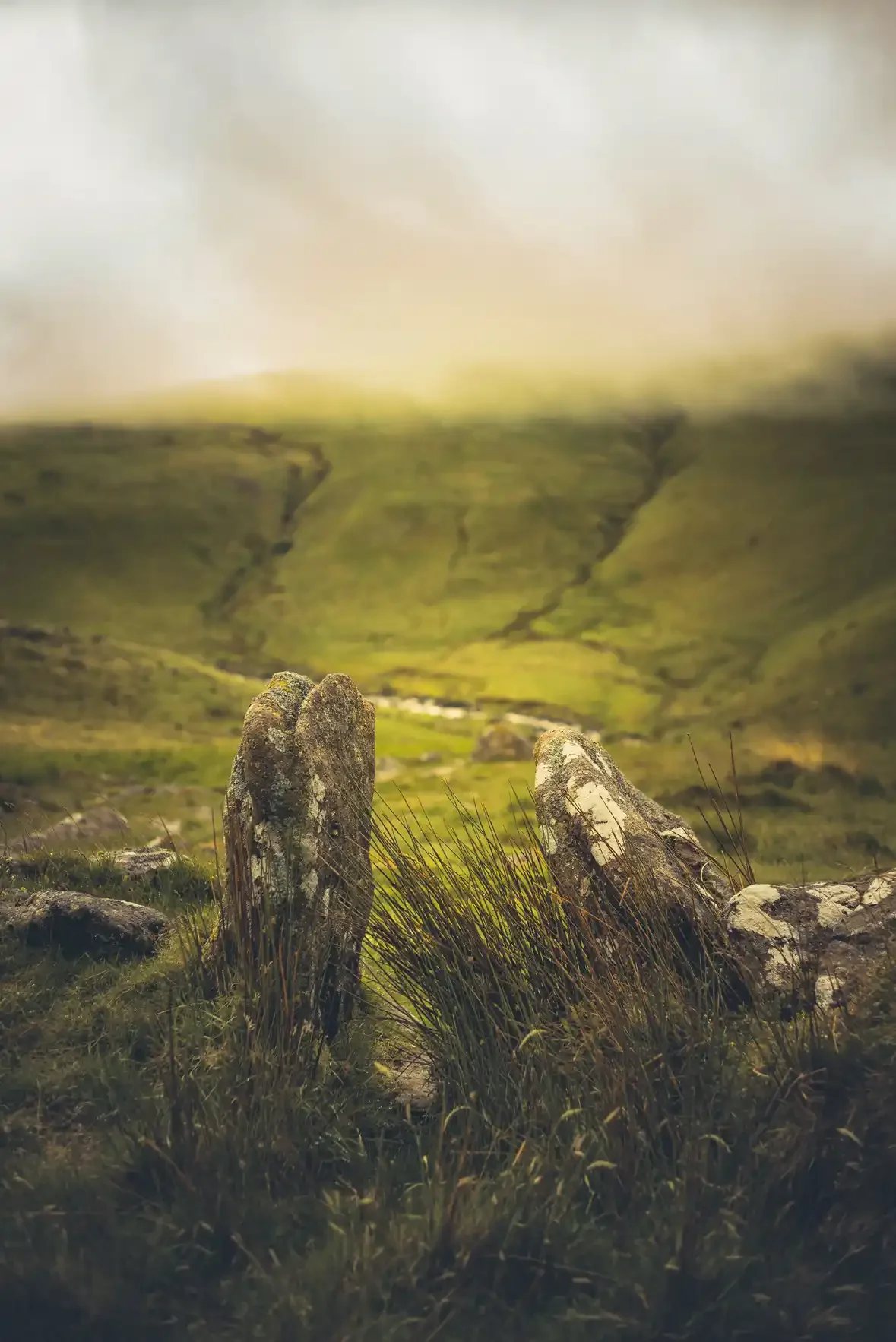
I think that’s what I like about Mary.
I can identify.
I’m reminded of a time when studying feminism in movies that our lecturer (whilst discussing the ladder scene in “Coma”) read the shedding of high heel shoes and pantihose’s identified all the usual aspects. I could see the point in all of the theorising, but ultimately I also saw a human being trying their best and making a few mistakes (very much like I would have). I think we’re all more like Dr Wheeler than Rambo.
The internet equivalent ….
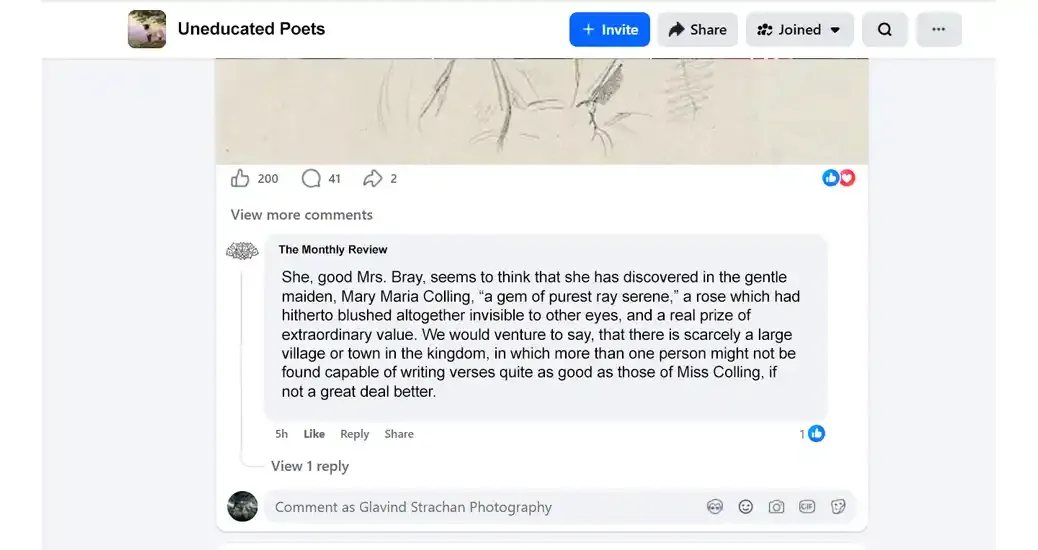
Mrs. Bray’s work has died before her. One of the minor celebrities of a former day, her tales are no longer read, and her very name is probably unknown to most of the novel-readers of the present ; but she only died last year, and now we have an autobiography of her, which contains some letters of Southey’s, and occasionally interesting illustrations of social characteristics of the early part of the century; but has otherwise little that is of value.
Further Reading on Mary Maria Colling
Primary sources
- Bray, Anna Eliza, ed.Fables and Other Pieces in Verse, by Mary Maria Colling. With some Account of the Author, in Letters to Robert Southey, Esq., Poet Laureate, &c. London: Longman, 1831. Available on Google Books: https://books.google.com/books?id=xUleeaTAGzwC
- The Athenaeum, no. 211 (12 November 1831), p. 762. Review of Colling's Fables, almost certainly by Maria Jane Jewsbury. https://books.google.com/books?id=XdmrNMZ3luIC&pg=PA762
- The Gentleman's Magazine, and Historical Chronicle, December 1831, p. 534. Review of Colling's Fables. https://books.google.com/books?id=V6VJAAAAYAAJ&pg=PA534
- The Spectator, 14 January 1832, p. 18. "Mary Colling's Poetry." https://archive.spectator.co.uk/article/14th-january-1832/18/mary-collings-poetry
- Southey, Robert. "Poetry by Mary Colling." Quarterly Review, vol. 47 (1832), pp. 80–103. Published anonymously. https://books.google.com/books?id=RTi1inKch_0C&pg=PA80
- Dowden, Edward, ed.The Correspondence of Robert Southey with Caroline Bowles. Dublin: Hodges, Figgis, and Co., 1881. Available on the Internet Archive: https://archive.org/details/correspondencewi00soutuoft
- National Archives. Will of Mary Maria Colling, Spinster of Tavistock, Devon. Proved 13 September 1853, Prerogative Court of Canterbury. https://discovery.nationalarchives.gov.uk/details/r/D13713
- The New Bray Archive, West Sussex Record Office, Chichester. The 1825 fair-copy manuscript notebook of Mary Maria Colling. Catalogue reference per Obey 2010: Box 3, Bundle 13. https://www.westsussex.gov.uk/leisure-recreation-and-community/history-and-heritage/west-sussex-record-office/
Secondary sources
- Alford, D. P. Letter on Mary Maria Colling, in W. H. Kearley Wright, ed., West-Country Poets: Their Lives and Works (London: Elliot Stock, 1896). The most extensive 19th-century biographical source. Available on the Internet Archive: https://archive.org/details/westcountrypoets00wrigrich
- Oxford Dictionary of National Biography, "Colling, Mary Maria (1804–1853), poet and domestic servant." Online edition, Oxford University Press, 2004. (Subscription, Wikipedia Library access, or UK public library membership required.) https://www.oxforddnb.com/view/10.1093/ref:odnb/9780198614128.001.0001/odnb-9780198614128-e-61556
- Obey, Erica. "'The Poor Girl's Talent': Romantic Mentorship and Mary Colling's Fables." Keats-Shelley Journal, vol. 59 (2010), pp. 65–77. The most substantial modern scholarly treatment. https://www.jstor.org/stable/41409531
- Low, Dennis.The Literary Protégées of the Lake Poets. Aldershot: Ashgate, 2006. Chapter 1, pp. 21–23, on Colling. Now published by Routledge: https://www.routledge.com/The-Literary-Protegees-of-the-Lake-Poets/Low/p/book/9780367882457
- Low, Dennis.Four Literary Protégées of the Lake Poets. PhD thesis, University of Hull, 2003. The earlier version of the above. https://hydra.hull.ac.uk/resources/hull:5708
- Orlando Project. Entry on Mary Maria Colling. Cambridge: Cambridge University Press. https://orlando.cambridge.org/people/1602e35e-d158-4021-9a4f-ed09808c7828 (subscription required for full entry)
- Sampson, Julie. "Talking about Tavistock: Mary Maria Colling; A C19 Maid-Servant Poet." Women Writing on the Devon Land blog, 9 April 2019. Useful local-historical context. https://newdevonbookfindsaway.blogspot.com/2019/04/talking-about-tavistock-mary-maria.html
- Pulsford, Ann. "A Literary Christmas 1836 at Tavistock Vicarage." Formerly on dartmoorlinks.co.uk; the original page is now offline but accessible through WayBack Machine. Cited in Sampson 2019 above for the claim that Mary Colling's headstone now stands in the churchyard in front of St Eustachius Church, Tavistock, but does not mark her original grave. This is an incorrect attribution. The Pulsford article says Mary’s grandmother’s headstone is now at St Eustachius Church. I have been unable to locate either a plot location or headstone for Mary.
- Tavistock Local History Society. Thanks to the lovely people at Tavistock Local History Society, 2021. TLHS, Tavistock Cemetery Transcriptions at https://www.tavistockhistory.co.uk/
Related works on labouring-class poets in the period
- Fulford, Tim, ed. Robert Southey: Lives of Labouring-Class Poets. London: Routledge, 2024. https://www.routledge.com/Robert-Southey-Lives-of-Labouring-Class-Poets/Fulford/p/book/9781032450872
- Christmas, William J.The Lab'ring Muses: Work, Writing, and the Social Order in English Plebeian Poetry, 1730–1830. Newark: University of Delaware Press, 2001.
- Goodridge, John, et al.A Database of British and Irish Labouring-Class Poets and Poetry, 1700–1900. https://www.exeter.ac.uk/research/projects/labouringclasswriters/
Mr. Southey spoke warmly in praise of Mary Colling ; and observed that in the eyes, forehead, and upper part of the face she was perfectly beautiful. “ What a sweet creature she would have made,” said he, “had she but been brought up in a little higher sphere of life.
For Clarity - A Footnote
I have no experience in analysing poetry, nor even researching local history.
I will not defend my claims, they are just claims, idle thoughts that occurred to me and rather than let them dissipate into the ether, I decided to write them down - my sincere hope is they ignite an interest in maybe one other person or at least my methods (mad as they be) can be expanded upon by people who actually know what they are doing.
If anything I have said upsets you, I am truly sorry and I meant no harm, I’m just curious.
My references are incomplete as in the construction of this piece the task became rather unwieldy and I lost my focus for a while (I shall attempt to update as many as I can).
That being said, I have saved as much of my source material (even if it’s a url and nothing else) to a folder on my backup hard drive and am happy to share these with anybody with a similar inquisitive mind 🤣
This way originally published on my Photography website “Glavind Strachan Photography”
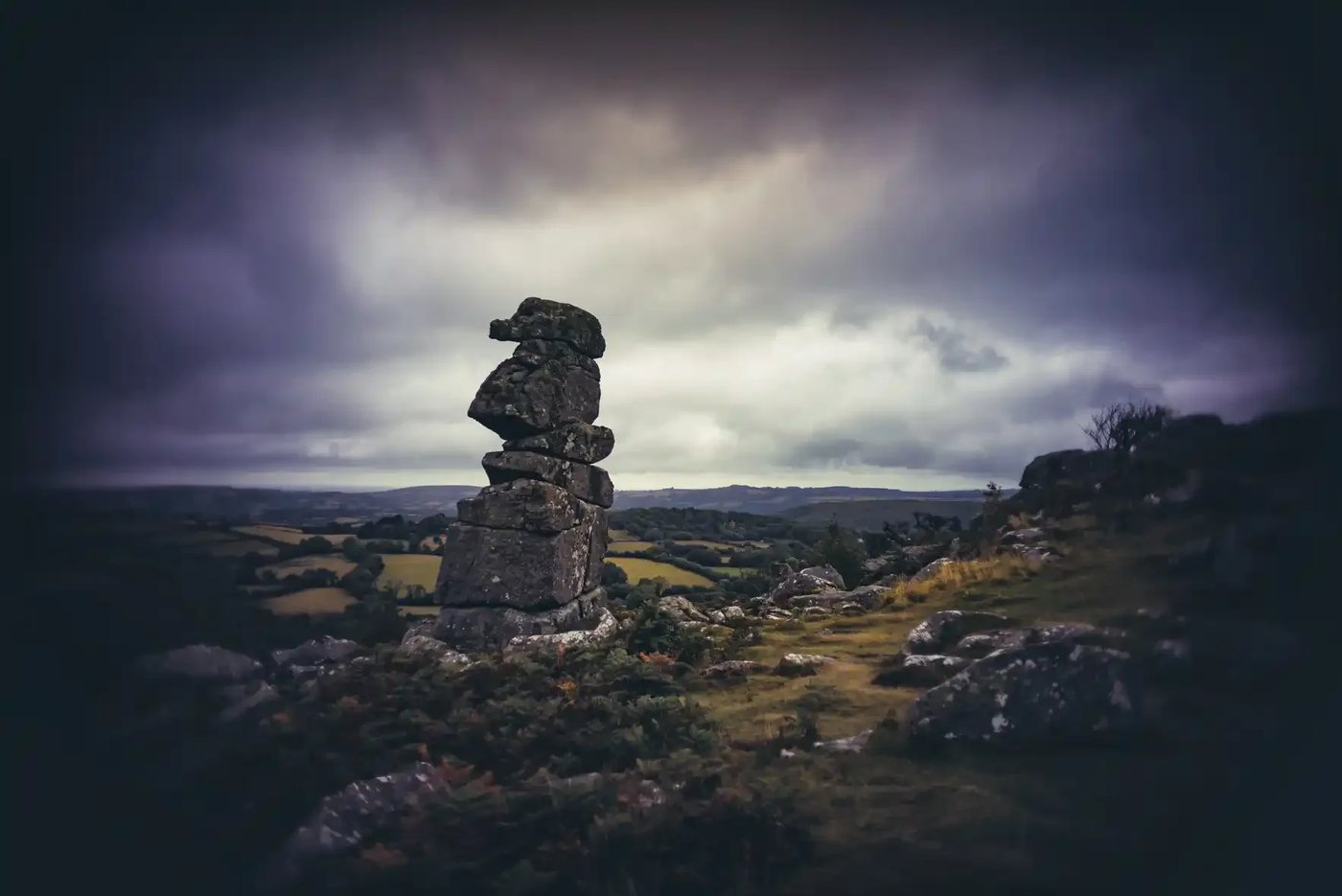
Bowerman’s Nose: Legends are like memes in slow motion
The universe is full of magical things patiently waiting for our wits to grow sharper.
Search anywhere for "Bowerman's Nose" today and almost every result will tell you basically the same story. A cocksure hunter and his faithful hounds are turned to stone by witches whose ritual they disturb.
The Dartmoor National Park website tells it. Atlas Obscura tells it. Nearly every local holiday cottage blog repeats it almost verbatim. ChatGPT, of course, will happily retell it with some extra bells and whistles.
The Legend of Bowerman’s Nose
Here is the basic outline: (in case you either don’t know, or can’t be bothered to read any of the online sources) - there are embellishments and slight deviations from this, however those are expected (and indeed, actively encouraged when you are constructing a legend).
Bowerman is a hunter (loved by all in the local area for his wonderful generosity and all round loveliness, because; as we all know; throughout time, every member of the landed gentry has been absolute saints).
An unfortunate Bowerman (and his hounds) accidently (or maliciously, depending on the version) upset a witches ritual, and they without hesitation decide that this mild inconvenience is worth petrifying somebody and in the process; making themselves an easy target for some not unwarranted local antagonism. Standard legend fair.
Now, I’m the first to say that I love a good myth, legend or random snippet of local folklore, however here's the really interesting bit about Bowerman’s Nose. The story, in the “complete” form that everyone knows, appears to have been reintroduced to the world in the early 80’s by two cheap visitor booklets sold in Devon gift shops.
Before that, you have to go back to a rather (to my mind) tongue-in-cheek book from 1939 to find anything resembling it. In the very same story, the author also manages to shoehorn in an appearance by Sir Francis Drake and blaming the witches for inventing the Welsh national dress 🤣
Before that, the rock had a profusion of disparate stories attached to it.
Let me try and explain why “Legends are like memes in slow motion” (or, I suppose “Memes are like Legends on Fast Forward” - whichever takes your fancy).
Preamble: I should probably explain that this piece started, as a lot of my better tangents do, with a recon mission.
I'd been asked to photograph a coven of witches (yes, they still exist, and yes, that's a different blog post) and my Hill & Moorland Leader brain decided Hound Tor was the right venue, accessible enough for a group with varied physical ability, and dramatic enough to make the slight incline worthwhile.
Whilst I was in the area checking the lay of the land, I wandered over to Bowerman's Nose because it was close enough and it had been a while since I’d last visited.
Whilst lying amongst fern and sheep poop, it occurred to me that I'd never taken the time to properly look into the legend behind the rocks.
So I did just that.
I also ended up using an abridged version of what you are about to read as the “presentation” you have to make for your Hill & Moorland Leader Assessment. Basically, you have to talk for ten minutes on the moor about something that interests you about Dartmoor. I presented my talk on the edge of Hartland Tor (it was pretty well received, if I say so myself).
What follows is the story of that story.
A "Rock Idol" - Carrington and the Druids (1826)
As with most myths and legends there seems to be very little logic or even the pretence of coherence between the various lines of thought.
The earliest serious literary reference I can find to Bowerman's Nose is in Noel Thomas Carrington's 1826 poem “Dartmoor”. Carrington describes the “structure” as a "Rock Idol"; not in the Jimi Hendrix sense; and many commentators ran enthusiastically with the idea that Druids had carved the stones to this shape for ritual purposes.
This was very much the fashionable nineteenth-century reading. Antiquarians of the period were keen to find pre-Christian religious infrastructure absolutely everywhere on Dartmoor, and a thirty foot column of weathered granite that vaguely resembles a man was an obvious candidate.
There are zero witches in this version. There are absolutely no hounds and certainly no hare. There's just a bunch of rocks that kind of resemble a fellow in a flat cap, if you’re squinting, or have partaken of way too much strong Westcountry cider.
On the very edge
Of the vast moorland, startling every eye,
A shape enormous rises ! High it towers
Above the hill’s bold brow, and, seen from far.
Assumes the human form ; - a Granite God !
- To whom, in days long flown, the suppliant knee
In trembling homage bow’d. The hamlets near
Have legends rude connected with the spot,
(Wild swept by every wind,) on which he stands
- The Giant of the Moor.
Carrington himself, writing in the notes to his poem says;
This is an enormous mass of stone or pile of rocks upon Heighen Down in Manaton, rising to a height of more than 30 feet. At a distance it wears the appearance of a rude gigantic figure, but, on a nearer approach, it is found to consist of ledges of granite, irregularly piled on each other. It is generally considered as a rock idol, and bears the name of Bowerman’s Nose, of which name there was a person in the Conqueror’s time, who lived at Huntor or Houndtor in Manaton. In the road from Two Bridges to Tavistock Dr. Berger and his friend Mr. Necker were both struck at once with the resemblance of a granite rock to the Egyptian Sphinx in a mutilated state.
He goes on to expound the idea that those who think druids didn't have anything to do with Dartmoor are obviously deluded.
The Conqueror's man and the great stone - 1870-1900
By 1870 we get a different angle. A reference from the rather ramblingly named guidebook “The South of Devon and Dartmoor : Torquay, Teignmouth, Dartmouth, Dawlish, Totnes, Ashburton, Newton, Moreton, Kingsbridge, Tavistock, [etc.] with a Sketch of the natural history of the district” gives us another reading.
This is assumed to have been a rock idol, but whether correctly or not we have no means of judging ; the cognomen of Bowerman being derived from a person of that name, who is said to have lived at Houndtor in the Conqueror’s time. These rocks are seen to the greatest advantage on the Manaton side, and consist of five layers, some of them severed into two distinct masses, the topmost stone being a single block, giving a fancied resemblance to the human organ. Carrington’s highly graphic and poetical description is immediately realised on approaching its vicinity —
Suddenly the rock isn't a druid idol; it's a memorial to a real Norman local with a very large nose. Fifty years on from Carrington and still no witches, no hounds, no hare.
In 1898, Hilderic Friend's “Bygone Devonshire” throws all of this out. Friend can find no historical landowner named Bowerman, so he turns to his Celtic wordlist and proposes that the name is really maur + man - corrupted Celtic for "great stone."
The curious pile of rocks, which is pointed out to the tourist near Manaton, bears the name of Bowerman’s Nose. One naturally expects so suggestive a name to have a legend attached to it. Bowerman is therefore a whilom worthy who owned the estate in the olden time, and was remarkable for his facial peculiarities. The rocks resemble the nose of the man, and are therefore named after that person. Alas! your unimaginative antiquary comes and cuts the ground from under you. He has been through Domesday, but can find no landowner named Bowerman ; and, moreover, he has turned up his Celtic wordlist and found that man means ‘a stone,’ and Bower is a corruption of “maur” which means ‘great’ The name Manaton itself is on the same principle shewn to have a purely rocky, and not a human association.
This sounds very satisfying and is almost certainly totally incorrect. Various writers have noted that Celtic word order would put the noun first, giving us maen vawr, which would corrupt into something like "Minevower", not "Bowerman." Even with a broad Westcountry accent, they’re very different words.
The Dartmoor scholar R. Hansford Worth made this objection:
No violence should be done to the forms of the language in which the name is assumed to have been framed. As an example: it is not permissible to derive ‘Bowerman’ from Vawr maen, the Great Stone, since the Celtic form would be maen vawr, as in the ‘Man of War’ rock off the Cornish coast.
The much simpler explanation, as Eric Hemery later noted
This is Bowerman’s Nose, a name perhaps attributable to the proboscis of a former moorman of the locality named John Bowerman, who was buried at North Bovey in 1663. More fanciful origins, such as are commonly attached to natural phenomena, may be discounted.
The surname apparently turns up in Dean Prior records of 1772. It's a local family name. The rock memorialises a man, somehow, in some way, just as the 1870 source said.
In 1900, the Reverend Sabine Baring-Gould weighs in via “A Book of Dartmoor” and scolds anyone ridiculous enough to believe Druids had anything to do with the moor at all.
There are, indeed, to be seen curious piles of rock, but none of these are artificial, and there is not a particle of evidence that any of them received idolatrous worship.
Being of good Christian stock, it's hardly surprising he's keen to distance himself from the idea of druids (just pointing out, not judging). Baring-Gould is a renowned author and his debunking of ridiculous pagan theories is a recurring motif of his.
So, here’s the state of play at the beginning of the twentieth century: a possibly-Norman, possibly-Celtic, possibly-just-a-rock with a man's surname attached. Still no witches. Still no hounds. Still no hare.
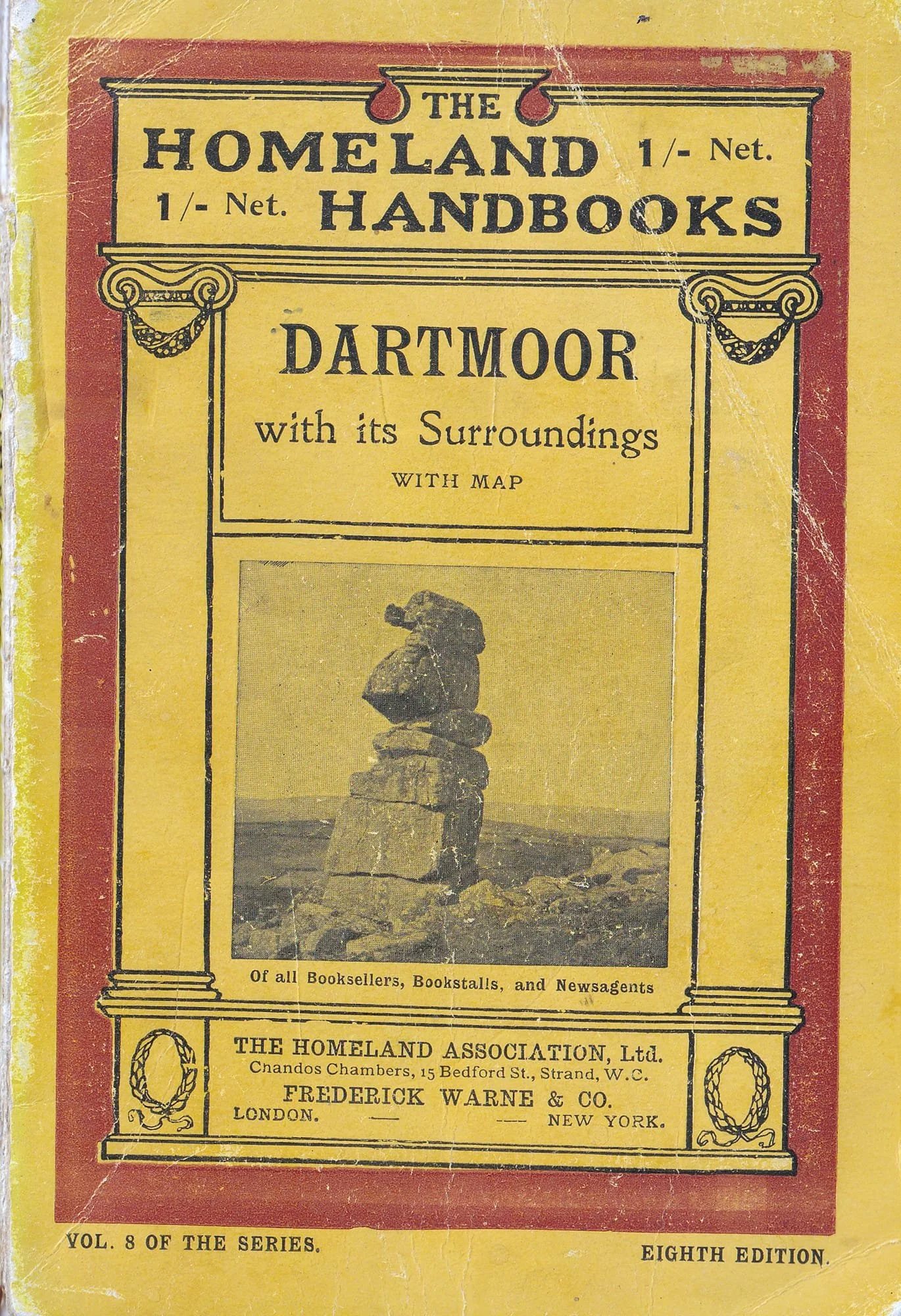
God did it - Lisle and Clinton-Baddeley (The Nineteen Twenties)
In 1920, Clifton Lisle in his book “Hobnails and Heather” (the story of a hike through England and France made by the boy scouts of Troop 1) informs us that Bowerman was turned to stone by God:
East of Grimspound is Bowerman’s Nose—another strange sight of the moor, a record and warning in one. The Nose is a huge rock standing on Hayne Down, but once it was lively enough, so they say, being none other than Bowerman himself. Bowerman was a good chap, from all reports. He lived on a farm and helped build Manaton Church. Everybody liked him, even the parson,as he went about his lawful occasions. But human as the rest, he had his failing, and it scotched him in the end. When hounds called he had to go. There was no resisting that appeal, and he knew it. One Sunday, in spite of church and St. Winifrid, the call came and off he went, hounds, horses, and all. Poor soul! Who can blame him with a dreamland of grass on the hillside above and his pack at their fox in a covert? But he paid for his fun. That very day he was changed to stone. You can see him yet within sound of his church bells. Dartmoor is full of such awful examples. The Standing Stones on Hamel Down, those that dance on Christmas Eve, are said to be maidens who jigged on a Sunday.
Not by witches.
This also echoes the story of the Nine Maidens stone circle near Belstone, who are traditionally said to have been petrified for dancing on the Sabbath. Lisle was another devout Christian, and a Sabbath breaking explanation evidently appealing more than some pagan idol worship.
In 1925, V.C. Clinton-Baddeley seems to almost be poking fun at the diverse retelling of the tale:
At Hounter Farm, nestling beneath the Tor, there lived once on a time, or so tradition says, one Bowerman. He is supposed to have built a church at Manaton, and to have named it after his daughter, Winifred. Many antiquarians believe, however, that it was named after Winfrid or Boniface, the Devonshire saint and the Apostle of Germany. Bowerman is also said to have erected Bowerman’s Nose. Another legend states that the Nose is Bowerman himself, petrified there for hunting on Sunday. What Sabbath-breakers these Dartmoor people were! They never learned their lesson. Petrification was rife.
This pattern (no matter how irritating to the researcher) matters.
I’ve mentioned eight different writers and each offers various different explanations for what Bowerman's Nose is. Not one of them mentions witches. Not one of them mentions a hare.
Skinner's 1939 fever-dream - where the witches eventually arrive
And then, in 1939, A.G. Skinner publishes a slim book called “Tales of the Tors”, and everything changes.
An aside:
Back in October 2025 (when this idea was first forming) I went to see the wonderful Emma Cunis (Dartmoor's Daughter), at The Museum of Dartmoor Life in Okehampton where she was talking about her brilliant book “Dartmoor: Myths & Legends”. I’d already messaged Emma and told her of a “gap” in my research and she brought along her own copy of “Tales of The Tors” for me to take a look at.
Without her, this piece would be missing its keystone.
Skinner's version is the first one I've been able to find that has the recognisably modern structure. There's Bowerman the much loved hunter, his pack of hounds, the disturbed witches, the witch-turned-into-a-hare, the chase, the petrification. The skeleton of the story we now all love and repeat, are all set in place.
However, Skinner's version also has things the modern story has quietly dropped. A farmer's wife cuts the heads off Bowerman's hounds. Sir Francis Drake gets crowbarred into the narrative (for reasons I discuss later). And, one of the disgruntled witches is, apparently, the source of the Welsh national dress 😜
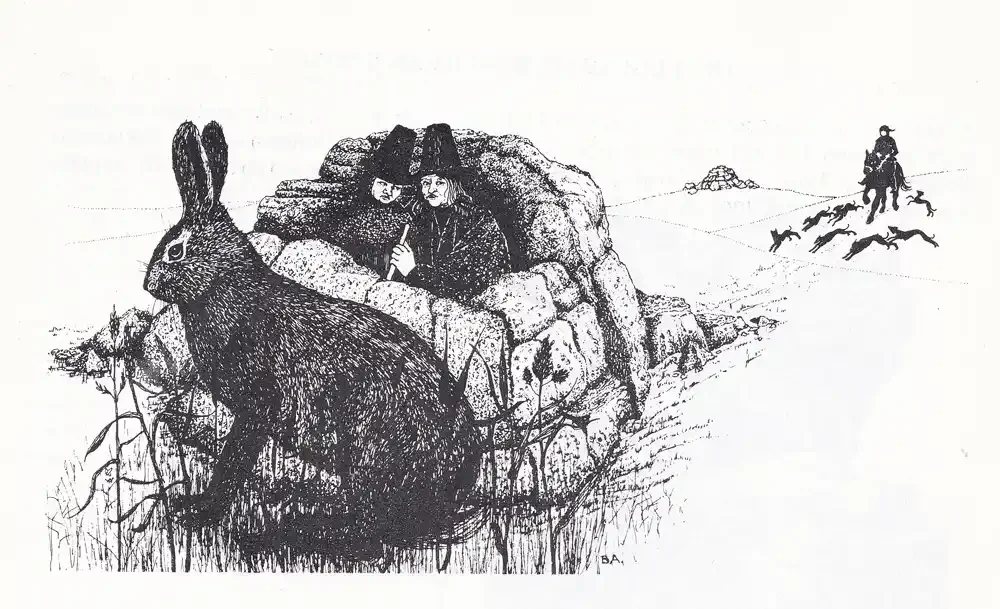
Purely for transparency (and the fact that a digital copy of Skinner’s retelling doesn’t seem to exist anywhere, here is the tale in full. I shall scan the whole book when I have time and upload it to archive.org.
BOWERMAN’S NOSE
or
HOW THE WELSH GOT THEIR NATIONAL HEAD-DRESS
In the time before Domesday Book, when folk never fought each other for land because there was plenty to go round, there lived at Manaton, Dartmoor, a famous huntsman called Bowerman. With his pack of black hounds, he was wont to scour the moor from early dawn to dewy eve.
How old he was, no one ever knew, though lots of people made guesses-some said - as old as Methuselah, for, although he lived in the far back ages, he was still alive when William the Conqueror granted Dartmoor to his half-brother, Robert Mortain. Nor was his reputation as a huntsman even then in any wise diminished. When people heard the joyous sound of his famous horn echoing away among the tors and forests they would cry:
‘’That be Bowerman, fer certain’, and therewith they would drop their work whatever it might be and join in the chase, for Bowerman’s nose, which was the biggest nose ever imagined, could smell out the wiliest old fox of them all.
But one day when Bowerman was hunting over Hay Tor he disturbed the witches who were busy brewing a storm. Their shrill voices could be heard weaving their horrid spells and incantations, accompanied by the croaking of the frogs and the bubbling of the nasty concoction in their huge cauldron:
Come, south wind, bring the rain:
North wind, blow it back, again:
Come, west wind, bring wet weather:
East wind, bring storm and rain together
’Horrible old hags !’ he cried, as he looked up and saw a number of witches hurtling round his head. ‘I’ll teach them to spoil my sport!’ And he blew a mighty blast on his horn-and called in his hounds for fear the witches might ‘overlook’ them.
But one of the witches, the oldest and most wicked, had been so startled by Bowerman’s horn that she fell off the ragwort stem she was riding, right into the middle of the cauldron and not only got a bad ducking which she deserved, but her hat was ruined. It was not fit to be seen even on a witch, so, as you may imagine, she was very angry.
A few days later, on a lovely, frosty morning, Bowerman donned his hunting attire, called his hounds, and rode out to the chase, accompanied by Robert the Earl and all his friends and neighbours. They had a splendid day. As Bowerman rode home along the ancient Abbey Road, his hounds at his heels, suddenly a hare started up beneath his feet. Bowerman and his hounds at once gave chase.
The hare was very clever and very swift, for it was the old witch disguised. Mists gathered over the moor, and still the old witch, who had cast a spell over Bowerman, led him on and on till at last he fell off his horse from sheer exhaustion and sank down into a patch of boggy soil. Here, I think, he would have disappeared altogether, as the witch intended, but he was so eager to save his hounds that with a mighty effort he kept his head above ground. At that moment the witch resumed her former shape and turned what remained of Bowerman into stone.
Then, resuming the shape of a hare before his very nose, she led the hounds, who were under her spell, to a farmer’s wife nearby. This old woman was in the witches’ debt, and in return for food she gave the witches, they taught her some of their secrets.
When she saw the hare-witch she recognized her at once in spite of her disguise and ran out to see what she could do for her. The witch commanded her to bring out her largest carving knife and cut off the heads of Bowerman’s hounds one by one, they, like their master being too tired to resist.
This she did, while the witch, who had resumed her normal shape, looked on approvingly. The farmer was away, otherwise she would not have dared obey the witch’s order, for the good man hated the foxes that stole his grey geese and ran off with them to their dens.
Years passed. Folk came who knew nought of the story of Bowerman the Hunter, and they worshipped his stone image as a god.
This irked him terribly. It was the last thing he wanted. But once a year between sundown and sunrise he had the power to take his human form, and go a-hunting once more.
Sir Francis Drake is said to have seen him and his headless hounds as he drove along the ancient Abbey Road between Tavistock and Plymouth. Doubtless Sir Walter Raleigh saw them, too, when he was Forester of the Duchy to good Queen Bess. You, too, may see them and hear the shrill blast of Bowerman’s horn on a moonlight night-if you choose the right place and the right moment.
And what happened to the old witch? She found she had made the moor too hot for her, for every one loved Bowerman, so she and her sisters mounted their ragworts and flew to Wales. This explains how the Welsh women got their tall black national hats.
For those of you not willing to spend the time reading this brilliantly inventive piece, here’s me reading it for you …
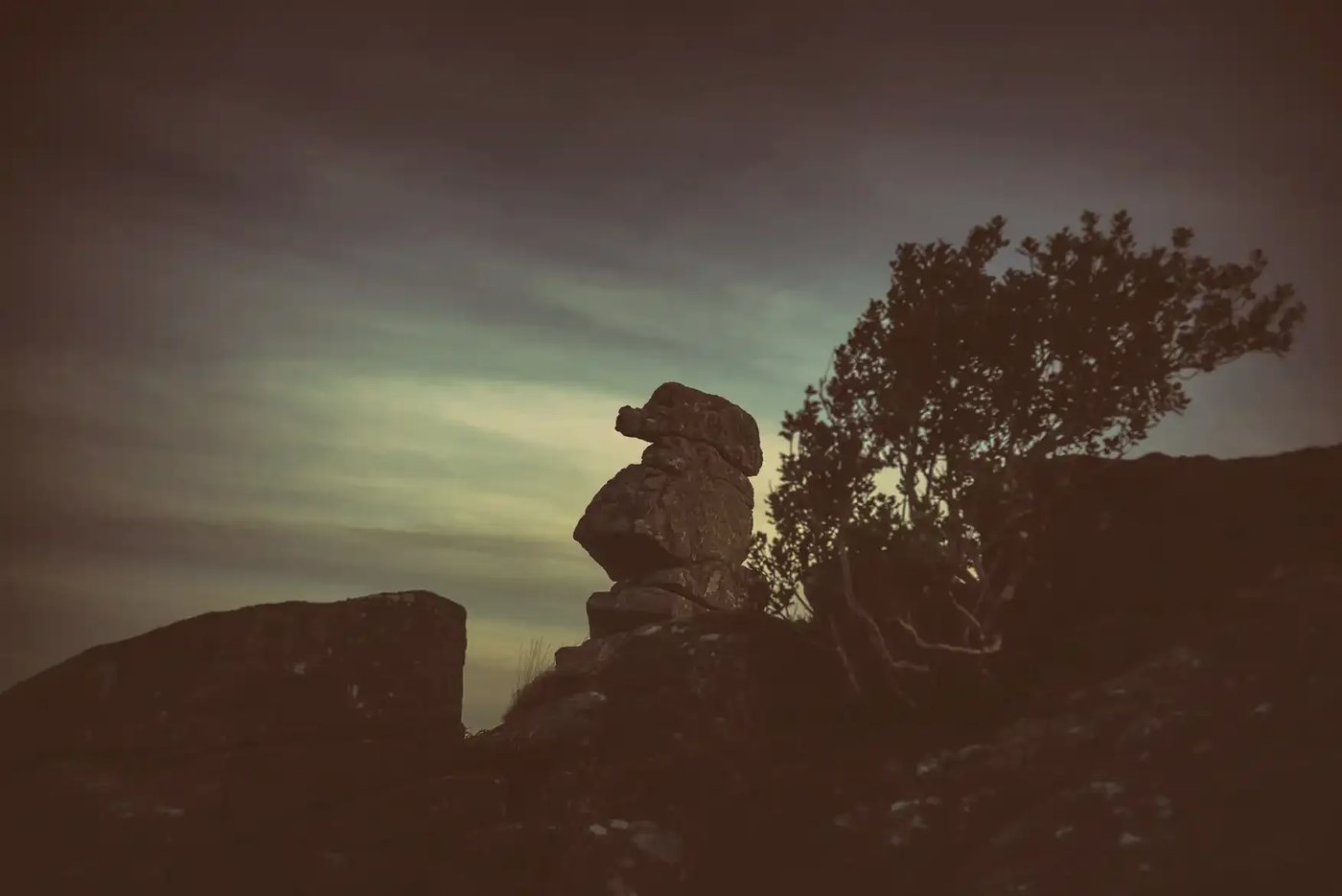
I would never (heaven forbid) consider suggesting that this book was published purely to excite and titillate. But I will note that it was very obviously written (with tongue very much in cheek) to excite and titillate 🤣
A small note on the author of “Tales of the Tors”.
A.G. Skinner is Aileen Georgina Skinner. For ninety years she has been cited as A.G. Skinner (though rarely cited at all, if my recent research is correct). When I started my dive into this deep rabbit hole, I assumed that the author was a man, because almost everyone writing about Dartmoor in 1939 was.
On re-reading the story (and some of the others in the book) it occurred to me that the style of storytelling was extraordinary if not unique for the time (I’m possibly manifesting here, whatever … it yields results) .
Searching for “Tales of the Tors” on the British Library website told me our author was called Aileen and an even deeper dive using a free month’s subscription on Ancestry revealed the “Georgina”.
Disclaimer: I do not have the resources to 100% guarantee this A.G. Skinner is that A.G. Skinner 😁However she is the only A.G. Skinner in the 1939 Register, and everything else appears to fit!
That being said, let’s reveal the author of our modern day take on a famous legend: Aileen Georgina Skinner was born in Kensington in October 1882, daughter of Colonel Monier Williams Skinner of the Royal Engineers, himself born in Ceylon, into a family with longstanding roots in British colonial service.
By 1911 she was living in Budleigh Salterton. She served in Queen Mary's Army Auxiliary Corps during the First World War and was awarded a campaign medal (I have a copy of her medal card).
She authored three books across two decades, “Mushroom Land, etc.” (1920), “Flower Legends” (1932), and “Tales of the Tors” (1939).
All of these, on the evidence of the first two titles and the publishers who published them are children's books. I’ve no way of proving this (though I have contacted the British Library) and it seems Aileen remained single all her life, though with six brothers and sisters, she would have had plenty of nephews and nieces to write stories for.
She was 57 when “Tales of the Tors” appeared with the Methodist Epworth Press, three weeks after Britain declared war on Germany.
This gives the line …
when folk never fought each other for land because there was plenty to go round
… added resonance.
She lived another 27 years, dying in 1966 at the age of 84, and is buried in the churchyard of St Mary the Virgin, Bathwick, in Bath.
Aileen Georgina Skinner has been more or less invisible in everything written about Bowerman's Nose.
The book that started the modern witch story is hers; her name belongs in front of it.
I’m putting together a longer piece about her separately, because she has earned more than a paragraph. In the meantime; here; at least, she gets her name back.
Back to the matter in hand!
Aileen is writing a tall tale, not carefully transcribing an oral tradition, she’s taken aspects of older stories and put a new twist on them. The Francis Drake and Welsh national dress flourishes are the giveaway.
It would appear, to me at least, that the first appearance of the witches and the transmogrification into a hare story in print is an embellishment for comic effect, for entertainment. It isn’t, and doesn’t seem to present itself as, the serious cataloguing of an ancient traditional story.
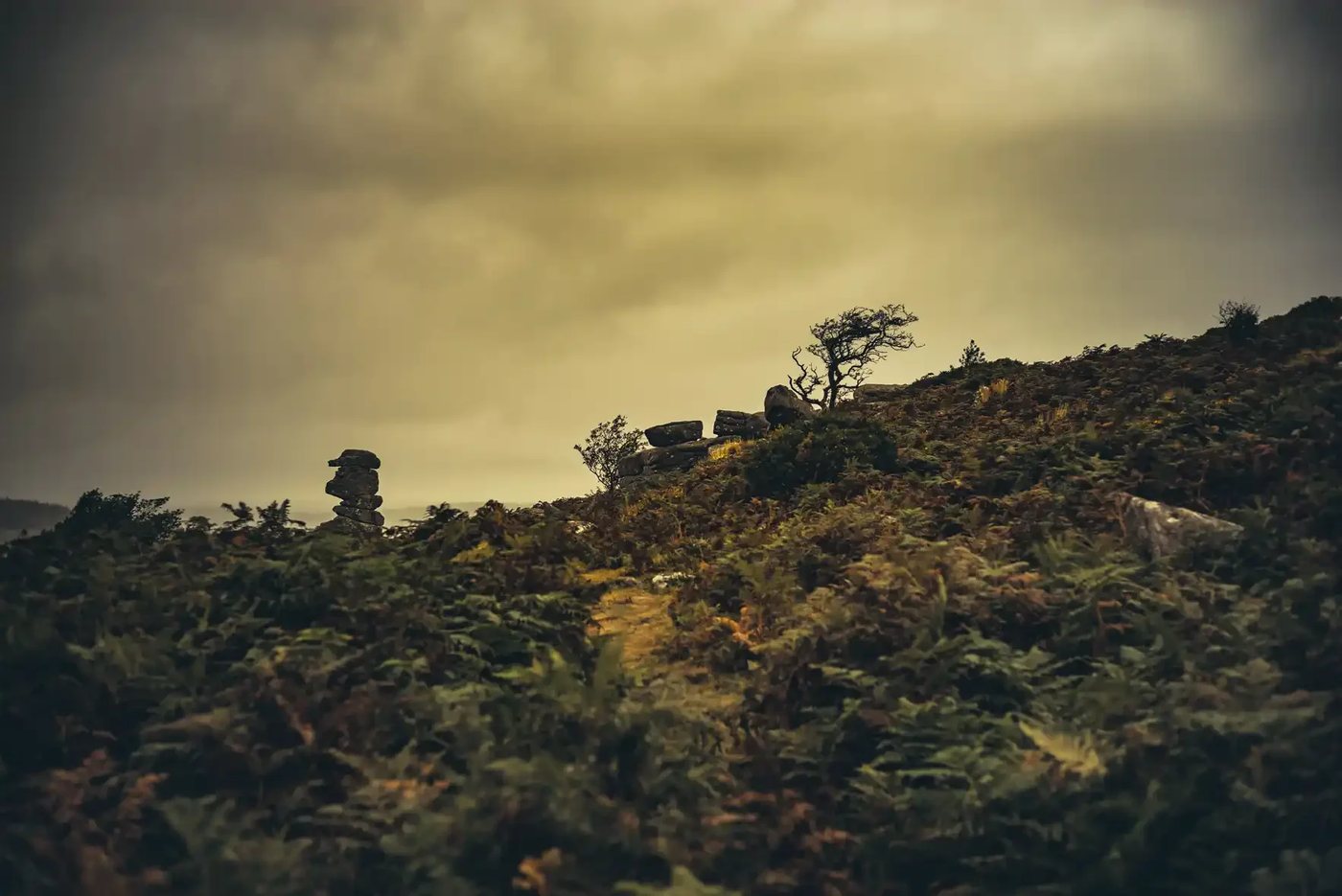
The Folklorists' Silence
My research for this time period (incomplete as it is) has turned up at least three serious works dedicated to Devon and Dartmoor folklore by writers who took the subject genuinely seriously. As well as a handful of other guides about the area.
One would assume that if the Bowerman's Nose witches story were authentically traditional; that is, passed down through generations of moor folk through oral tradition; these three would have recorded it. They didn't.
In fact, whilst re-reading my own copy of "The Witchcraft and Folklore of Dartmoor" (1971) by renowned local journalist and author from Sticklepath; Ruth E. St. Leger-Gordon; I was surprised to notice this observation from a Dartmoor resident famed for collecting stories about witches and local folklore;
Bowerman is the hard core of a small tor, now lying in a clitter of fallen rock around his feet. Weathering of the granite cracked his protecting shell and he eventually emerged in his present form like a chicken from an egg. With grey cap pushed well back from a face consisting mainly of the parrot-like feature which gives him his name, if ever a figure invited legend it is Bowerman. Yet, apart from one mythical murmer [sic], no story emanates from this oddest of “men”. Any old fantasies that surely must once have existed, are now concealed for ever in Bowerman’s granite bosom. All that can be said about him with certainty is that Druids were in no way responsible for what has been fashioned entirely by nature, and that in the name we once more meet the Celtic maen. Bowerman is — or rather was — vawr-maen, the “great stone”. Somebody added the “nose” for obvious reasons; not we hope because he bore any resemblance to a completely mythical Norman bow-man who, according to a misty scrap of folklore, settled on a nearby moorland farm after the Conquest.
I initially got excited by the mention of “apart from one mythical murmer “ ... yet on reconsideration, this is obviously a reference to the "nose" bit.
Published in 1972, this can only mean that part of the "Legend" must have been "discovered" (or “rediscovered”) sometime between 1973 and when it appears in any sort of written form (more on this later).
My own copy of "The Folklore of Devon" published in 1977 by Ralph Whitlock does not mention Bowerman's Nose at all. Seems like a terrible omission.
In 1981, F.H. "Harry" Starkey, another renowned Dartmoor expert with multiple books to his name, also has nothing to say about witches or hares.
At the north-western end, just below the highest point, will be found a feature famous in Dartmoor scenery and folk lore. This is Bowerman’s Nose, a natural rock pillar consisting of layers of rock piled one upon the other and standing about 25 feet high. The topmost layer is so shaped as to give the impression of a human figure wearing a peaked cap. In former times this was identified as a rock idol and of course the Druids were held to be responsible. We now know that this strange figure is the result of natural weathering over many thousands, perhaps millions, of years. The name Bowerman has also exercised the imagination of many people in the past. There is an old account which states that a person named Bowerman lived nearby in William the Conqueror’s day, the suggestion being that the rock took its name from him — but is it perhaps the case that he took his name from the rock … ?
Worth mentioning here that (amongst many other things) F. H. or ‘Harry’ Starkey discovered the old Manga Clapper bridge and when it was restored is now fondly known as Starkeys Bridge. There is also a memorial stone nearby.
Starkey was also a committee member of the Dartmoor Preservation Association and the Devonshire Association and belonged to both the Devon Archaeological Society and the Ramblers Association.
Even some of the popular gift shop titles, still fail to mention witches;
I prefer the local version, that a man called Bowerman lived at Hound Tor around 1066 and sported a nose identical to the splendidly stubby organ that still adorns the granite column.
Several writers, producing work over a decade or so, all of whom (you would presume) would have at least mentioned this aspect of the story if it had been circulating in oral tradition (even if they believed them to be untrue).
Silence is the evidence.
“When you have eliminated the impossible whatever remains, however improbable, must be the truth” - hang on, totally different line of thought there!
How a gift-shop pamphlet completed a legend
Finally (and this is where it all starts to come together), in 1983, a small independent publisher called John Pegg puts out two cheap booklets: “A Visitor's Guide To Dartmoor - The Land, Its Legends and History” and “After Dark on Dartmoor”.
I stumbled across these as they were referenced on a few websites and I managed to find a copy of each on eBay 😁
They're the kind of thing you pick up on a day trip as a memento, slim, cheerful, true gift-shop fodder.
They both contain the witches and hare story, discovered, (I’m making an assumption here) presumably from Skinner’s story of 1939 with the more obviously outlandish bits omitted🤣
A famous Dartmoor landmark, this extraordinary rock formation is not nearly as remote as you might think from photographs. It is located north-east of Widecombe, within a few minutes’ stroll of the narrow road which runs due north from Hound Tor. The resemblance it bears to an idol with a human head wearing a hat is most uncanny, the more so because it is the only standing rock pile at this particular spot. It could almost be one of the mysterious Easter Island sculptures, and at one time was thought to have been the work of the Druids, but is in fact said to be a purely natural formation. You cannot help wondering though, whether the effect was assisted by human agency at sometime. ... Scholars say that this name is derived from the Celtic ‘vawr-maen’, meaning ‘great stone’. Traditional legend, more romantically, relates that in Norman times a man lived on this part of the Moor, near Manaton, who was an archer or ‘bowman’. He was also a great hunter, and one day he and his pack of hounds were in hot pursuit of a hare when they disturbed a coven of witches in the middle of their magic spells. Furious, the witches decided to punish Bowerman. So the next time he went hunting, one- of them turned herself into a hare and led him such an exhausting chase that he eventually fell from his horse into a bog. Before he had completely disappeared from sight, the witch turned him into stone. The same fate befell his pack of hounds, whose petrified shapes can still be seen on the crest of nearby Hound Tor.
This is, as far as I can tell, the moment the modern legend enters mainstream circulation.
There are not many stories featuring witches on Dartmoor, but the one involving Bowerman, is probably the best known. It used to be thought that the famous landmark of Bowerman’s Nose was man-made-‘A granite god” the words of the old Dartmoor poet Carrington’ In his notes to Carringtons work, W. Burt goes-on to say:.’It is generally considered as a rock idol and bears the name of Bowerman’s Nose, of which name there was a person in the Conqueror’s time, who lived at Huntor or Houndtor in Manaton’. This tradition of Bowerman’s Norman origin has remained strong, despite the assertion of scholars that the name is derived from—- the Celtic ‘vawr’maen’, which merely means ‘great stone’. Those favouring the Norman story prefer to think of Bowerman as meaning ‘bowman’ or ‘archer’. He was also said to be a mighty hunter, and one day he and his Pack of hounds were in hot pursuit of their quarry when they disturbed a coven of witches in the middle of their magic spells and actually knocked over their cauldron. Furious, the witches decided to punish Bowerman. So the next time he went hunting, one of them turned herself into a hare and led him such an exhausting chase that he eventually fell from his horse into a bog. Before he had sunk further than his waist, however, the witch turned him into stone. The same fate befell his pack of hounds, whose petrified shapes can still be seen on the crest of nearby Hound Tor.
After 1983, the references abound.
The story then propagates through numerous guidebooks, websites, Dartmoor National Park's own educational materials. Each new retelling treating the previous one as a primary source, none of them noticing that the trail goes cold, hard, in 1939 with a comic confabulation, and before that doesn't exist at all.
I should make it plain here. I'm not saying Pegg invented the story; he didn't, Skinner did, or at least he playfully combined a series of interesting ideas he’d read about.
I'm not even saying Pegg knew what he was doing, these were small commercial publications, and the most likely explanation is that he came across Skinner's book, thought "the tourists will love this one," and trimmed off the bits that were a bit too much.
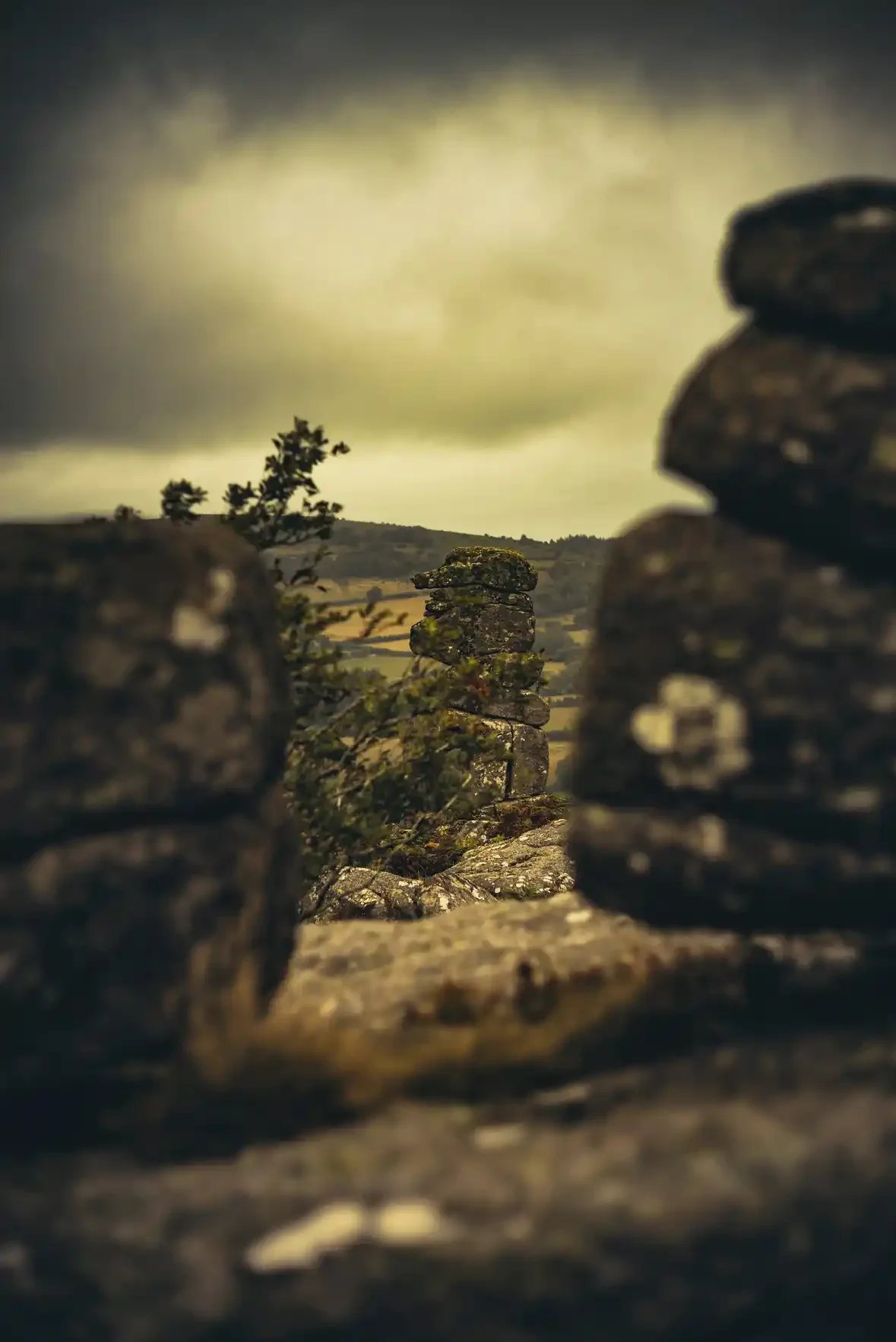
In retrospect, the actual effect of the two publications was to take a piece of well meaning, jovial 1939 entertainment and inject it into the gift-shop economy as authentic local folklore. From there, it just grew legs and travelled far and wide.
It doesn’t take long for the myth to spread.
A folk tale says that they are the hounds belonging to Bowerman the mighty hunter, who were all turned to stone by a wicked witch.
It’s not at all surprising that our friend Mr Pegg (only two years since rediscovering the “witches”) has them once again, making an appearance in another publication.
Here Celtic mythology took over. The story goes like this. When Bowerman the hunter was turned to stone on Hayne Down by a gang of local witches, his hounds ran on only to be overtaken by the spell and suffer the same fate as their master. They are the granite shapes which dominate Hound Tor’s stacks and towers.
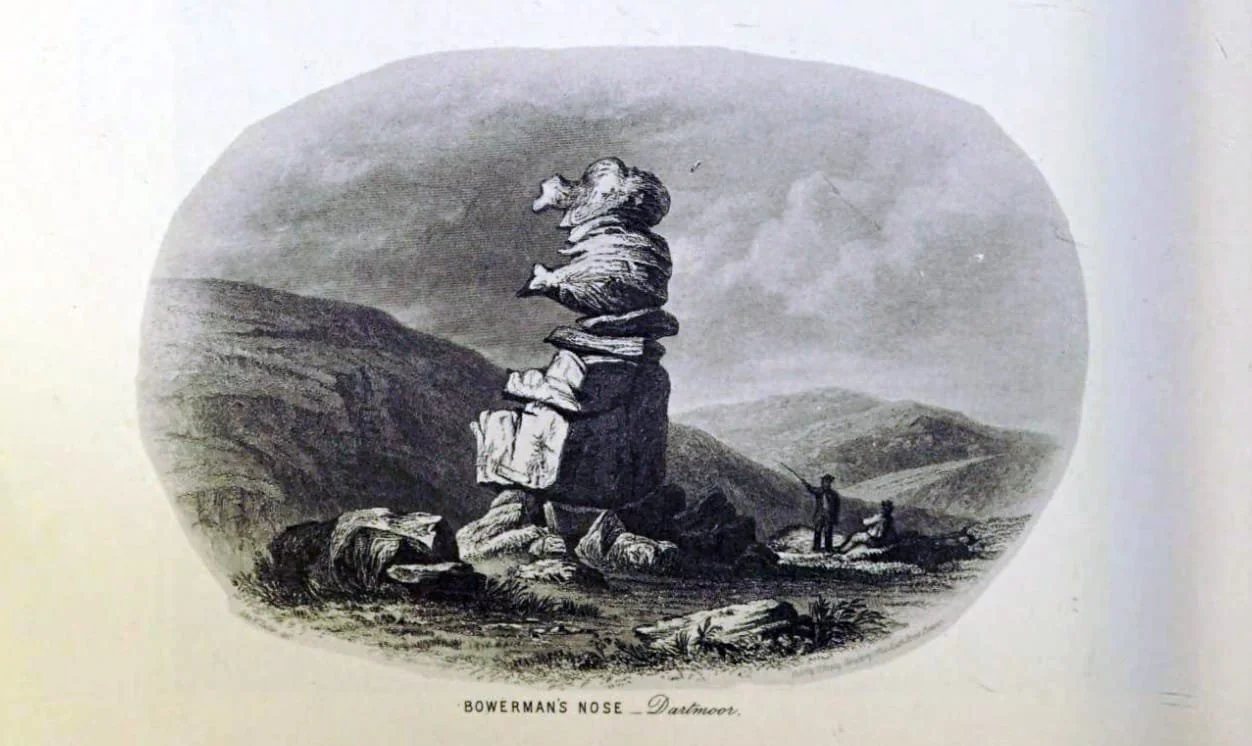
So, because this is the way my mind works, I now had to have a dig around to find out why Aileen Skinner’s addition of witches and hares just makes sense.
Where the hare actually came from
The witch “transforming into a hare” element didn't just appear as if by magic. I did some reading and by 1939, Dartmoor already had a fairly well documented witch/hare legend and long before anyone attached it to Bowerman's Nose, the story was in active oral circulation in Devon. I’ve managed to track down two independent printed pieces.
The first mention of a witch turning herself into a hare on Dartmoor that I can find turns up in the “catchily entitled” - “Traditions, legends, superstitions, and sketches of Devonshire on the borders of the Tamar and the Tavy illustrative of its manners, customs, history, antiquities, scenery, and natural history, in a series of letters to Robert Southey, esq” by Mrs Anna Eliza Bray in 1838. I transcribe it here in full, as it seems to only appear in one of the copies held on archive.org :
An old witch, in days of yore, lived in this neighbourhood; and whenever she wanted money, she would assume the shape of a hare, and would send out her grandson to tell a certain huntsman who lived hard by, that he had seen a hare sitting at such a particular spot, for which he always received the reward of sixpence. After this deception had many times been practised, the dogs turned out, the hare pursued, often seen, but never caught, a sportsman of the party began to suspect, in the language of tradition, “that the devil was in the dance,” and there would be no end to it. The matter was discussed, a justice consulted, and a clergyman to boot; and it was thought that, however clever the devil might be, law and church combined would be more than a match for him. It was therefore agreed that, as the boy was singularly regular in the hour at which he came to announce the sight of the hare, all should be in readiness for a start the instant such information was given: and a neighbour of the witch, nothing friendly to her, promised to let the parties know directly when the old woman and her grandson left the cottage and went off together; the one to be hunted, and the other to set on the hunt.
The book this passage came from formed one of the foundational Victorian collections of Devon folklore, recorded by Mrs Bray directly from oral sources on Dartmoor.
My personal favourite is the “The Witch Hare of Tavistock” which comes from the much less well known “English Forests and Forest-Trees: Historical, Legendary, and Descriptive (London: Ingram, Cooke, and Co., 1853)”.
Chapter IX is dedicated to Dartmoor Forest, and there is a section explicitly titled "Witches and Witchcraft" (p. 179). The compiler — working fifteen years after Bray, for a different publisher, in a different city, in service of a completely different project (a national survey of English woodlands rather than a regional folklore collection) — records a witch-hare story for Dartmoor that echoes Bray's so closely that they cannot be coincidence.
‘Once upon a time’ an old witch lived in the neighbourhood of Tavistock ; and whenever she wanted money, she would assume the shape of a hare, and would send out her grandson to tell a certain huntsman who lived hard by that he had seen a hare sitting at such a particular spot, for which he always received the reward of sixpence.
A witch and her grandson run a small scam where the boy tips off the local huntsman that he's spotted a huge hare in a local field, the huntsman pays him sixpence, and then the hounds chase the witch (in hare form) for hours and hours without ever quite catching her (not surprising as she has wit beyond that of your average hare).
The huntsman eventually grows suspicious, engages the help of local squires and the clergy, has the cottage watched, and eventually catches the two red-handed. The witch is arrested and burnt at the stake.
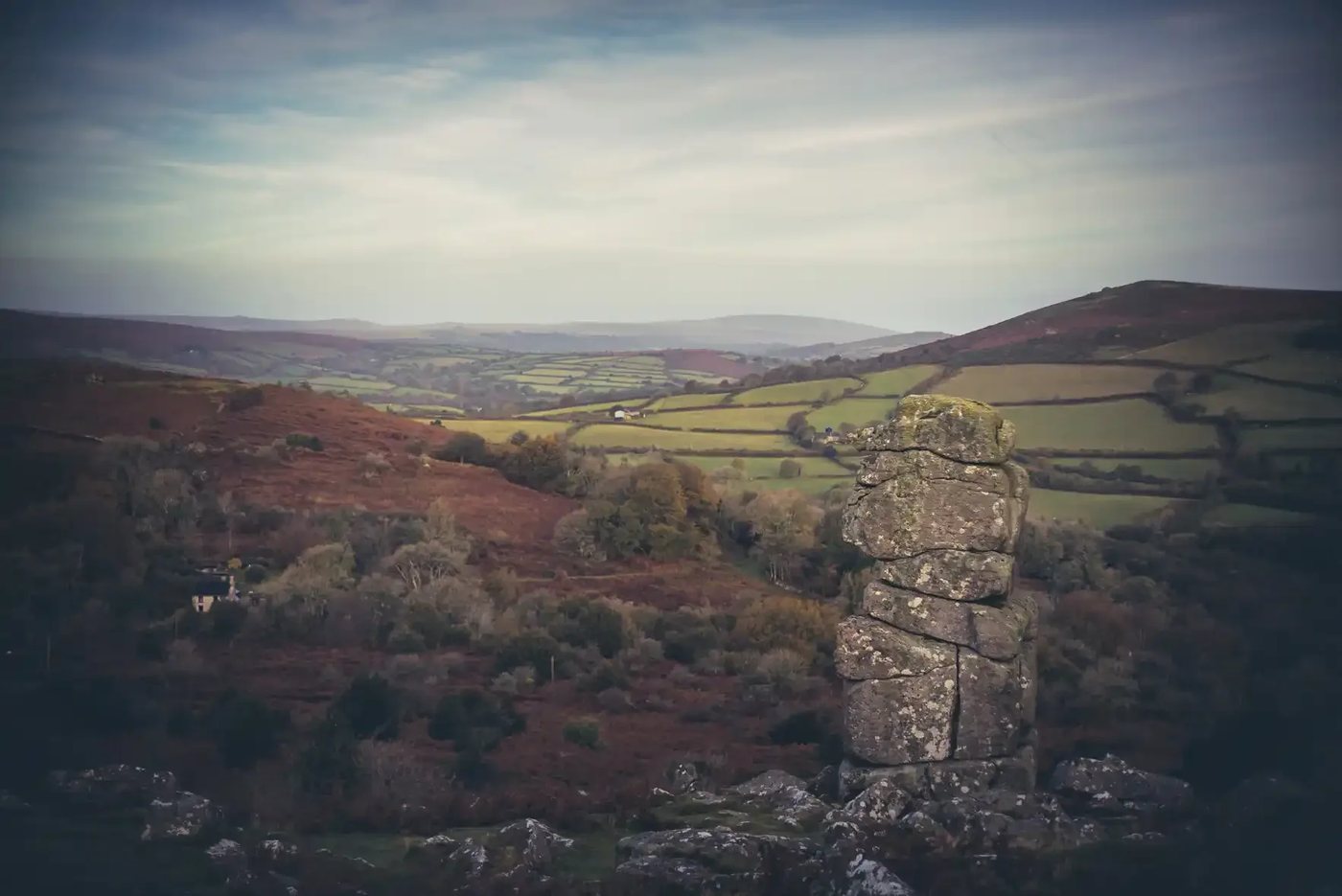
These aren't just isolated Dartmoor oddities. The witch as a wounded hare story is a well documented international folk-tale type, with various versions of the story collected in Scotland, Wales, Ireland, Norway, Denmark, and even rural America.
What Skinner appears to have done in 1939 wasn't really invention. It was grafting. She took a pre-existing, demonstrably traditional folk-tale archetype; witch becomes hare, hunter and hounds chase her, witch is eventually unmasked or wounded; and attached it to Bowerman's Nose, a rock that had previously been a druid idol, a Norman noble, a Celtic etymological mishap, and a Sabbath-breaking morality tale, but had never, before 1939, been part of the hare tradition.
Then she changed the ending. Instead of the witch being unmasked, or shot with silver, or burnt at the stake, she tacked on another idea from the legends past, the hunter is petrified.
The component parts were genuinely old. The specific combination was new in 1939. And one of the things that makes legends feel ancient is the recognisability of their parts: Skinner's readers had grown up hearing variants of the witch and hare story, so when she attached one to Bowerman's Nose, the new graft felt like something they already half remembered.
That's how a legend is welded onto a landmark.
Which brings us to the witch's name.
Levera - the witch who turns into a hare
In every modern retelling of the Bowerman's Nose legend I can find, if there is a witch and the witch has a name, that name is “Levera”.
Aileen Skinner doesn’t name her witch in 1939 (even the one who moves to Wales).
The name doesn't appear in either of Pegg's 1983 booklets. It doesn't appear in Tim Sandles's Legendary Dartmoor retelling. Nor does it appear in any printed source I’ve been able to lay my hands on.
Where it does appear, with a unique and very identifiable phraseology is the Dartmoor National Park's very own "Legend of Bowerman's Nose" page. The place I first learnt it.
"Levera by name"
It’s probably a good time to mention that whoever wrote that page has also read “Tales of the Tors” …
The witches, realising what a hornet’s nest they has stirred up mounted their broomsticks and were carried on the wind over the Bristol Channel into Wales. That is why, even to this day, many Welsh women wear tall, pointed witch’s hats and why there have never since been any evil witches in Devon.
Once you notice this fingerprint, you start finding it everywhere (at least digitally).
The trail of "Levera by name" is the trail of one piece of late-twentieth or early-twenty-first century web copy, propagating outwards through the search results until it has become the canonical version of the story.
The Wayback Machine has it’s first crawl of the page as 16th January 2018 - I couldn’t discover if there was a previous version before this.
I can't prove the National Park were the originators (and, as I explain later, I’m not trying to point fingers here, I’m merely satisfying my own curiosity).
It is, of course, possible that they heard the name somewhere on their Dartmoor travels, sat by a fire in a pub, pint in hand, storyteller as a companion. The most likely answer though (as Sherlock would point out) is that an education officer at the NPA was composing a child friendly version of the Skinner story, and; deciding the witch needed a name; reached for one.
And here’s the tiny philological joke that makes my day.
When I first read that the witch who turned Bowerman to stone had a name (and it was because I was researching this piece) there was something about “Levera” that kept ringing a very faint, far off bell in the back of my mind.
Days later, it popped back into my head, all at once, possibly something I learnt whilst enjoying English Lit classes with the fantastic Mr Burrows - Lovingly known as “Henry”, even though his name was Trevor.
A “leveret”, from the Old French “levrat”, is the word for a young hare.
It's the term hunters of old and today, more so naturalists and biologists use to refer to a hare in its first year of life. Whoever it was that composed the modern Bowerman's Nose retelling either half-remembered "leveret" (like I did) or knew the word perfectly well and reached for it as a reasonably unusual sounding witch's name.
Shift a few letters around and give it a feminine suffix and you have Levera.
The witch who turned herself into a hare is called “Hare” (well, close enough).
How many people have copy and pasted what Jake the poacher from “Withnail and I” told us all along : “Here hare here” 🤣
My brain finds this oddly amusing.
Folklore has always known that names carry secrets. Rumpelstiltskin is a story about exactly this — a goblin whose power dissolves the moment somebody recognises his name. Levera, the Bowerman's Nose witch, has spent years hiding in plain sight. She was always her own clue.
It also tells you everything you need to know about how legends propagate in the era of search engines and the need to create content. A mutation only needs to happen once. After that, every downstream retelling accepts and repeats the addition without question.
The word "Levera" is now embedded in the Bowerman legend that I’d not be at all surprised if it far outlasts most of the people reading this article 😂
Legends are memes in slow motion
Here's the thing that struck me when I sat down to write this all up.
The "6/7" meme, has gone from an almost incidental lyric in Skrilla's "Doot Doot" to a totally incomprehensible moral panic in primary schools in just over a year. It mutated, propagated, and embedded itself in the language and culture of the young at viral speed. Hashtags accelerated it. TikTok intensified it. Children loved it. Teachers and parents, not so much!
Bowerman's Nose did the same thing. It just took 150 years.
Carrington's “rock idol” begat Friend's "great stone" begat Baring-Gould's debunking target begat Lisle's Sabbath desecrator begat Skinner's witch-cursed hunter which begat Pegg's gift-shop legend that begat the Dartmoor National Park's official version. All culminating in ChatGPT's cocky, confidently asserted fact.
Each generation lifted from the previous and added its own elaborations.
Myths and legends are the OG memes.
Stories that, like stoned snails, went viral very, very, very slowly.
Instead of TikTok, people had hunting trips and pub fires; instead of hashtags, they had heroes and spooky ghostly ladies. The Devil dropping by Widecombe, the Hairy Hands grabbing your steering wheel on the B3212, Bowerman frozen mid-chase on the slopes of Hayne Down - these are the 6/7 memes of their day, propagating slower and mutating with every retelling.
Just like the meme, each new writer adds their own twist. Before long, chaos reigns. The Wisht Hounds chase you through the ancient gnarled woodlands; the piskies lead you astray; humans, as ever, have always loved a good remix.
For shits and giggles I asked ChatGPT to make me a meme about Bowerman's Nose using one of my own photographs, so I could use it on my Hill & Moorland Leader presentation.
I hate to admit it, but it's pretty good.
A note on Storytelling before we close
I want to be absolutely clear about one thing.
Nothing in this article is intended as a complaint about the existence of the witches story, or about the writers and tellers who have helped it spread.
I’m just interested in learning and I absolutely love a good mystery. My brain just works like that.
Aileen Skinner did what storytellers have always done. So did John Pegg. So did whoever first wrote "Levera by name" on the Dartmoor National Park's website.
Stories grow in the telling. They accumulate specifics, drop details, attach themselves to different landmarks, swap endings, change protagonists, they discover new homes in new generations and transform to fit the era. That is not a flaw in storytelling. It is what storytelling is.
We are what we pretend to be, so we must be careful what we pretend to be.
The Bowerman's Nose witch story has been pretended into existence over the course of nearly a century, told and retold through a series of books, booklets, websites, podcasts, and now the AI chatbots that ingest all of these and spew it out (and still, somehow, mange to give you the wrong answer).
None of that is malicious. It is a quiet demonstration of the reasons why people tell stories at all, and what happens when the pretending becomes so good that nobody really remembers it all started as pretence.
It would be awry of me if I didn’t mention a few of things that have entered the arena in the last forty years or so that the older storytellers couldn't have anticipated or could have even dreamt of.
The first is tourism. Dartmoor's modern visitor economy has a real commercial interest in the moor being ancient, mysterious, and full of legend, and a tourist board with a website is a very different propagation engine than a 1939 children's book.
I’m positive the Victorian tourist market was profitable for Devonians, but the scale of the machine today is one hundred fold. Stories that earn their keep get retained, amplified, retold; stories that don't, fade. That isn't spiteful; it's commerce, it’s capitalism. It does, however, shape which version of the legend you encounter when you stand at the foot of Hayne Down with your phone out (if you can get reception).
It goes without saying that Aileen Skinner, even living until 1966 could not imagine the Internet. Information, good and bad, at your fingertips. Rather than months for a new idea to even permeate the populous and years to take hold, it can take minutes.
Then there is artificial intelligence, which is, at this very moment of you reading, busily storing these thoughts of mine and will no doubt regurgitate them to somebody somewhere who has typed “Bowerman’s Nose” into a search engine.
The trick is to not believe everything you read (and definitely not to thoughtlessly use AI).
Legends transmogrify to fit the social and economic circumstances of their own time. That’s always been known and always the truth. The difference is that today, that cycle has gone from generations to weeks, and the loudest source (or the one with the biggest marketing budget) becomes the “truth” for everyone downstream. This doesn’t just go for Dartmoor Legends.
This article started out as a curious look into a story I thought I knew. It progressed into some research for a talk on a hillside near Postbridge and helped me achieve my Hill & Moorland Leader qualification. It’s become something of a metaphorical hill I just needed to climb. The article has existed in two different versions for some time and it’s taken hours to merge the two into what I hope is a coherent look at several different aspects
This article isn't a debunking of ideas.
My hope is that it’s a small piece of accurate attribution.
The witch in the modern story is named after the hare.
The hare and the witch come from a Devon folk tradition which in turn (it would appear) is repeated all over the world. The hunter, the chase, and the petrification were deftly assembled into their current form in 1939 by a London born, Devon raised writer named Aileen Georgina Skinner, who was 57 at the time, had been active during World War I and was now watching the country prepare for war once again.
The story is hers. It belongs to Aileen, to John Pegg, to whichever education officer added the witch's name to the story and to everyone who has ever heard the tale and repeated it with a little flourish of their own.
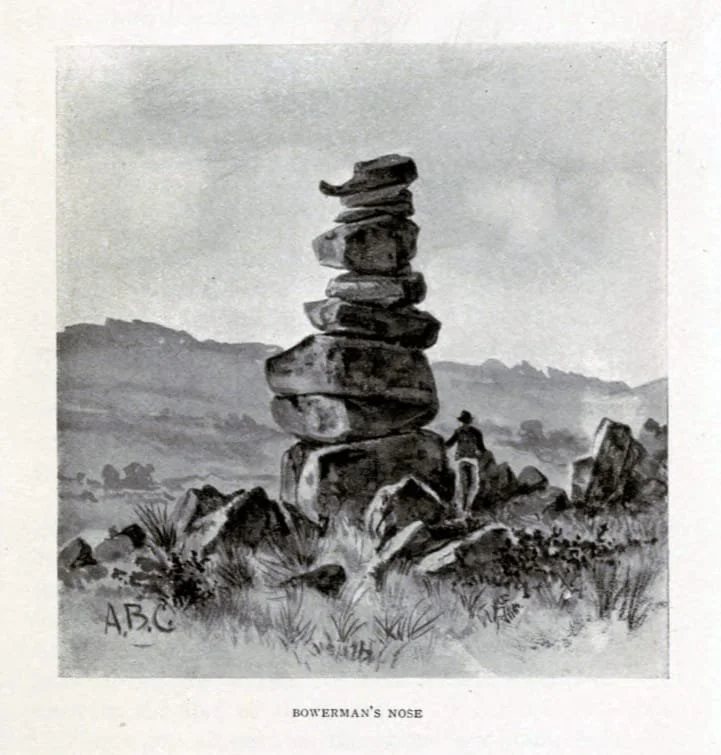
I couldn’t resist - when I was editing this article (and it’s been a behemoth of a task) I’m not sure I want to take on anything this size again … I dropped my ChatGPT created “meme” back to it’s creator and asked it to "zhuzh it up a bit" …
Could you take this meme of Bowerman’s Nose, brighten it up significantly (to make it much more 2026 meme) add some cartoon arms to the stone structure and add some text suggesting the structure is taking part in the “6-7” meme.

Books always speak of other books, and every story tells a story that has already been told.

Further Reading:
Primary sources (chronological)
Carrington, N.T., Dartmoor: A Descriptive Poem (1826)
Friend, H., Bygone Devonshire (1898)
Baring-Gould, S., A Book of Dartmoor (1900)
Lisle, C., Hobnails and Heather (1920)
Clinton-Baddeley, V.C., Devon (1925)
Skinner, A.G. [Aileen Georgina Skinner], Tales of the Tors (Epworth Press, 1939)
St Leger-Gordon, R.E., The Witchcraft and Folklore of Dartmoor (1972)
Whitlock, R., The Folklore of Devon (1977)
Lauder, R.A. & Williams, M., Strange Stories from Devon (1982)
Pegg, J., A Visitor's Guide to Dartmoor and After Dark on Dartmoor (1983)
Pegg, J., The Face of Dartmoor (1985)
Carter, B., Walking in the Wild (1988)
Hemery, E., Walking Dartmoor's Ancient Tracks (1997)
Modern retellings
Cunis, E., Dartmoor: Myths & Legends
Sandles, T., Legendary Dartmoor
Dartmoor National Park's "Legend of Bowerman's Nose"
Online archives used
Ancestry.co.uk (for the Aileen Skinner research)
Witch as a Wounded Hare : Further Reading
The Witch as Hare or the Witch's Hare: Legends & Beliefs in Nordic Traditions
Old Woman As Hare: Approaches to Narrative Folklore Analysis
Story about a witch who transforms herself into a hare
Confessions of Issabell Gowdie Black 1662
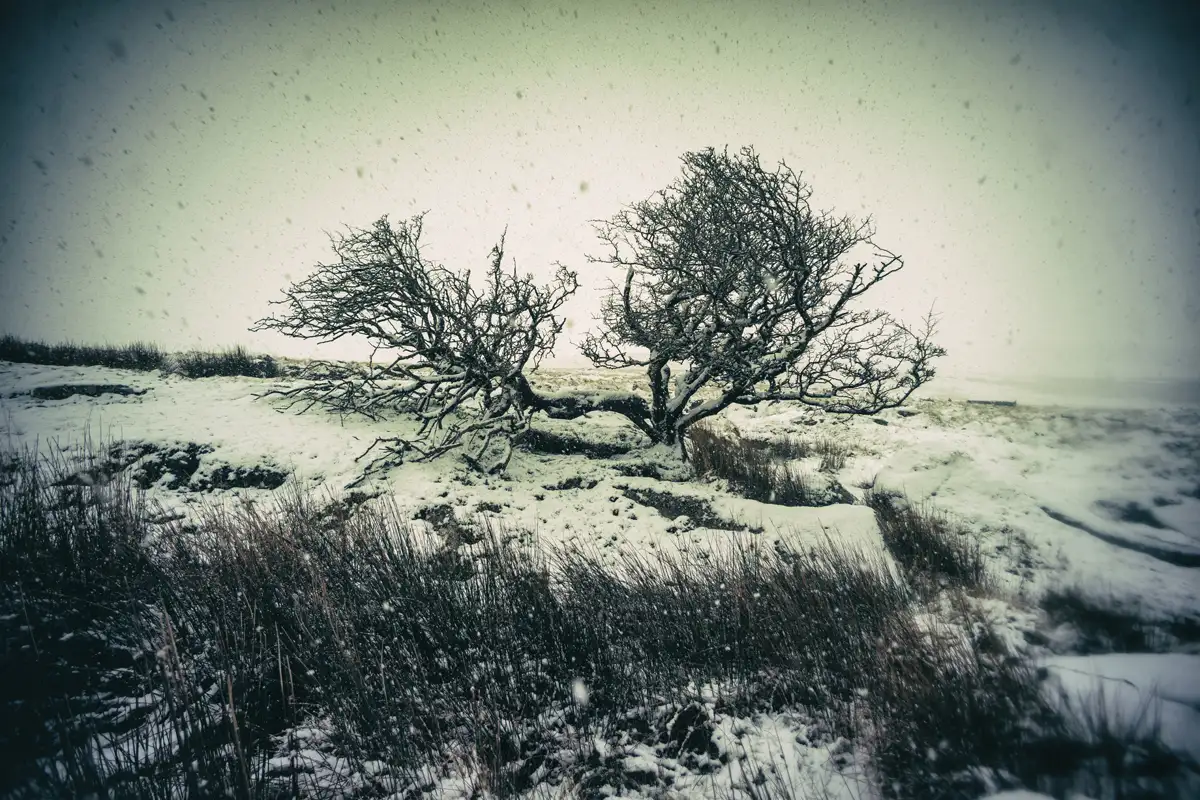
Exercise Baskerville
In 1967 there were eighteen deaths from exposure (hypothermia) and frostbite on British hills and mountains.
Dartmoor had its share.
In April that year there was still snow on High Willhays.
Junior Private Barry Jones died of exposure, aged just fifteen years, during a map reading expedition on the north moor.
He was in a group of eight Junior Privates, inadequate clothing was deemed a contributory factor.
Local GP and councillor Dr. Charles Jones prompted Okehampton Borough Council to buy 250 copies of the British Mountaineering Council leaflet “Exposure” (BMC 380).
It was distributed to youth organisations, hotels, guesthouses and notice boards around the borough. In May, the Ten Tors expedition, organised by the Army, had icy rain and dense mist.
Over one hundred participants were still on the moor on Monday morning, it was supposed to finish on Sunday afternoon.
The weather for Ten Tors 1987 is still regarded as one of the worse to date.

The British Army had used Dartmoor for training since Napoleonic times; Okehampton camp was built at the end of the 19th century. In the Second World War almost the whole moor was used for training, this continued to include training for the Suez crisis in 1956 through to the present day.
Both Mons (Aldershot) and Eaton Hall (Chester) Officer Cadet Training Units set up battle schools at Okehampton Camp. The BMC pamphlet “Exposure” was issued throughout the Army during the summer of 1967 but the copies sent to Mons Officer Cadet School in Aldershot were not received.
Exercise Baskerville was a British Army navigation exercise from Ripon Tor to Okehampton Camp. It was held regularly and, until 1967, trained 2,171 cadets without serious injury or incident.
On exercise in November 1967 were fifty-seven officer cadets from the Mons Officer Cadet School, seventeen of them from Commonwealth countries. They were in patrols of three or four students, each with a different route of about twenty miles.
Equipment included maps, compasses, binoculars, flare guns (Verey pistols), torches and field dressings. For foul-weather each student was equipped with a cape or “poncho” only intended to be showerproof. They also carried A41 radios and rifles.
On the evening of 1st November 1967 Dartmoor gave its normal weather for that time of year – cold, driving, rain. These were not raw recruits. Officer Cadet Ugba, 28, from Nigeria, was a sergeant with ten years service, including active service in the Congo. Officer Cadet Kalani (aged between 20 and 24), from Kenya, had completed an Outward Bound course and expeditions to Mount Kilimanjaro. Both died.
They were in different patrols, but their stories seem similar.
They became progressively weak but the symptoms of hypothermia were not recognised. Once the casualty collapsed the only treatment known to their fellow cadets was to give expired air resuscitation (mouth-to-mouth).
Officer Cadet Gabriel Ugba
Officer Cadet Gabriel Ugba probably collapsed at or near Great Kneeset. The nearest rough track accessible by Landrover would have been at Dinger Tor, where there was an observation post (now removed).
It must have taken quite an effort to carry the casualty that distance. Once there he was transported to Okehampton War Memorial Hospital, where he was pronounced dead.
Officer Cadet Harrison Kalani
It appears that Officer Cadet Harrison Kalani was first in trouble on the banks of Ladybrook on the side of Cosdon Hill. His group’s radio had broken and, with only one torch for the whole group, a heroic effort was made by Cadet Pyemont to raise the alarm. It took a civilian, Frank Woodward of Belstone, to guide the rescue party to the casualty, but they had no stretcher.
One finally arrived but Harrison Kalani succumbed five hours after the first alarm was raised.
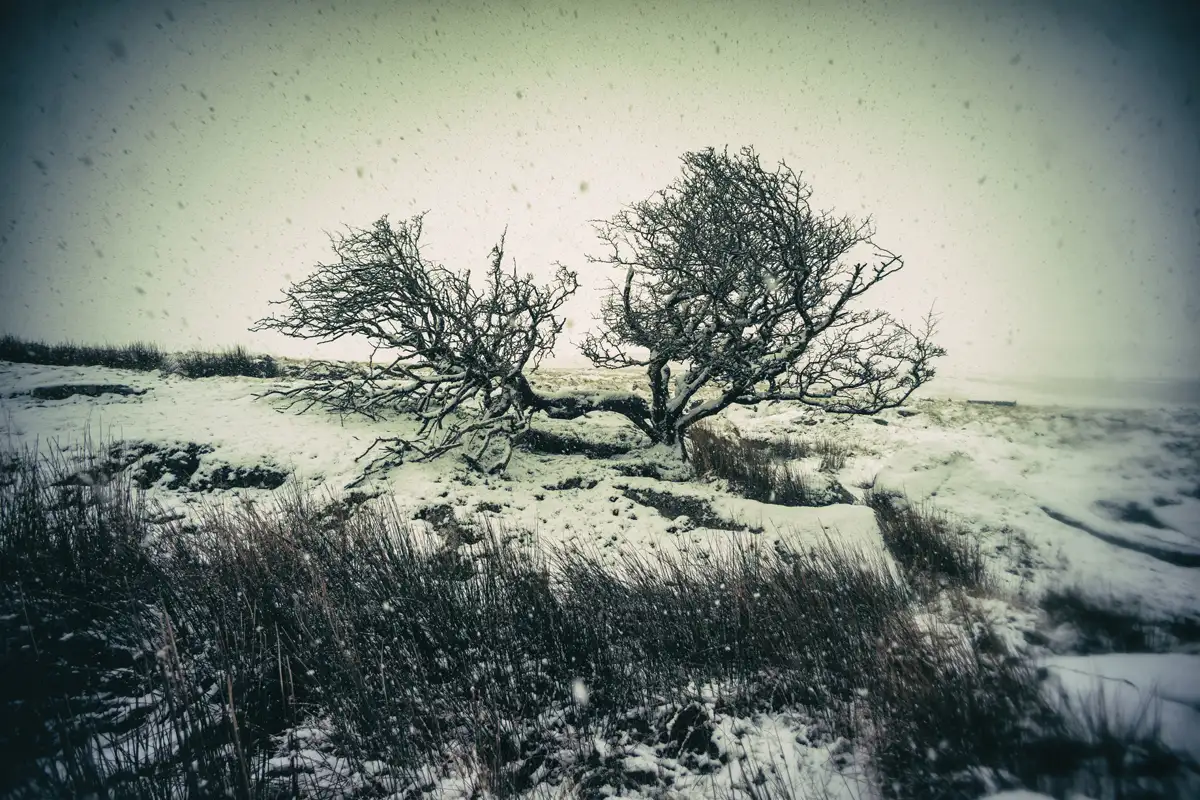
At the inquest on 20th November the Coroner said the cause of death was “Cold and exhaustion” with a verdict of “Misadventure”.
An MOD publication, “Survival Against The Elements”, was finally produced over six years later in 1975.
By then the Dartmoor Rescue Group had been setup and was equipped and functional, partly because of these incidents, spurred on by the indomitable Dr. Jones.
There was neglect or negligence but not criminal negligence.
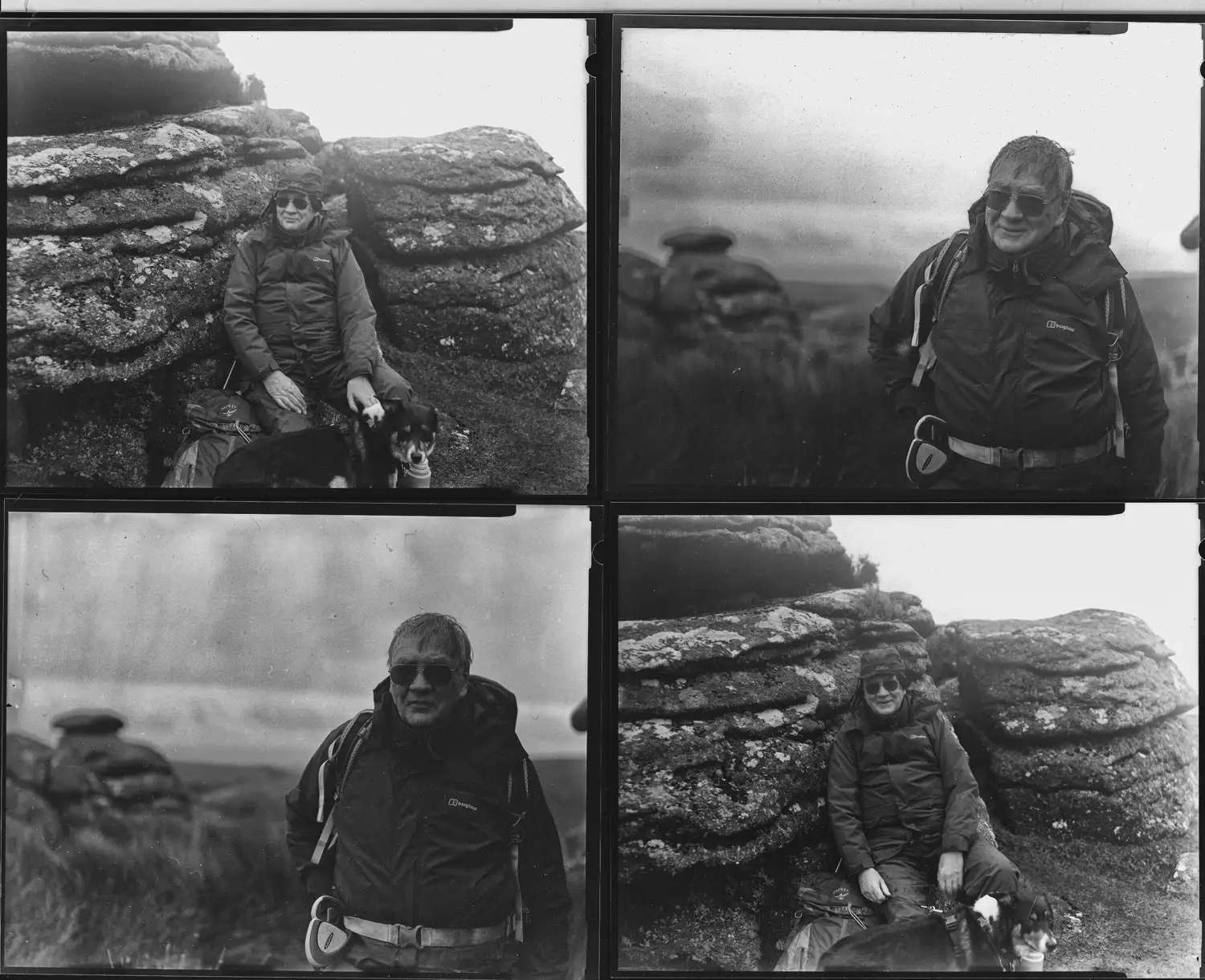
The black and white photographs were taken by Paul Glavind Strachan using a large format film camera on a walk to Shelstone Tor.
This article was originally written for the predecessor of this website, its namesake … a zine called “Our Dartmoor”.
In the Footsteps of Francis Drake
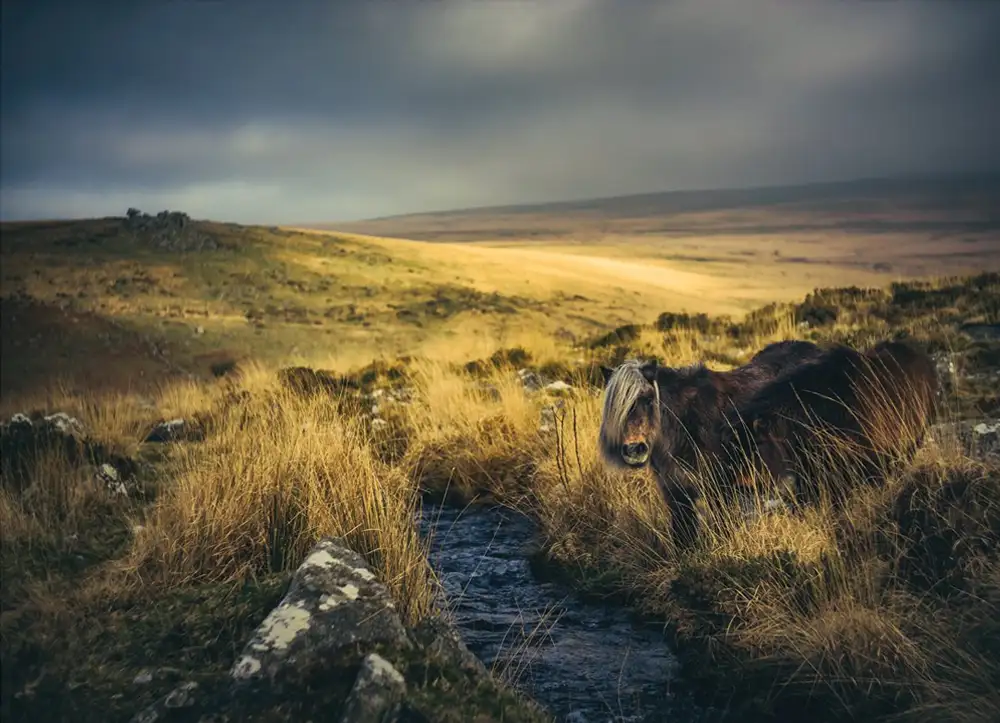
As a boy growing up in Plymouth, I often found myself looking to the north-east, where the hills of Dartmoor rose, sometimes purple in the sunshine or wreathed in cloud, grey, mysterious and beckoning.
Needless to say, as soon as I could, I headed for those hills and discovered what William Crossing so aptly described as “the land of streams”.
At school, a friend and I established the Rambling Club and most weekends we took the No. 83 Western National bus to Yelverton or the Plymouth Corporation service No. 46 to Meavy.
If Sam was the conductor, he often “forgot” to take our fares! In those days, we seventeen year-olds didn’t need a risk assessment to take a gang of unruly third formers into the “wild and wondrous region”!
For me, it was not only the streams but the leats of Dartmoor which fascinated me … from Francis Drake’s Plymouth Leat of 1591 to the many smaller watercourses supplying farms and powering mines and mills, and the thirty miles of leats flowing down to Devonport, they exerted a fascination which has never left me.
So it was inevitable that I felt the need to get it down on paper. It was nearly thirty years later that “Water From The Moor” appeared, telling the story of how my home city was able to quench its thirst with water from those distant hills.
The Fishing Feast
One curious tradition I referred to in the book was The Fishing Feast, when once a year the civic dignitaries of Plymouth met at the headweir of Plymouth Leat to celebrate Drake’s achievement and to raise glasses of pure Dartmoor water with the toast:
May the descendants of him who brought us water never want wine.
After this, trout were caught in the leat and served later at a grand supper. The headweir on the River Meavy is no more, drowned beneath the waters of Burrator Reservoir.

Not so long ago, I came across an extraordinary photograph of the event in 1896, just two years before the site was lost beneath the water.
Nearly a hundred men are grouped around the spillway of the leat, unsmiling behind their beards, severe beneath their toppers and bowler hats, held firm by their waistcoats and watch-chains.
Just three women and three children have somehow penetrated this male preserve.

David J. Hawkings
David is the author of “Water from the Moor: Illustrated History of the Plymouth, Stonehouse and Devonport Leats”. He also went to the same school I did 😁 a few years before me. Along with his son, Simon, he hosts a podcast called “Myths of the Moor”.
This article was originally written for the predecessor of this website, its namesake … a zine called “Our Dartmoor”.