

← Browse Historical Figures · Browse the directory
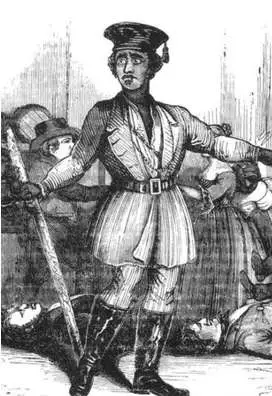
Richard Crafus
Almost every fact about Richard Crafus is contested. Sources disagree on when he arrived at Dartmoor Prison: the prison museum and a 2024 piece on insidetime.org both give November 1814 (insidetime specifically 9 November), while historian Robin F. A. Fabel's 1989 article Self-Help in Dartmoor and a separate account from Pride of Baltimore both give 9 October 1814. Accounts also disagree on his birthplace, at capture he is said to have claimed Vienna, in Dorchester County, Maryland, though other accounts suggest Salem, Massachusetts, or elsewhere in Maryland or Virginia, on his height, described across sources as anything from 6ft 2in to 7ft tall, and even on the name of the privateer he was serving on when captured near Bordeaux in spring 1814 (given as the Racoon in one account and the Requin in another). His own testimony has not been located by this research. What follows should be read as an unsettled, contested history, not a single confirmed biography.
After French prisoners of war left Dartmoor in 1814, Number 4 block became home to a large population of Black American prisoners, reportedly around ninety at first, and developed its own self-governing social world: a theatre that staged productions including Romeo and Juliet, a boxing school, gambling including a smuggled roulette wheel, and its own preacher. White prisoners took part too. The museum records Number 4 as, unexpectedly, one of the best-run blocks in the prison. Its leader, remembered as "King Dick" and said to have worn a bearskin cap and carried a large club to keep order, is usually identified with Richard Crafus, alias Seaver, though Fabel's own footnote on the identification calls it highly probable rather than absolutely certain. He was reportedly twenty-three years old at the time of his capture.
Much of what is known comes from A Journal of a Young Man of Massachusetts, attributed to Benjamin Waterhouse, which describes the block's discipline, boxing and music, and named figures including a preacher called Simon and a deacon called John. The Dartmoor Prison Museum itself cautions that Waterhouse was not a Dartmoor prisoner and did not witness these events directly, so his account is a secondhand, white American narrator's portrait rather than a neutral eyewitness record, and its assumptions about race are part of what any reader should weigh, not a transparent window onto Number 4's Black leadership.
Accounts of his later life also diverge. Most agree he relocated to Boston, sometimes under the name Richard Seaver or Seavers, and taught boxing there, one account has him doing so from 1826 to 1835 and leading an annual Election Day procession on Boston Common. That runs directly against a separate claim, repeated in earlier research on this subject, that he died of consumption in 1831. Both cannot be true, and this research has not been able to resolve which, if either, is correct, so his eventual fate is left open rather than stated as settled.
Kind words
Be the first to leave kind words for Richard Crafus.
Leave kind wordsKnow a Dartmoor person we should feature? Suggest a listing, it is free.
Suggest a listing