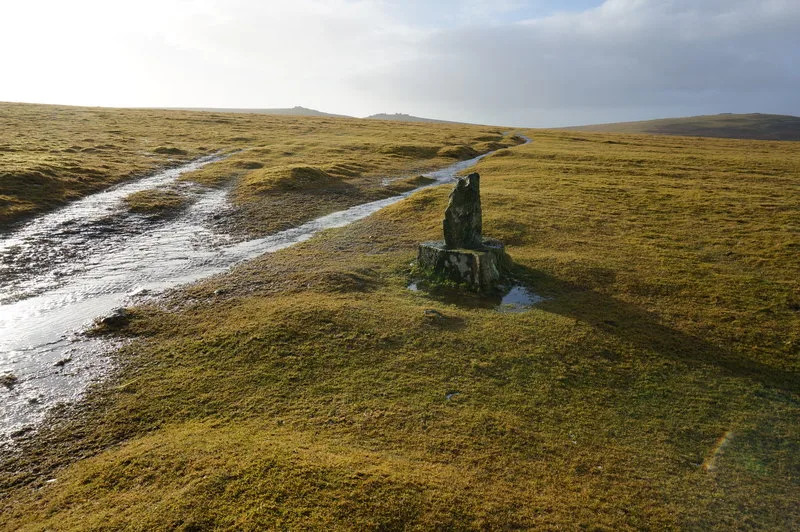
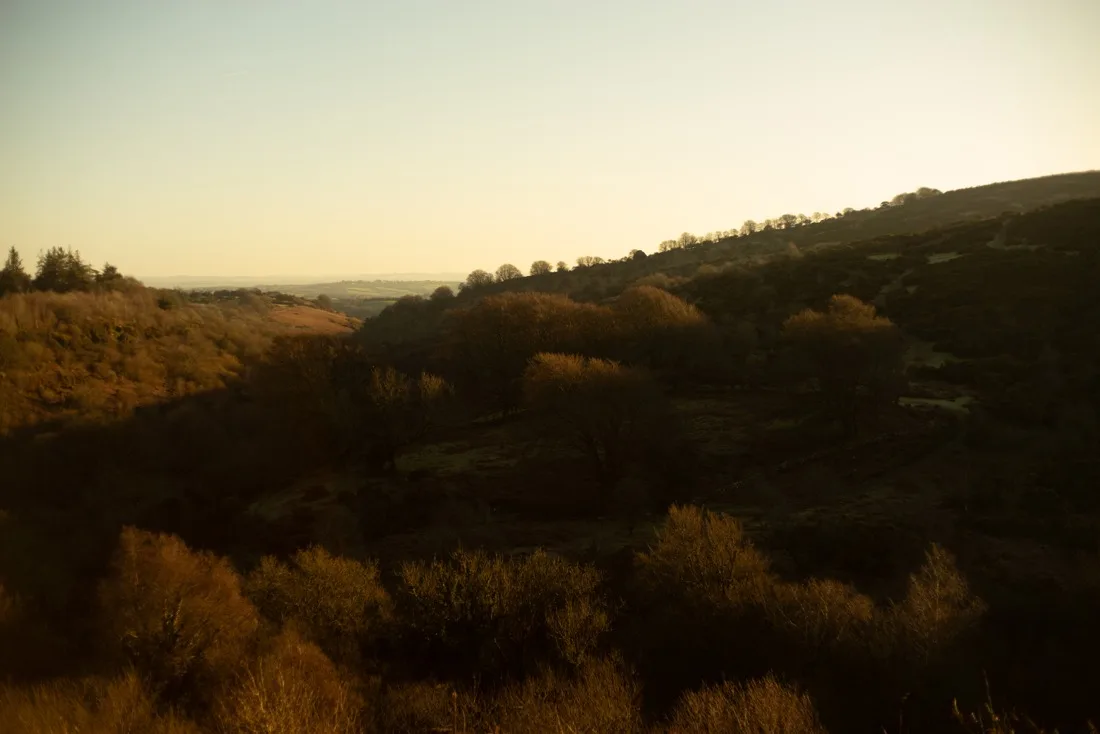
- Parish: Peter Tavy, on the peat-cutters' track above Cudlipptown
- Died: October 1762 (a Bray family manuscript)
- Marker: an upright granite pillar on a squared granite base, with a letter S cut into the stone
- Stone set upright on its plinth: May 1936, by the Dartmoor Preservation Association
Stephen's Grave is a single granite pillar beside the peat-cutters' track on Peter Tavy Common, where the track rises above Boulter's Tor and runs on towards Broadmoor and White Tor. It marks the burial of a young farm servant who poisoned himself in October 1762 and, as a suicide, was refused the churchyard. It stands immediately above Wedlake Farm, in the valley of Peter Tavy Brook, where Mary Bray's family lived.
The 1762 account
The fullest early account is a manuscript that came down in the Bray family of Wedlake. It passed to the Rev. I. K. Anderson, rector of Mary Tavy, who gave it to Sabine Baring-Gould, and Baring-Gould printed it, mistakes and all, for the Devonshire Association in 1901. It is headed "An Account of the Death of John Stephens who Poisoned himself on Account of Mary Bray", and the copy is incomplete.
John Stephens was a farm servant living with Mr Roger Chubb at Godsworthy, and is described as a man of good character. He had been courting Mary Bray, daughter of Andrew and Mary Bray, farmers at Wedlake. Her parents and her brother opposed the match and worked on her until the courtship all but ended. About a week before he died he was heard to say that he would be in Peter Tavy churchyard by that day week.
In the week of Michaelmas Fair at Tavistock he went to the fair, where he tried to reach Mary and found her walking with another young man. He then bought poison from a druggist, saying it was for rats. He was taken ill at a barber's house in the town, but by some means fell in with the Brays and walked home with them as far as Bedge, and on to Tellan Corner where they parted. He reached Godsworthy about ten that night, was violently sick, and was dead before the doctor arrived.
The smell of the body was so bad that the next morning it was carried up to a corner of a field and laid in a gap made for sheep to pass between fields, where it stayed until the inquest. The jury returned a verdict that he should be buried at the first four crossways, and he was buried near Broadmoor Corner on Peter Tavy Common, "where the Grave is to be seen at this Day".
After the burial
The manuscript says that Stephens was afterwards seen at Godsworthy, at Wedlake and on the path between the two farms, and that both households were alarmed by unusual noises and the rattling of things in the house. They applied to the Rev. Dr Jago of Tavistock, and the disturbances stopped. Mary Bray, it says, saw him again after she left her father's house, and was left with an injury she would never explain and never quite denied having come by through something she had seen. She never married, and died on 3 May 1816, in her 72nd year, when she dropped from her chair in her brother's house.
The telling that William Crossing gave in his Guide to Dartmoor adds a detail that has stayed with the grave: at the moment Stephens was laid in the ground, some linen bleaching at Higher Godsworthy was caught up into the air and never seen again. Crossing also notes that the mound marked a suicide buried "with the barbarous rites once customary". Baring-Gould, writing in 1901, observed that there was hardly any distinguishing object at the spot, and that little or nothing was remembered about Stephens.
Where the sources differ
- His first name. The 1762 manuscript, and the walking guide by John Weir and Brian Le Messurier, call him John. Crossing, Clive Gunnell's My Dartmoor and, later still, Pegg all call him George.
- Why he did it. The manuscript puts it down to the Bray family turning Mary against him and to his jealousy at the fair. Crossing and Weir say the girl was unfaithful. One version Pegg gives has him refused by her father because he was too poor.
- How. The manuscript has poison bought at Tavistock to kill rats. Gunnell has the nightshade picked from the hedgerows, with Mary at Higher Godsworthy and her father and brothers throwing him out into the yard, and his body found next day on Longstone Moor. Pegg repeats the nightshade and also records a version in which he first killed the girl with a poisoned apple.
The manuscript, apparently written by one of the Bray family, is the earliest of these sources and the one used for the account above.
The stone
Weir and Le Messurier say the pillar leaned and was insecure for many years, until the Dartmoor Preservation Association set it up on a plinth in May 1936. Gunnell and Pegg both mention the letter S, and Gunnell describes the pillar standing on a squared granite base. The grave lies on a well-used line across the moor: walkers coming up from Cudlipptown pass it on the way to White Tor and the standing stone on Langstone Moor.
Sources
- S. Baring-Gould, "Stephen's Grave", Eighteenth Report of the Committee on Devonshire Folk-Lore, Report and Transactions of the Devonshire Association, vol. 33 (1901), pp. 123-127, printing the Bray family manuscript.
- William Crossing, Guide to Dartmoor.
- Clive Gunnell, My Dartmoor.
- John Weir and Brian Le Messurier, Dartmoor and Exmoor (Great Walks).
- John Pegg, After Dark on Dartmoor: the Devil, Ghosts, Witches, Pixies (1983).