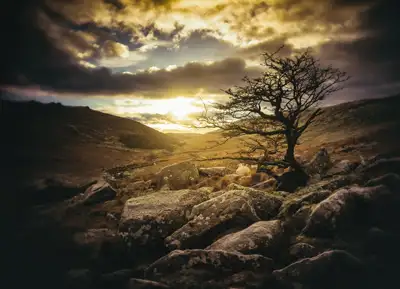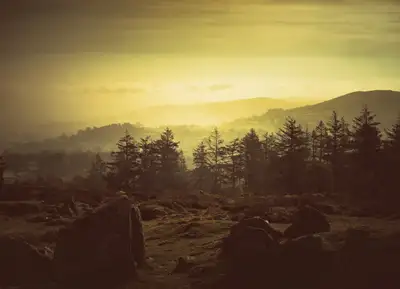

A Vast Solitude
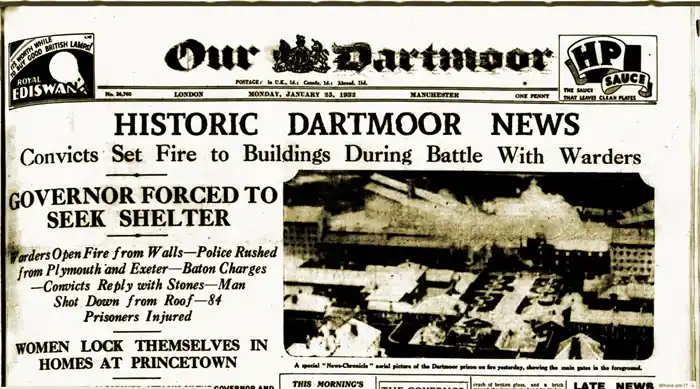
I had a conversation the other day where the person I was chatting with mentioned that people forget that Dartmoor (and other National Parks) are predominantly manufactured landscapes - this isn't the main thrust of this article, but it's worth noting considering the way the writer in this article from almost 140 years ago views the moor.
It appearsd that there is a moment, somewhere in the 1880s, when Dartmoor stops being a place people apologise for and starts to become a place they celebrate, or even boast about. You can watch it happen in this one cutting, a simple book review from the Morning Post in the summer of 1889.
The reviewer starts out, almost defensively, borrowing a line from Carrington (who wrote Dartmoor: A Descriptive Poem published in 1826), calling it "a spot almost unknown, untrod."
Sixty years on from the famous poem, he admits, little had changed: the tourist still "looks upon the moor as a weird, wild waste, to be gazed at and passed by," and even in Devonshire "it remains an unknown land." And then, quote by quote, the piece falls in love. I reproduce it here, exactly as it ran. Read it now or skip past and come back to it; the argument works either way.
The Morning Post
Monday, June 24, 1889
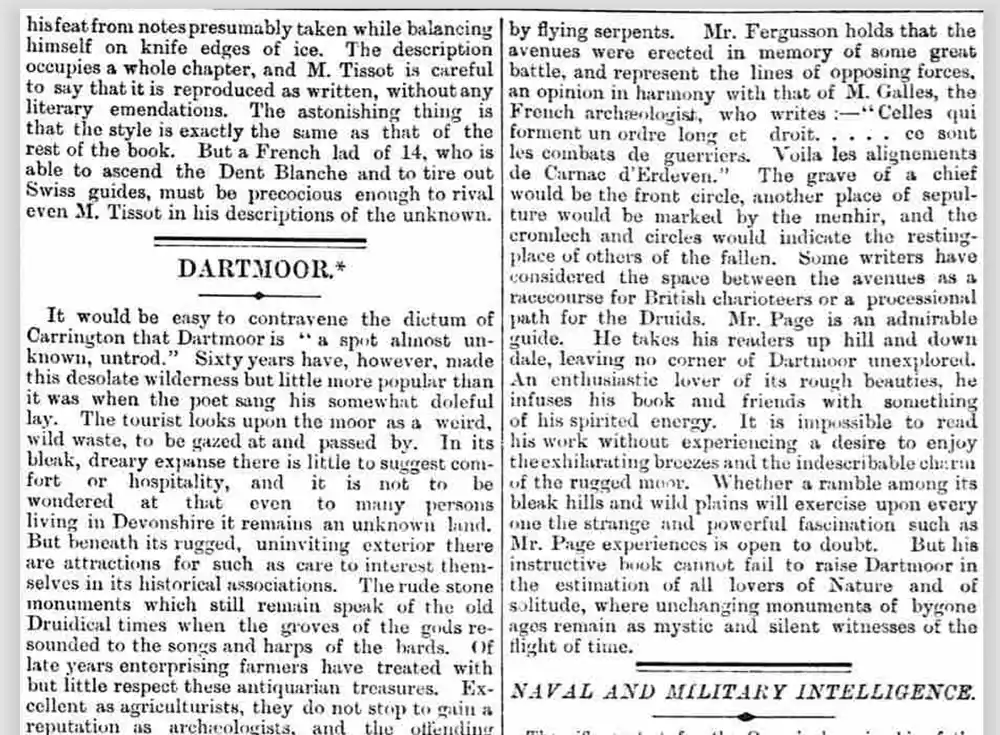
Dartmoor.
A review of "An Exploration of Dartmoor and its Antiquities," by John Lloyd Warden Page.
It would be easy to contravene the dictum of Carrington that Dartmoor is "a spot almost unknown, untrod." Sixty years have, however, made this desolate wilderness but little more popular than it was when the poet sang his somewhat doleful lay. The tourist looks upon the moor as a weird, wild waste, to be gazed at and passed by. In its bleak, dreary expanse there is little to suggest comfort or hospitality, and it is not to be wondered at that even to many persons living in Devonshire it remains an unknown land. But beneath its rugged, uninviting exterior there are attractions for such as care to interest themselves in its historical associations. The rude stone monuments which still remain speak of the old Druidical times when the groves of the gods resounded to the songs and harps of the bards. Of late years enterprising farmers have treated with but little respect these antiquarian treasures. Excellent as agriculturists, they do not stop to gain a reputation as archaeologists, and the offending stones are ruthlessly removed to make way for the modern instruments of land reclamation and prosaic farming. Against the depradations of these peaceful marauders some action has, however, been recently taken by the establishment of a Dartmoor Preservation Society, whose primary object is the protection of these mysterious relics of remote antiquity. The railway has penetrated to the metropolis of Dartmoor, and the granite wilderness may be attacked from Okehampton, Tavistock, Plympton, South Brent, and Ashburton. A champion of the grand old moor has arisen in the person of Mr. Warden Page, who, in a volume prepared with evident care, relates much that will be new to the majority of readers with regard to its traditions, as well as to its form, extent, and present characteristics. In some measure Mr. Page's work is founded upon the Rev. S. Rowe's "Perambulation," which has been accepted as the standard book upon Dartmoor, an article written by Mr. Richard John King, and the Reports of the Transactions of the Devonshire Association and Plymouth Institution. But the chief value of the treatise is due to the author's personal acquaintance of many years with the moor. The Forest of Dartmoor, as it is still called, has an area of one hundred and thirty thousand acres situated in the heart of Devonshire. Trunks and leaves of trees dug out of its morasses show that at a remote period it has been to some extent wooded. It must be remembered that the term "forest" referred more directly to a hunting ground than to a dense growth of trees such as the word generally suggests. Certain it is that there is no such forest at Dartmoor now. Possibly the tinners who formerly worked there exhausted the supply of wood, as they were allowed to supply themselves with fuel necessary for fusing the ore. Of the present aspect of the place Mr. Page thus writes:—
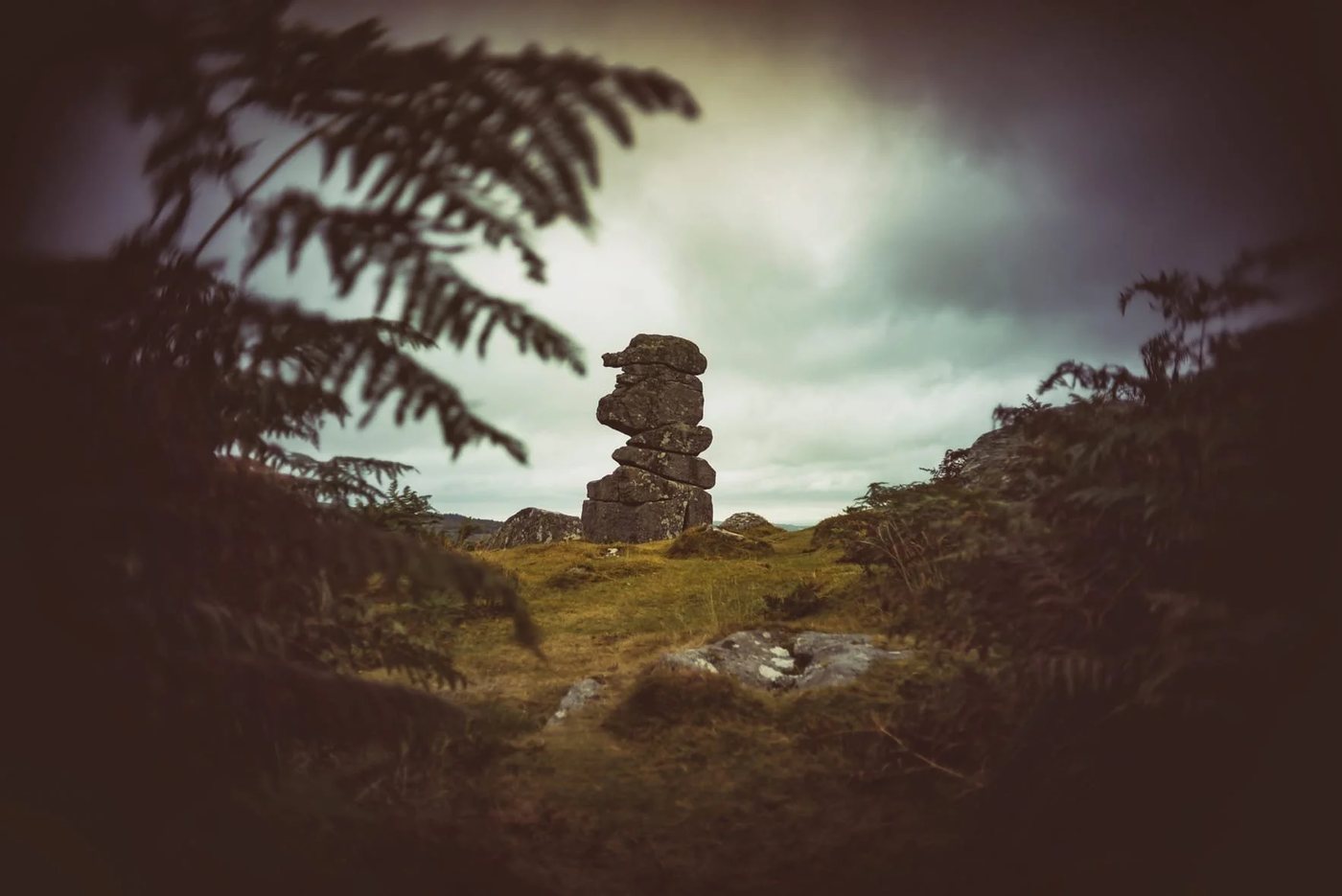
It is a vast solitude. Save the convict settlement of Princetown and a few scattered cottages abutting on the roads which cross the central district, scarce a human habitation greets the eye. In the northern quarter, where the great morass about mysterious Cranmere lies, a dark blot on the surface of the landscape, nothing but an occasional cart-track, faint and broken, hints at the presence of man, and the traveller may walk from the outskirts of Princetown to Okehampton — a good fifteen miles — without meeting a soul. Long ridges rise in dusky sweep against the sky — line beyond line, like the waves of ocean, to which, indeed, they have been not inaptly compared — and from these waves — to carry out the simile — rock-strewn crests start forth capped with grotesque piles of granite. These are the 'tors,' a word whose etymology is discussed elsewhere; and it is to these rugged peaks that Dartmoor in a great measure owes its fascination. Lions couchant, sphinxes, and other strange monsters are the order of created (and uncreated) being more commonly assumed by the disintegrated granite; but not unfrequently man himself is represented, carved by the slow but sure hand of time from the grim rock. Down the slopes are scattered in wild confusion huge blocks of splintered granite, locally known as 'clatters' or 'clitters.' Some of these blocks must weigh scores of tons, and the eye is bewildered by their picturesque disorder and varied forms. Frequently the loveliest ferns fill the interstices, and lichens, grey, white, and orange, contrast with the almost black patches of moss which, watered plenteously by the mists, cling to their rugged sides.
An idea is widely held that Dartmoor is a kind of Salisbury Plain, but the tors in which it abounds give it a totally different aspect. Their average height is said to be 1,400ft., but this altitude is largely exceeded in the northern quarter of the moor. High Willhays and Yes Tor measure respectively 2,059 and 2,029ft. Standing upon one of the loftier hills, mile after mile of heathey expanse may be seen, and the distant heights display an ever-changing variety of hues as the clouds drift over them. The charm of scene is enhanced by the dashes of colour in the green bog, the purple heather, the red and brown rushes, and cotton grass. In the valleys clear streams ripple in their rapid race to the far-off fertile country. That which must strike the visitor more forcibly than all else is the almost painful silence that reigns supreme on the hills:—
A light murmur, says Mr. Page, may float up from the torrent hundreds of feet below, a faint rustling as the breeze sighs through the heather may strike upon the ear; but all else is not. And if the time be evening, the sense of weirdness is intensified, for against the setting sun looms up the shapeless ruin of some ancient keep, or the form of a great stone monster who has kept watch and ward over this solemn land since the Deluge.
Many rivers find their source in the central morass, but of lakes Dartmoor can boast nothing more ambitious than Classenwell, a pool no larger than a Westmoreland tarn. Mr. Page warns his readers against attaching too much credence to the many stories of hairbreadth escapes from Dartmoor bogs. The element of danger doubtless exists, but if the pedestrian avoids the treacherous bright green patches he need fear no harm. These bits of "seething and quaking bog" consist of a thin layer of sodden moss over a substratum of black slime and water. A slight thrust with a pole causes the mass to emit a seething or hissing sound, and the surface will then commence to quiver in most unmistakable manner. The late Bishop Hannington had an unpleasant experience in a Dartmoor bog, and readers of Miss Edna Lyall's "Donovan" will remember how the hero nearly lost his life in Fox Tor Mire; but Mr. Page assures us that such danger is very much more imaginary than real. He walked hundreds of miles upon the moor, and, like the driver of the Wild Irishman, is "a living man yet." Of the cromlechs and stone avenues, which constitute an important part of the ancient treasures of Dartmoor, the author has much to say. He describes them in words and illustrates them in map and picture. He does not accept the rough-and-ready theory that they are all Druidical relics. The origin of these curious monuments of ancient times is so surrounded by doubt and difficulty that he does not pretend to give a certain solution of the problem. There are many near Merivale Bridge, where the Staple Tors and the great Mis Tors are separated by the Walkham, of which he gives the following graphic account:—
These interesting antiquities will be found close to, and for the most part on, the south side of the road which passes through what appears to have been part of an aboriginal village. Close to these hut-dwellings are two avenues, running nearly due east and west, the one 780ft. in length, the other 590ft. The stones are about 2ft. apart, and of most irregular height, though seldom exceeding 3ft. They vary much, too, in shape; evidently no tool has been used upon them, so that some are thin and pointed, others thick and truncated. A circle, with a diameter of 11ft. 8in., and which appears to have contained a kistvaen, stands about the centre of the larger avenue. Proceeding down this avenue from the east end, we shall, after traversing some 250ft., find at a distance of less than 100ft. to the south the remains of a cromlech. The cover-stone, of which the centre part has evidently been removed by some granite robber, is 6ft. 7in. by 5ft. 1in., and 15in. in thickness. Towards the west end, at a distance of 36ft. and 72ft. respectively, are the ruins of two cairns. We now steer for the tall menhir, still further to the south. On the way we pass an almost perfect sacred circle, consisting of ten low stones, the largest being about 1ft. 10in. high by 2ft. wide. Its diameter is 54ft. From this the menhir is distant 105ft. It is a remarkably fine specimen, and the tallest on the moor, having a height of about 13ft. Surrounding it is an imperfect circle of small, round stones about 6in. high. The hut-circles and supposed pound to the north of the avenues call for no especial mention.
Among the various theories that have been advanced in respect to these parallelitha, that of Mr. R. J. King tends to regard them as relics of ancient British serpent worship, and compares them with similar remains at Stanton Drew in Somersetshire, and at Karnac in Brittany. Legends still linger that the Dartmoor Tors were haunted by flying serpents. Mr. Fergusson holds that the avenues were erected in memory of some great battle, and represent the lines of opposing forces, an opinion in harmony with that of M. Galles, the French archaeologist, who writes:—"Celles qui forment un ordre long et droit .... ce sont les combats de guerriers. Voila les alignements de Carnac d'Erdeven." The grave of a chief would be the front circle, another place of sepulture would be marked by the menhir, and the cromlech and circles would indicate the resting place of others of the fallen. Some writers have considered the space between the avenues as a racecourse for British charioteers or a processional path for the Druids. Mr. Page is an admirable guide. He takes his readers up hill and down dale, leaving no corner of Dartmoor unexplored. An enthusiastic lover of its rough beauties, he infuses his book and friends with something of his spirited energy. It is impossible to read his work without experiencing a desire to enjoy the exhilarating breezes and the indescribable charm of the rugged moor. Whether a ramble among its bleak hills and wild plains will exercise upon every one the strange and powerful fascination such as Mr. Page experiences is open to doubt. But his instructive book cannot fail to raise Dartmoor in the estimation of all lovers of Nature and of solitude, where unchanging monuments of bygone ages remain as mystic and silent witnesses of the flight of time.
* "An Exploration of Dartmoor and its Antiquities." With Maps and Illustrations. By John Lloyd Warden Page. London: Seeley and Co.
What I wasn't really expecting from an 1889 book review was a conservation story. The reviewer notes, with some heat, that "enterprising farmers have treated with but little respect these antiquarian treasures," the stones "ruthlessly removed to make way for the modern instruments of land reclamation." The remedy, newly arrived, is "the establishment of a Dartmoor Preservation Society, whose primary object is the protection of these mysterious relics of remote antiquity." The society that still fights the moor's corner today is right there in the cutting, brand new and already needed. The argument we are still having, about who the moor is for and what may be cleared off it, was already in the newspaper in 1889.
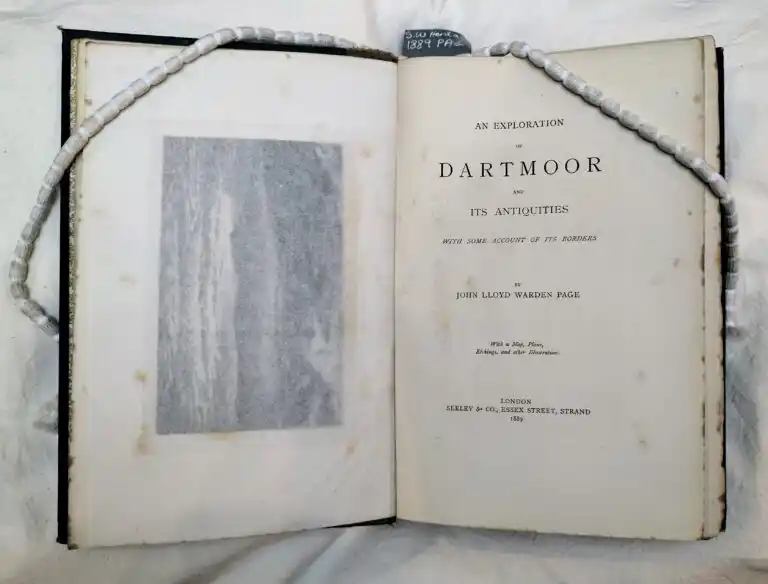
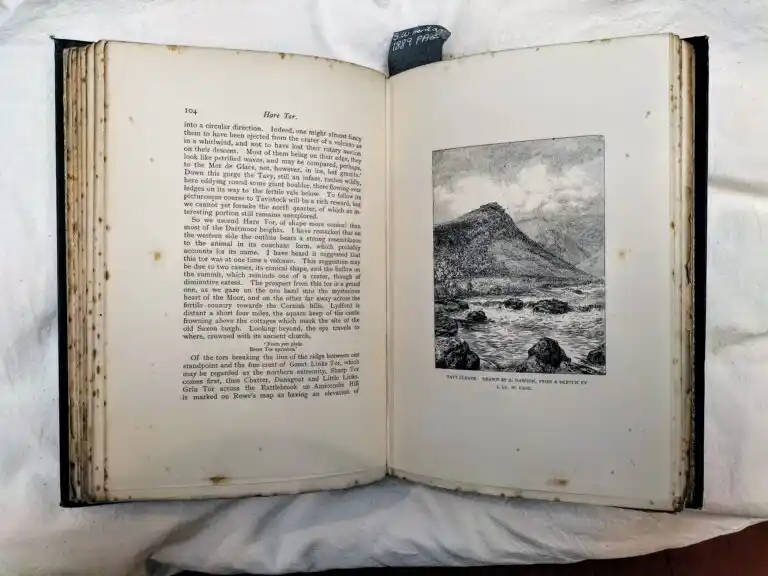
And here is the part that turns a nice old cutting into a walk you can take on Saturday. When Page reaches "these interesting antiquities... near Merivale Bridge," he is describing stones that are still there. This is Merrivale (the paper spells it Merivale), the great ceremonial complex beside the B3357 between Princetown and Tavistock. The "two avenues, running nearly due east and west, the one 780ft. in length, the other 590ft." are the Merrivale stone rows. The "tall menhir... the tallest on the moor, having a height of about 13ft." is the Merrivale standing stone, still about thirteen feet, still exactly 105ft from the little sacred circle just as Page paced it. You can stand on that spot today, this transcript in your hand, and check his measurements against the granite. Almost nothing in the passage has changed in the hundred and thirty-six years since he wrote it, which is the reviewer's closing phrase made physical: they really are "unchanging monuments of bygone ages."
There is even a whisper of the Dartmoor that Conan Doyle would make famous a decade later. The reviewer soothes the danger of the bogs by reaching for fiction: the late Bishop Hannington had "an unpleasant experience in a Dartmoor bog," and "readers of Miss Edna Lyall's Donovan will remember how the hero nearly lost his life in Fox Tor Mire." Fox Tor Mire. Grimpen was not invented from nothing.

What I love about this cutting is that it is not really a book review at all. It is the sound of a whole culture deciding, on the page, that the empty quarter of Devon is not an embarrassment but a treasure. The tourist is still being told to gaze and pass by. Warden Page, and his reviewer, are among the first to say: stop, and look properly. We have been doing as we were told ever since.